4.2.6 - Dependency Theory
Dependency theory explains global inequality by arguing that poverty in the Global South is not a sign of being "left behind" but a result of being pulled into an unequal world economy on exploitative terms. In this lesson, you will learn how Andre Gunder Frank and Immanuel Wallerstein explain underdevelopment, why colonialism and neo-colonialism matter, and how to evaluate dependency theory in 10- and 20-mark answers.
From modernisation to dependency
Dependency theory developed in the 1960s as a critique of modernisation theory. Modernisation theorists tend to explain poverty in terms of internal obstacles such as tradition, weak values, or a lack of entrepreneurial culture. Dependency theorists reject that starting point. They argue that development and underdevelopment are produced together inside a single capitalist world system. Rich countries did not simply develop first and then leave poorer countries behind. Instead, the wealth of core nations was built partly through the extraction of labour, land, raw materials, and profits from colonised and peripheral regions.
Dependency
A relationship in which one country's economy is shaped by and subordinated to the needs of more powerful countries.
This is why dependency theory is usually seen as a broadly Marxist perspective. It focuses on power, class interests, and exploitation at a global level. Colonialism, slavery, and imperialism are central because they reorganised whole societies around the needs of European expansion. From this view, global inequality is not accidental. It is structured through trade, investment, debt, and political influence.
Dependency theory is also sociological because it connects economic relations to power and stratification. It shows how global inequalities affect class formation inside poorer countries, encourage the rise of local elites who benefit from foreign capital, and shape culture and identity by making "development" look like copying the West. The theory therefore links global processes to social differentiation within nations as well as between them.
Frank and the chain of dependency
Andre Gunder Frank argued that underdevelopment is not an original condition. In his phrase, capitalism creates the "development of underdevelopment". This means poor countries are poor because they were incorporated into the capitalist world economy in a subordinate position. Their resources and labour were organised to serve the growth of wealthier countries rather than their own balanced development.
Development of underdevelopment
Frank's idea that underdevelopment is actively produced by capitalist exploitation rather than being a natural starting point.
Frank's famous image is the metropolis-satellite model. At the top sits the metropolis, meaning powerful industrial centres that control finance, trade, and decision-making. Below sit satellite regions whose economies are shaped around supplying what the metropolis wants. Surplus flows upwards through the chain. Rural areas feed towns, towns feed national capitals, and poorer countries feed richer ones. Each level extracts value from the level below.
The theory describes a chain of extraction.
[DIAGRAM: asset_name: 2_6_03_dependency_theory__diagram_01; asset_slug: 2_6_03_dependency_theory__diagram_01; recommended_method: retained_png; description: Hierarchical flow diagram of Frank's metropolis-satellite model. At the top put "Global metropolis / core". Beneath it place "National capital". Beneath that place "Regional town". At the bottom place "Rural hinterland / local producers". Use upward arrows labelled "surplus" and "profits" moving towards the top, and downward arrows labelled "control" and "dependency" moving towards the bottom. Keep the layout simple and vertical.]
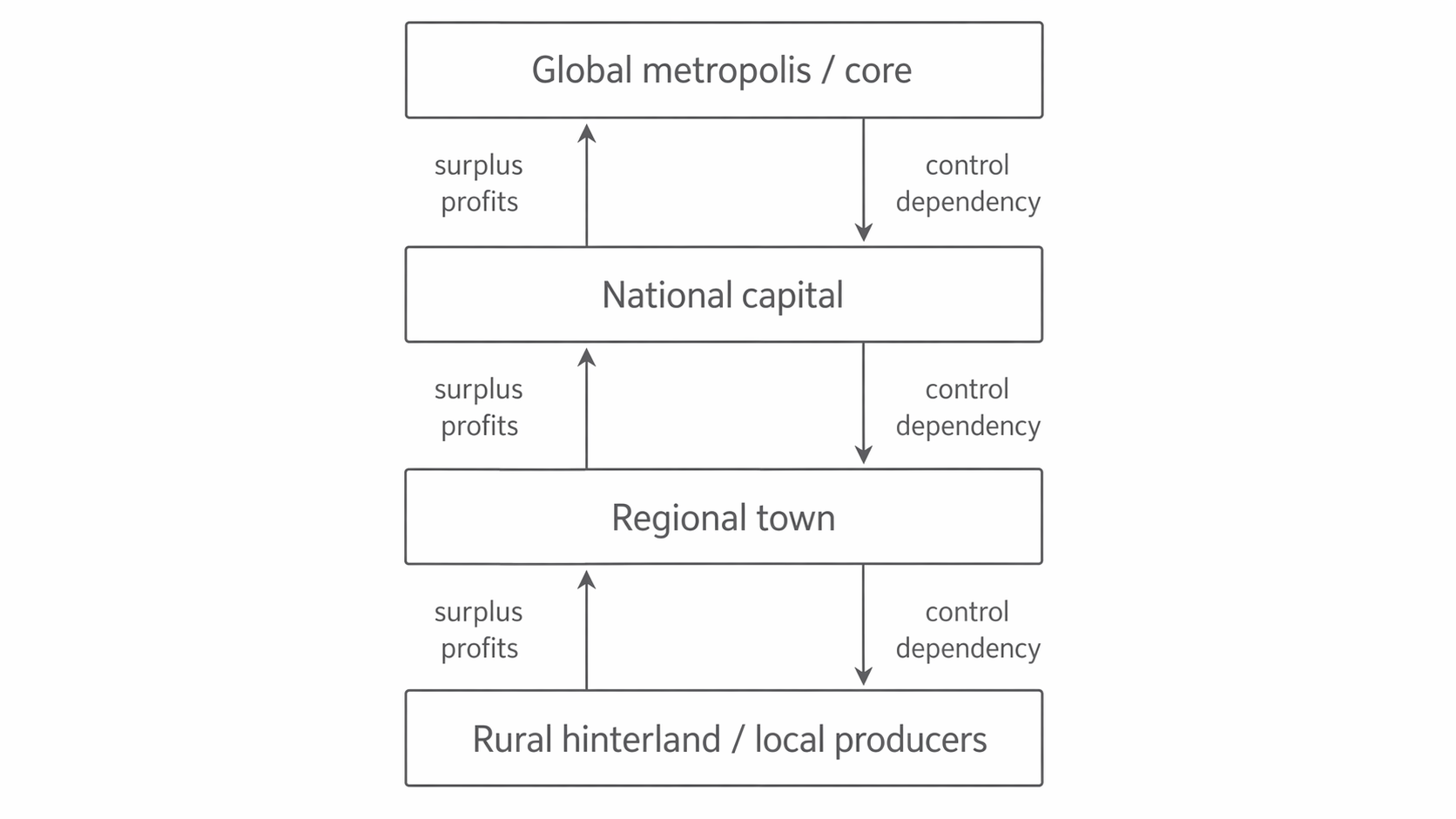
What matters is the direction of the arrows: value travels upward, while dependency and control travel downward.
This process is visible in Frank's analysis of Latin America. Colonial economies in places such as Brazil and Chile were structured around export crops or minerals for overseas markets. The problem, from a dependency perspective, is not simply that these countries traded with Europe. It is that colonial rule shaped their land ownership, labour systems, and political institutions around extraction. Plantation slavery, forced labour, and export dependence enriched European powers while weakening autonomous domestic development.
Frank also argued that local elites often become part of the problem. A comprador class can act as an intermediary between foreign capital and the local population, taking profits from export activity while much of the wider population remains poor. This is one reason dependency theory links international exploitation to internal class inequality.
Comprador class
Local elites in dependent countries who benefit from foreign capital and help channel wealth out of their own society.
The chain of dependency continues after formal independence. A country may have its own flag and government, but if its economy still depends on exporting cheap primary goods and importing expensive manufactured goods, the basic unequal relationship remains in place.
World systems and neo-colonialism
Immanuel Wallerstein develops dependency thinking by describing a world system made up of core, semi-peripheral, and peripheral societies. This model is more flexible than a simple rich-poor divide because it recognises an in-between zone.
World-system
A global capitalist order in which countries occupy unequal positions, typically as core, semi-periphery, or periphery.
Core nations dominate high-profit production, advanced technology, and global finance. Peripheral nations are pushed towards low-profit activities such as raw material extraction, cheap labour, and vulnerable export sectors. Semi-peripheral nations sit between the two. They are exploited by the core but may also exploit poorer regions themselves. This position can act as a buffer, reducing direct conflict between core and periphery and showing that movement within the system is possible, even if it is difficult.
Wallerstein is useful because he explains why global capitalism is not just a collection of separate national economies. It is a single system organised around unequal exchange. The core can pay relatively low prices for raw materials and sell back higher-value manufactured goods or services. The result is an unequal flow of wealth, investment, and decision-making power.
Continue this lesson.
You’re previewing NovaLearn without an account. Create a free account to read the rest.
Create free account