4.2.6 - World Systems Theory and Neo-liberalism
This lesson compares two major ways of explaining global development. One sees inequality as built into the capitalist world system; the other argues that freer markets create growth and mobility. This matters in sociology because the debate is really about power: who controls development, who benefits from globalisation, and why some societies are pushed into debt, dependency, or low-paid production while others dominate finance, technology, and trade.
World systems and the global hierarchy
Immanuel Wallerstein (1974) — argued that we should not explain development by looking at countries in isolation. Instead, we should see them as part of a single capitalist world-economy organised through an unequal international division of labour. In this system, wealth, political influence, and technological capacity are concentrated in some places and extracted from others.
World systems theory
A Marxist-influenced theory which argues that global inequality is produced by a capitalist world system divided into core, semi-periphery, and periphery.
Wallerstein divided the world into three positions. Core countries dominate advanced production, finance, and global decision-making. Peripheral countries are pushed towards exporting raw materials, low-paid labour, and low-value manufacturing. Between them sits the semi-periphery, which is crucial because it prevents the system from becoming a simple two-way split.
| Position | Main features | Why it matters sociologically |
|---|---|---|
| Core | High profits, advanced industry, control of technology and finance | Shows how global power is concentrated |
| Semi-periphery | Mixed economies, some industrial strength, exploited by core but able to exploit periphery | Acts as a buffer zone and a route for limited mobility |
| Periphery | Dependence on external capital, raw-material exports, cheap labour | Carries the heaviest burden of global inequality |
The semi-periphery matters because it makes the system dynamic. Some countries can move up, especially if they industrialise rapidly, expand exports, or become regionally dominant. That is why world systems theory is often seen as more flexible than earlier dependency theory. It allows for movement within the system, but that movement is still shaped by wider capitalist forces rather than by equal opportunity.
The layered model below shows Wallerstein's three positions inside one unequal system.
[DIAGRAM: asset_name: 2_6_04_world_systems_neoliberalism__diagram_01; asset_slug: 2_6_04_world_systems_neoliberalism__diagram_01; recommended_method: imagegen; description: Three-tier world-systems diagram with "Core" at the top, "Semi-periphery" in the middle, and "Periphery" at the bottom. Upward arrows from the periphery towards the core are labelled "raw materials", "labour and value", and "profits". Downward arrows from the core towards the periphery are labelled "capital and technology" and "core-controlled terms". A note explains that the semi-periphery can be both exploited and exploitative.]
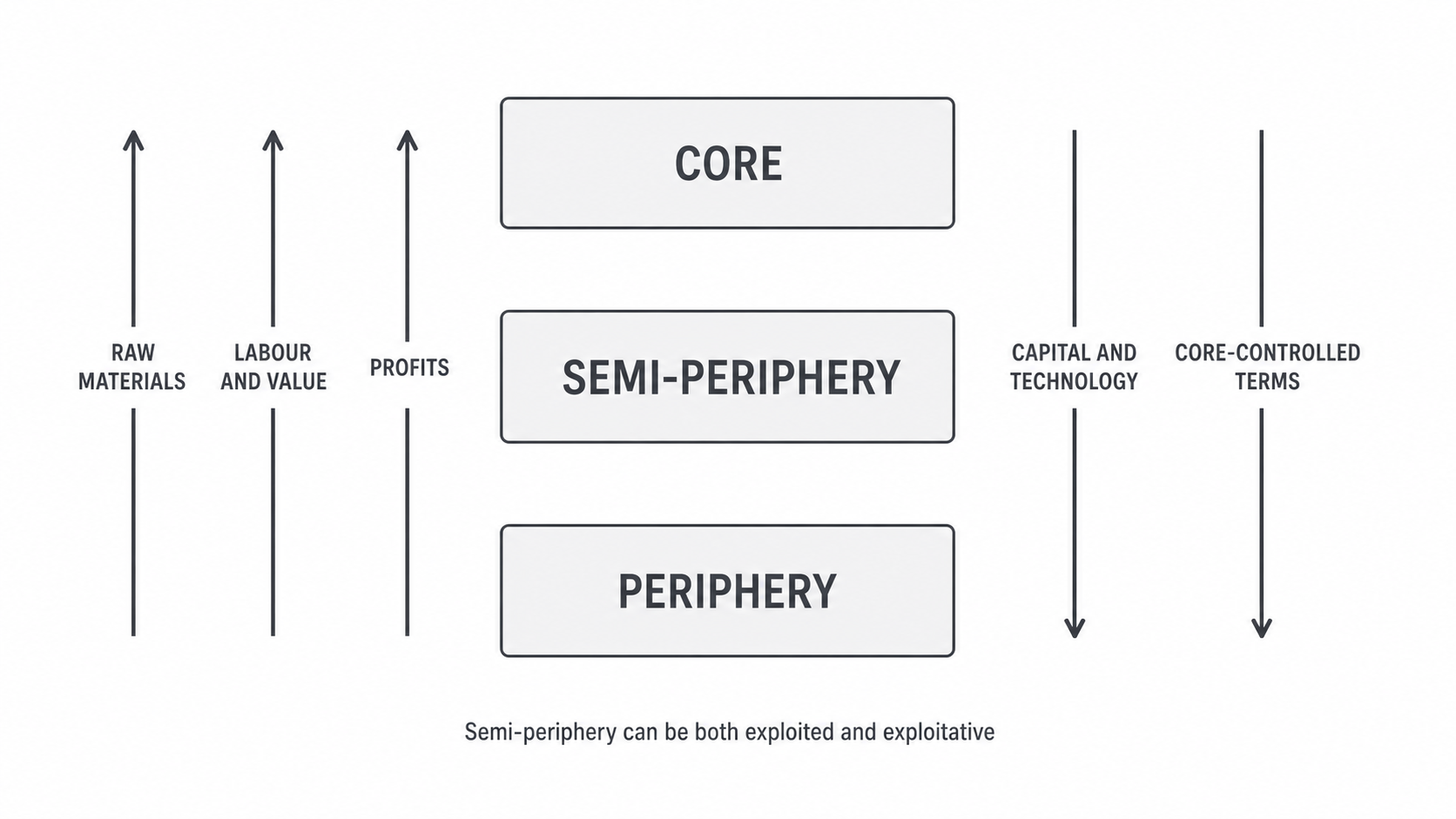
The point is not geography but unequal position inside one global system.
This model links directly to stratification and power. The global system sorts societies into unequal positions, just as class systems sort individuals into unequal life chances. It also shows that development and underdevelopment are connected processes: the wealth of the core is not separate from the poverty of the periphery, but partly depends on it.
Neo-liberal development and the Washington Consensus
Neo-liberalism offers a very different explanation. Rather than seeing global inequality as built into capitalism itself, it argues that development happens when markets are allowed to operate with as little interference as possible.
Neo-liberalism
A theory of development which argues that economic growth is best achieved through free markets, privatisation, deregulation, and limited state intervention.
Friedrich Hayek and Milton Friedman strongly influenced this perspective. They argued that states often distort markets, protect inefficient industries, and prevent growth. From this view, barriers to trade, large public sectors, and extensive welfare systems hold societies back. Development therefore depends on opening economies to competition and investment.
John Williamson’s Washington Consensus (1989) summarised reforms including fiscal discipline, trade opening and privatisation. His original list also redirected spending towards basic health, education and infrastructure; it did not simply demand withdrawal of all public services. The term later became associated with broader neo-liberal policies and historical Structural Adjustment Programmes (SAPs). Some adjustment packages combined spending restraint, reduced subsidies, privatisation and market opening, with contested social effects. Williamson’s original distinction.
Consider a hypothetical historical adjustment programme: a heavily indebted country takes an IMF loan after a balance-of-payments crisis. In exchange, it is told to reduce subsidies, sell state utilities, and cut spending on health and education. A neo-liberal would present this as painful but necessary reform; a critical sociologist would ask who bears the pain and whose interests are being protected.
Neo-liberals claim these reforms encourage efficiency, attract foreign investment, and integrate poorer societies into global markets. In that sense, neo-liberalism treats globalisation as a potential route to development. Economic relationships become more open, political decisions are reshaped by international lenders, and local cultures may also be affected as consumer markets, multinational firms, and Western policy assumptions spread across societies.
Continue this lesson.
You’re previewing NovaLearn without an account. Create a free account to read the rest.
Create free account