The Three Marks of Existence - No-self, aggregates and the chariot
No-self challenges an enduring independent owner of experience without denying ordinary persons or moral consequences. Examine the five aggregates and Milinda's chariot dialogue, then judge how the three marks relate and where their claims apply.
The five aggregates of experience
The five khandhas, or skandhas, are groups through which Buddhist analysis describes embodied experience. Anatta, or anatman, means not-self or no-self: none provides the permanent independent self to which people cling. This differs from asserting that there are no feelings, thoughts or conventionally identifiable people.
| Aggregate | Meaning | Example during a conversation |
|---|---|---|
| Form, rupa | Bodily/material aspects | Body and sound-producing processes |
| Feeling, vedana | Pleasant, unpleasant or neutral tone | An unpleasant response to criticism |
| Perception, sanna/samjna | Recognition and discrimination | Recognising a voice or identifying a remark |
| Mental formations, sankhara/samskara | Intentions, dispositions and other mental activities | An intention to reply and a habitual defensive response |
| Consciousness, vinnana/vijnana | Awareness dependent on a sense and object | Hearing-awareness of the speech |
Feeling here is not the whole category of emotions, perception is not an immortal perceiver, and consciousness is not a fixed observer outside the process. The groups distinguish aspects without claiming they function independently. A conversation depends on their interaction and changing conditions.
In SN22.59, the Buddha examines each aggregate as impermanent, liable to distress and not subject to complete command. If form were an independent self, one could secure it entirely as desired; actual bodies become ill and change. Similar questions apply to experience and mental activities. The inference challenges identifying these conditioned groups as a permanent owner. A critic can ask whether an owner beyond them is still possible; mere possibility does not yet supply evidence for it.
Nagasena and the chariot
The required dialogue in The Questions of King Milinda, Book II chapter I §1, tests how a person can be named without a permanent essence. In T. W. Rhys Davids'1890 translation, Nagasena explains that his name is a conventional designation. The king objects: if there is no enduring person, who receives gifts, acts or bears responsibility?
Nagasena asks whether the king's chariot is its pole, axle, wheels or other component, their collection, or something apart from them. The king cannot identify a separate essence, yet accepts the conventional name in dependence on the components. Nagasena applies this reasoning to the aggregates. This is a paraphrase of the argument, not a quotation that the person is merely a heap of disconnected parts.
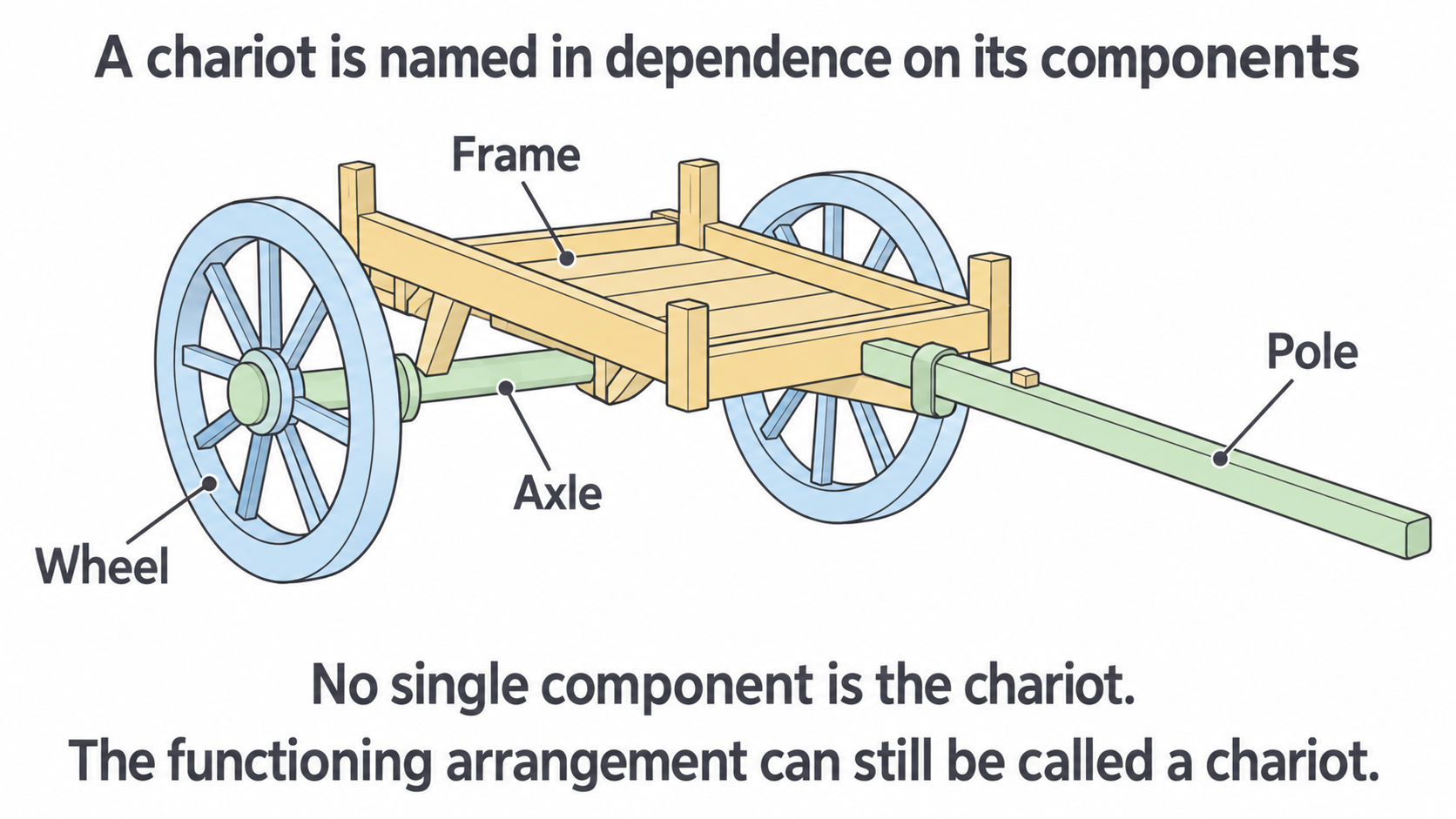
The functioning arrangement can transport someone and be repaired; rejecting an independent essence does not make it unreal in every ordinary sense. Likewise a conventional person can receive teaching and act. The analogy's force lies in distinguishing dependent designation from a hidden owner, not in discovering a tiny self somewhere between the components.
There are limits. A mechanical vehicle does not experience pain, whereas a person does; the comparison alone does not explain consciousness. Nor does a naming argument prove rebirth. A defence must add the Buddhist account of conditioned awareness and causal continuity. The analogy is strongest as a challenge to assuming that a useful name requires an independently existing permanent thing.
Continue this lesson.
You’re previewing NovaLearn without an account. Create a free account to read the rest.
Create free account