The nature or attributes of God - Boethius, Anselm and eternity
Trace Boethius' timeless solution to foreknowledge and freedom, explain Anselm's extension, and assess whether eternal knowledge preserves responsible action in time.
Foreknowledge and moral responsibility
In book V of The Consolation of Philosophy, Boethius investigates a problem with practical consequences. If God infallibly foreknows an action, that action seems unavoidable. If human conduct is unavoidable, why reward or punish it? Prayer also seems pointless if the future is fixed independently of any petition.
The worry is not merely that God causes an act by knowing it. It is that infallibility appears to rule out an alternative: God cannot know A and the agent later perform B instead. Boethius seeks to preserve divine knowledge, human agency and a just moral order together. His account therefore offers a theologically significant reason to rethink time.
He argues that what is known is grasped according to the knower's mode of understanding. Human beings encounter events through succession and anticipate a future; divine knowing need not use that mode. Treating God's knowledge as an earlier prediction may import a human temporal limitation into the very being claimed to transcend time.
Boethius' eternal present
Boethius distinguishes eternity from mere endless duration. A human or everlasting being experiences one moment after another, however long its life lasts. A timeless God possesses the whole of life together, without a before and after within divine experience. Book V.6 presents this as a complete present, rather than a long sequence of future events waiting to arrive.
What humans call future is therefore present to God. Divine knowledge is not foreknowledge in the sense of an earlier guess or prediction. God knows an event directly in an eternal standpoint. Observing a person's act need not force it; Boethius argues that divine seeing likewise leaves the nature of the act intact, including its voluntary character.
This aims to preserve omniscience without turning the person into a puppet. If an act is free, God knows it as free; God's different mode of knowing does not turn it into a coerced act. A critic can grant the absence of causation and still question whether an eternally infallible fact allows genuine alternatives. Timelessness removes a temporal past fixing the future, but does not automatically remove the issue of necessity.
Simple and conditional necessity
Boethius distinguishes simple necessity, belonging to a thing's nature or unavoidable condition, from conditional necessity, arising when a fact is known or specified. Given that someone is walking, they are walking; given infallible knowledge of it, the knowledge cannot be false. It does not follow that their walking was compelled by its own nature.
The inference “necessarily, if God knows A then A” differs from “if God knows A, then A is itself necessarily compelled.” The first expresses infallibility; the second transfers necessity to the action without further argument. Boethius uses this distinction to maintain that what is certain from God's perspective may still be voluntary in its own character.
Consider a person voluntarily giving away a possession. If an observer truly sees the gift, the gift occurs; that conditional certainty does not cause the generosity or make it a mechanically necessary act. Boethius extends this thought to divine seeing. The analogy illustrates the distinction, but a human observer is fallible and temporal, so it does not prove every aspect of the divine case.
The strongest remaining objection concerns alternative possibilities. If God's eternal knowledge is unchangeable, can the person choose otherwise while that knowledge remains as it is? A defender replies that had the choice differed, God's knowledge would have correspondingly differed; God knows the act the person performs rather than independently imposing one. The critic questions whether this counterfactual suffices for libertarian alternatives when an eternal fact is infallible.
Anselm and all times present
Anselm develops the timeless approach in De Concordia I.5. As present time contains different places without making them one place, divine eternity contains different times without undergoing their succession. All times are present to God, while they remain ordered as past, present and future for temporal creatures.
This is often called a four-dimensionalist approach in contemporary explanation of Anselm: time as well as spatial extension is comprehended by the divine standpoint. It is an interpretive label, not a claim that Anselm developed modern relativity or that God occupies a measurable extra physical dimension.
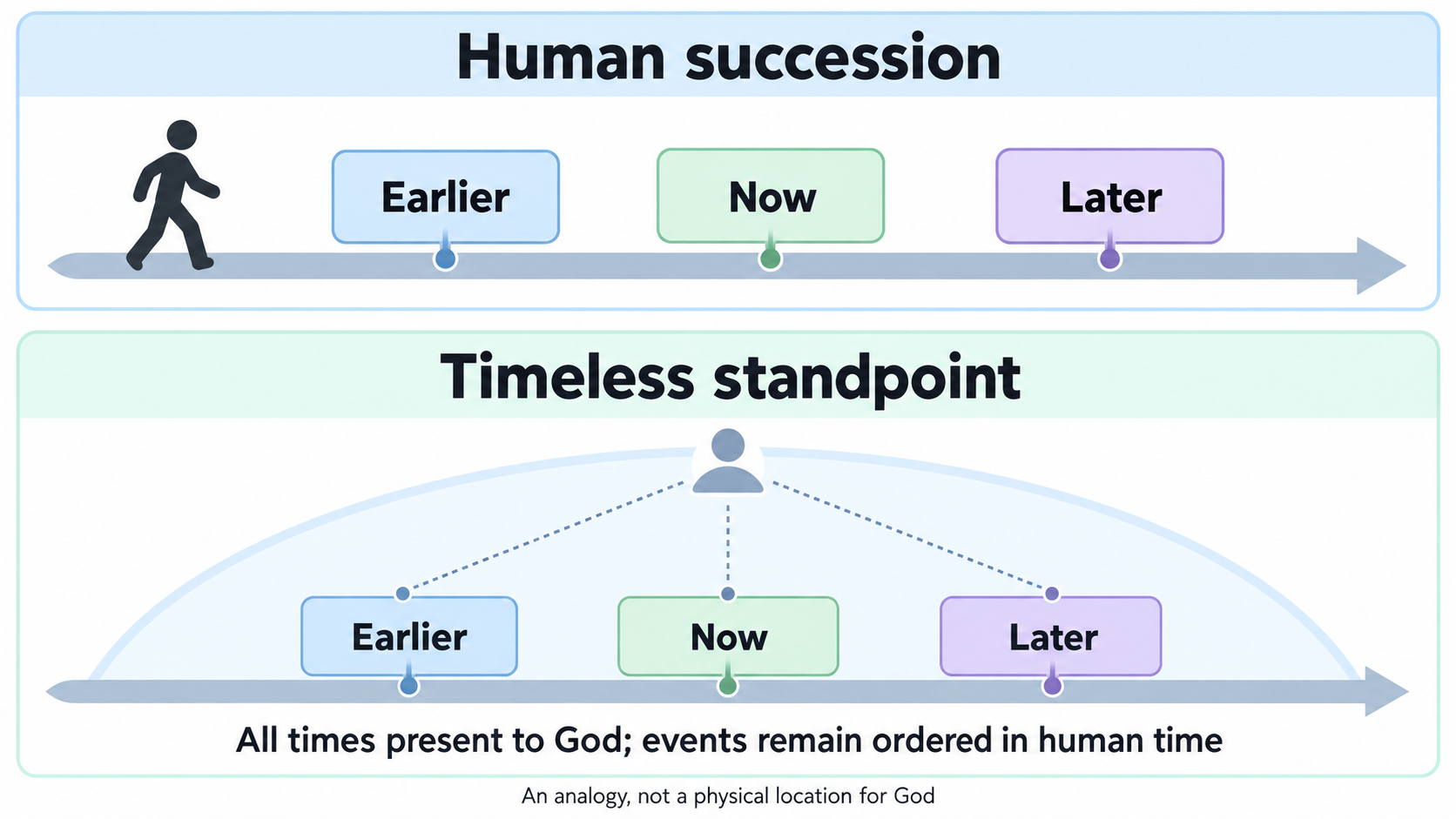
The diagram preserves the order of the events in both panels. Its viewpoint is an analogy, not a physical location or a picture of God. Seeing all events together from the divine standpoint does not mean a person's childhood and adulthood occur at the same human time.
Anselm can thus describe an act as not yet settled from a temporal agent's perspective while eternally present to God. Different descriptions concern different standpoints; saying both is not automatically a contradiction. Nevertheless, a critic asks whether the completed eternal view makes the temporal openness only apparent. The analogy explains how the proposal is meant to work, while the freedom objection still requires philosophical assessment.
Eternal action, prayer and justice
A timeless cause could have effects at different times without itself moving through a sequence of decisions. On this proposal God eternally wills an effect that occurs when a temporal creature prays. The prayer and response belong to the known order; God does not first learn the request and then change a plan. Divine action in time therefore need not mean a temporal change in God.
A defender finds this useful because knowledge remains complete and providence can include voluntary acts. Reward and punishment can then respond to actions known as responsible rather than forced. Prayer can be meaningful as a voluntary event related to its answer, even though God does not wait to discover it.
A critic questions whether this counts as a personal response. Human relationships involve learning, reacting and sometimes changing intentions. If all divine willing is eternal, the believer's language of God responding may require reinterpretation. Another critic presses infallibility: distinguishing simple and conditional necessity may preserve non-coercion while failing to establish alternatives in the strongest libertarian sense.
Boethius offers the conceptual distinction between eternity and succession and links it to just judgement. Anselm makes all-times presence more explicit. Their usefulness depends on the criterion: they preserve unrestricted knowledge and transcendence well, but leave difficult questions about changing relationships and alternative possibilities. The next lesson examines Swinburne's temporal alternative and its different cost.