Ancient philosophical influences - Plato’s Forms and the cave
Learn why Plato distinguishes changing appearances from intelligible reality, how the Forms and the Good explain knowledge, and what the cave reveals about education and mistaken belief.
Reason and changing appearances
Plato asks how we can know something securely when the things we see continually change. A flower is beautiful now but later wilts; a law may appear just to one group and unjust to another. If knowledge concerns what really is, changing appearances seem an unstable foundation.
Rationalism gives reason a central role in discovering truths that sensory experience alone cannot establish. Plato does not claim that human beings never use their senses. His stronger claim is that seeing examples is different from understanding the unchanging reality that makes them examples of something. In Republic V, 474c–480, he distinguishes knowledge of what is from opinion about the many changing things. This is a paraphrase of the argument, not a quotation.
Consider two drawn triangles. Their lines have thickness and their angles may be imperfect. Nevertheless, a mathematical proof concerns a triangle as such, rather than this imperfect drawing. The drawing helps us think, but reason grasps relationships whose truth does not depend on the drawing surviving. Plato uses this contrast to motivate an intelligible reality: accessible to thought rather than sight.
There are two moves to examine. First, sensory appearances can mislead and do not by themselves supply a universal standard. Second, Plato infers that stable objects of understanding must exist. The first does not automatically prove the second. We might correct appearances through more observation, or explain universal concepts without a separate realm. Plato's position is therefore more substantial than the sensible advice to think carefully.
Forms and the Good
For Plato, a Form is an objective, perfect and unchanging reality, not simply a private idea in someone's mind. Many beautiful things differ from each other, yet are beautiful by participating in the Form of Beauty. Particulars come and go; the Form is not born, destroyed or made less beautiful by disagreement.
The theory connects being and knowing. A Form gives a particular its character, and knowledge of the Form explains what that character really means. Knowing several apparently just decisions is therefore different from understanding Justice itself. Participation names this relationship, but also raises a problem: how exactly does an immaterial, separate Form explain a physical particular? Naming the relationship is not yet explaining its mechanism.
The Forms have a hierarchy. Plato gives the Form of the Good the highest explanatory position; this does not license inventing a complete fixed ranking of every Form. In Republic VI, 506b–509c, the sun analogy explains the Good. Sunlight makes visible things visible and supports their growth. Correspondingly, the Good makes intelligible objects knowable and accounts for their being. Plato describes the Good as beyond being in dignity and power; treating it as simply one more ordinary object misses its special role.
The Good is not identical to whatever an individual happens to want. It provides the standard through which we can judge a desire or a political decision. Nor is Plato's account automatically a proof of a personal creator God. The Good is an ultimate principle of reality, truth and value, not a deity who is described here as choosing to create the universe.
A strength is that moral criticism need not collapse into popularity: a society can approve an unjust practice and still be wrong. A challenge is access. If people disagree about goodness, claiming knowledge of an unseen standard needs justification. A rational standard is useful only if the reasoning used to identify it can withstand criticism.
The cave and the ascent
The cave is a philosophical analogy for the movement from restricted appearances towards understanding. In Republic VII, 514a–517c, prisoners have been chained since childhood, facing a wall and unable to turn their heads. Behind them a fire lights objects carried along a walkway behind a low screen. Shadows fall on the wall; echoes can make the prisoners associate voices with those shadows. Since this is all they have experienced, they take shadows for reality.
When one prisoner is released, turning towards the fire hurts and confuses him. The familiar shadows initially seem more credible than their causes. He is then led out of the cave. His eyes adjust gradually: first to shadows and reflections outside, then to objects, the night sky and eventually the sun. He comes to understand the sun's importance for the visible world.
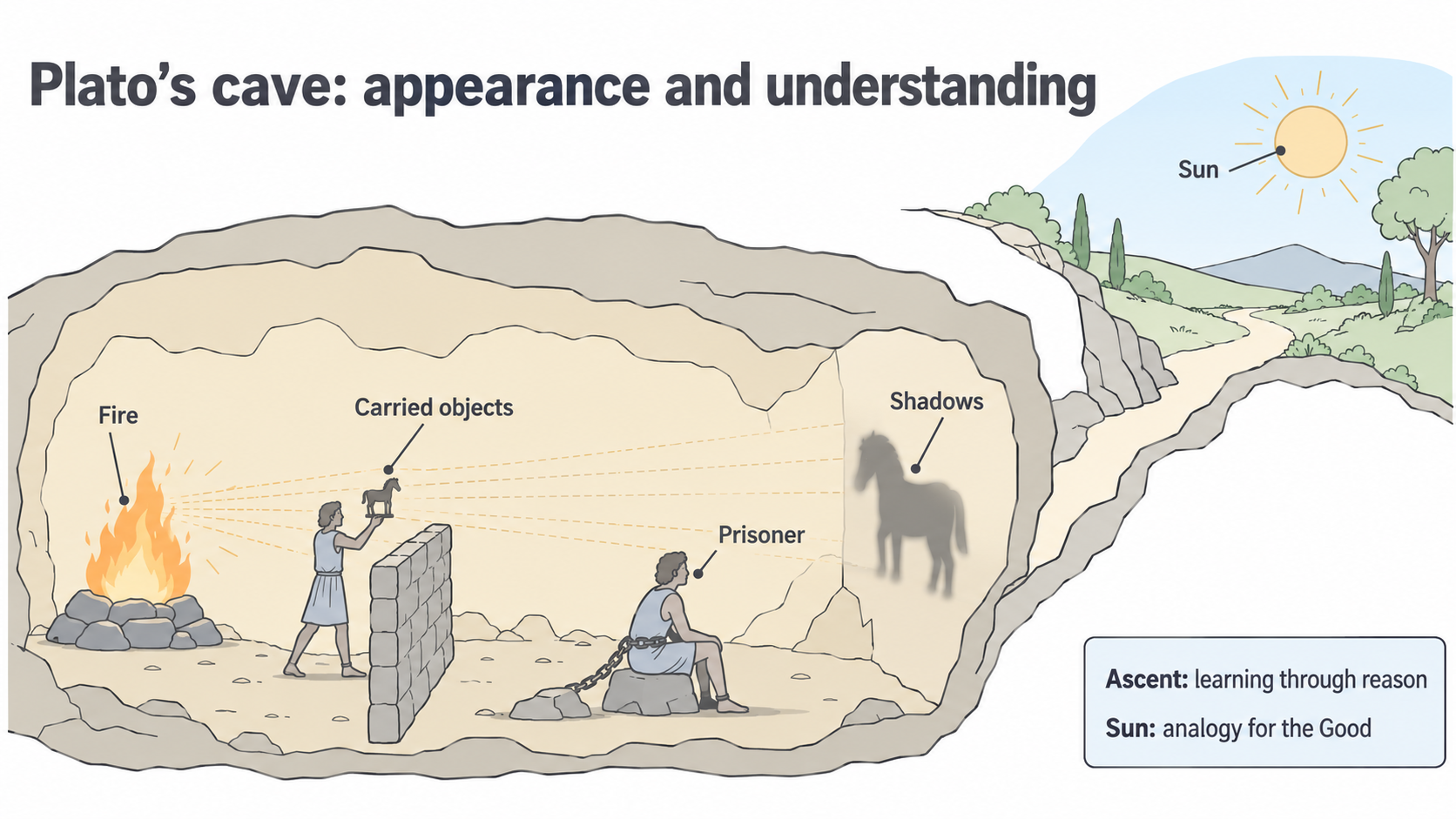
The ascent represents intellectual education, not a journey to a geographical place containing Forms. The shadows show how an appearance can be mistaken for its underlying reality. Outside represents intelligible understanding; the sun represents the Good. The story works with the distinction between visible and intelligible understanding developed through the divided line in Republic VI, 509d–511e. Education redirects an existing capacity to understand; it is more demanding than handing someone information.
The released prisoner returns and struggles to see in the dark. Others interpret his temporary difficulty as proof that leaving is harmful. They may even kill someone who tries to free them. Plato thereby links knowledge to responsibility and social resistance: the philosopher should help the community, but familiar opinion can resist criticism. The analogy also warns us that confidence, prizes for predicting shadows and majority agreement do not guarantee knowledge.
Testing Plato's explanation
An effective evaluation separates what the cave illustrates from what it establishes. A modern learner who believes every edited photograph may resemble a prisoner: evidence outside a restricted source can change the learner's understanding. Yet checking the original photograph still uses sensory evidence. This supports critical education without establishing Plato's separate Forms.
Plato can reply that collecting more examples does not answer the question of a universal standard. We judge unequal sticks as approximately equal, or laws as imperfectly just, by referring to something beyond the particular instances. That reply explains why rational reflection matters. A critic can still ask whether the standard is an independently existing Form or a concept developed through comparison and reasoning.
The Third Man problem, associated with Aristotle's criticism of separate Forms, sharpens the issue. If many humans and the Form of Human share a common character, a further Form may seem needed to explain that similarity, followed by another indefinitely. This challenges one way of explaining participation; it does not show that every form of rational knowledge is impossible.
We can therefore make a qualified judgement: the cave powerfully explains the difference between familiarity and understanding, and the Good offers an objective basis for truth and value. The further claim that these require separate Forms remains contestable. In the next lesson, Aristotle locates form within things and begins enquiry from observation. Comparing their answers will require judging explanatory power as well as certainty.