Death and the Afterlife - Judgement and renewed creation
Read the Sheep and Goats as an account of responsible judgement, compare judgement immediately after death with judgement at history's end, and examine the promise of a transformed creation.
The Sheep, Goats and the least
Matthew 25:31–46 presents the Son of Man coming in glory, gathering the nations and separating people as a shepherd separates sheep from goats. Those welcomed into the kingdom have fed the hungry, welcomed strangers, clothed the naked and cared for the sick and imprisoned. Those condemned have neglected such needs. Both are surprised to learn that their treatment of the least relates to their treatment of Christ. This is a paraphrase of the passage, not a quotation.
The scene connects Jesus' authority to divine judgement and gives ordinary acts profound significance. Failure includes omission, not just actively inflicting harm. It also challenges moral performance pursued merely for recognition: the caring people have not consciously calculated a reward for helping Jesus.
Who are the least brothers and sisters? One reading identifies vulnerable people generally. Another connects the phrase specifically with Jesus' followers or messengers, so receiving or rejecting them expresses a response to Christ. The wider context and use of kinship language matter to the debate. Neither reading warrants reducing the scene to social respectability or assuming that religious profession alone suffices.
The final contrast is eternal punishment and eternal life. Verse 41 uses the image of eternal fire. Outer darkness, gnashing of teeth, Gehenna and Hades are not expressions in this particular passage; attributing all familiar judgement images to it blurs the evidence. A strong interpretation explains the scene actually given.
Immediate and final judgement
Particular judgement concerns a person's destiny immediately after death. Final judgement concerns the public completion of history and resurrection. These need not be competing alternatives. Catholic teaching combines immediate judgement with a final judgement revealing the consequences of conduct within the whole history of creation. The Westminster Confession XXXII–XXXIII likewise combines an immediate state of souls with future bodily resurrection and judgement, while rejecting purgatory.
One coherent model is therefore: earthly life and death; a particular judgement and intermediate condition; final resurrection and judgement. This is a theological ordering, not a measurable timetable proving how time is experienced beyond death. If God is timeless, “immediate” describes the relation to a creature's death, not a change in divine knowledge.
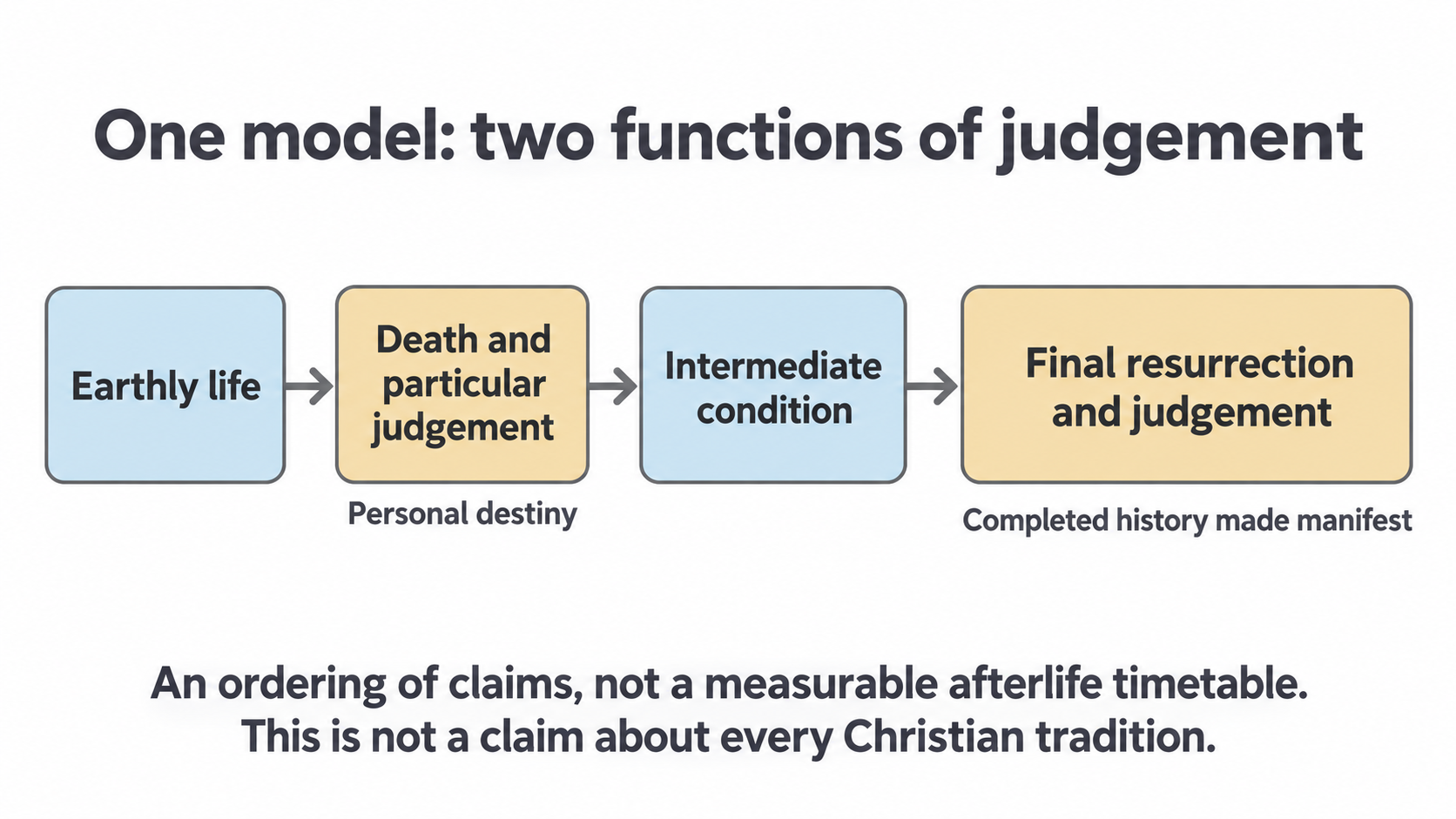
The arrows order this model's claims; they do not measure time beyond death. The two labels explain different functions, so the last judgement need not reverse the first. Other Christian interpretations do not all use this ordering.
A final-only interpretation instead emphasises biblical promises of resurrection at the end of time. It can question whether a conscious intermediate state is needed and may describe death as sleep until resurrection. An immediate-only emphasis highlights personal encounter with God but risks neglecting embodied restoration and the public vindication of justice. Each must explain the material it does not foreground.
There is a fairness reason for final judgement: an action's social consequences may continue after its agent dies, and victims need vindication rather than merely a private sentence on an offender. A critic asks whether this makes a second judgement redundant. A defender distinguishes determining personal destiny from manifesting its significance within completed history.
Continue this lesson.
You’re previewing NovaLearn without an account. Create a free account to read the rest.
Create free account