3.4.2 - Issues for dualism
If the mind is distinct from the body, how do we know other minds exist, and how can mind and body affect each other? You will examine the problem of other minds and two responses, Ryle's category-mistake objection, the conceptual and empirical interaction problems, and the challenges facing epiphenomenalism.
The Pressure On Dualism
Dualism says that minds, or at least some mental properties, are not identical with physical bodies, brain states, or physical properties. That separation is what makes dualism attractive: it seems to respect consciousness, thought, and subjectivity. The same separation also creates pressure. If the mental is not simply public bodily behaviour or physical brain activity, the dualist owes an account of how minds are known, how mental concepts work, and how mind and body can causally connect.
This lesson is not another lesson on arguments for substance dualism or property dualism. It asks what happens after a dualist view is on the table.
The route map below shows the main pressure points as a set of choices and consequences. Use it as a guide to the lesson's structure: each branch names a different way dualism can be challenged.
[DIAGRAM: asset_name: 3.4.2 - Issues for dualism - diagram 1; asset_slug: mind04_issues_for_dualism__diagram_01; recommended_method: retained_png; description: Route map of issues for dualism]
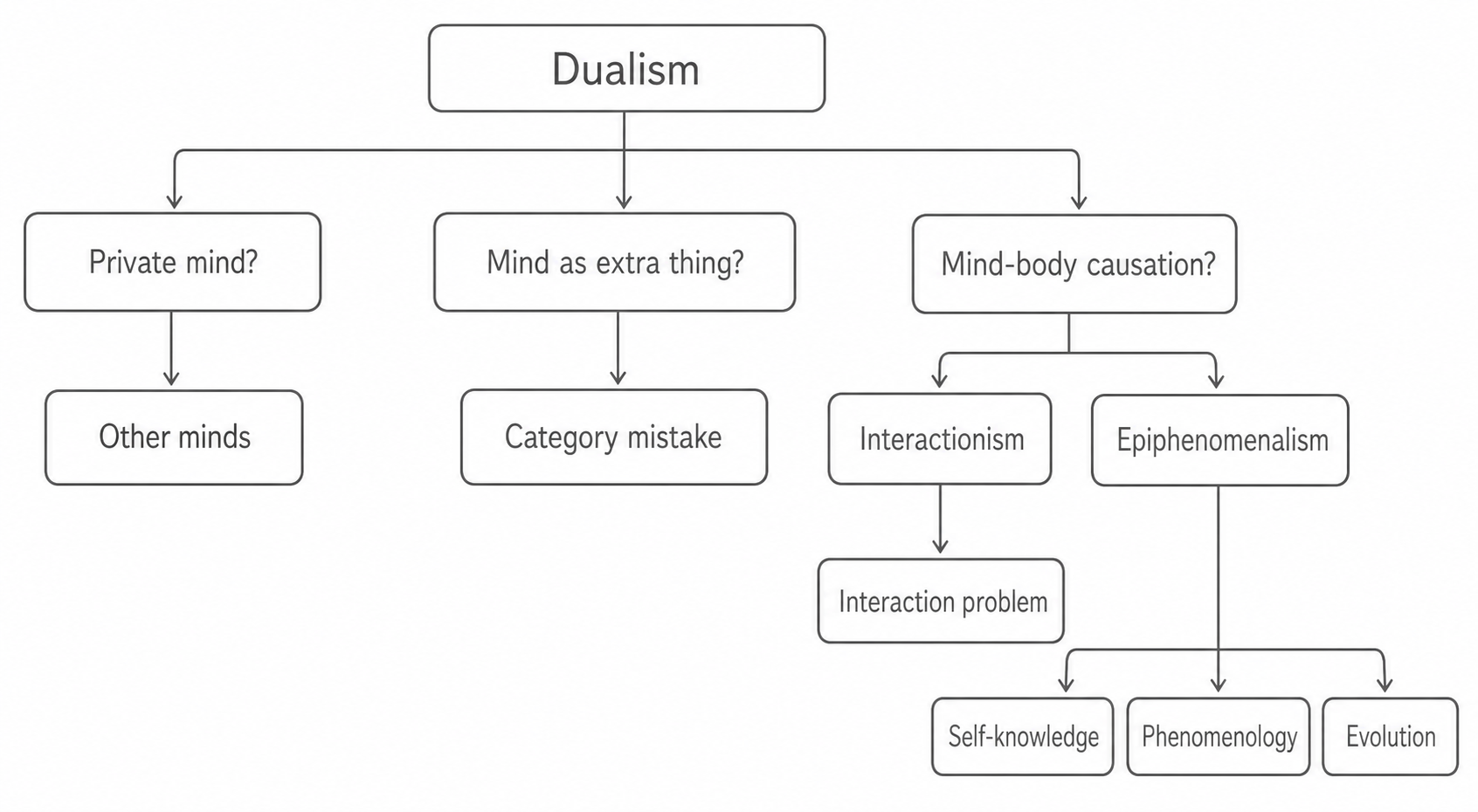
The table then sharpens what each branch is attacking. The same broad claim that mind is distinct from body creates different problems depending on whether the critic focuses on knowledge, concepts, causation, or the causal role of consciousness.
| Issue cluster | The pressure on dualism | Main target |
|---|---|---|
| Other minds | If minds are private or non-physical, how can I know that anyone else has one? | Epistemic access to other people's mental lives. |
| Category mistake | Does dualism wrongly treat mind as an extra thing alongside the body? | The conceptual category of mental language. |
| Interactionist dualism | If mind and body are radically different, how can they causally affect one another? | Mind-body causation. |
| Epiphenomenalist dualism | If mental events are caused by physical events but cause nothing, can we explain self-knowledge, agency, and evolution? | The causal role of mental life. |
The key exam habit is to name the exact target. A category-mistake objection is not the same as an empirical objection. A problem about knowing other minds is not the same as a problem about moving bodies. A good answer makes each objection hit the right part of dualism.
The Problem Of Other Minds
The problem of other minds begins with an ordinary contrast. I seem to know my own pain, fear, belief, or intention from the inside. I do not seem to know your pain in that way. I can observe your face, words, posture, behaviour, and circumstances, but not your pain itself.
For a dualist, this can become sharper. If mental states are non-physical, or if mental properties are not reducible to physical properties, then observing another body does not by itself reveal a mind. A body could, in principle, move and speak without there being an inner conscious life behind it. The challenge is not that other people probably lack minds. The challenge is that dualism needs to explain what justifies my belief that they have minds.
Anita Avramides' work on other minds is useful here because it shows how the issue emerges when self-knowledge is treated as direct but knowledge of others is treated as indirect. The dualist picture can make the mental look hidden behind behaviour.
Claim at issue: Dualism faces a problem about how we know other minds exist.

1. P1: On dualism, another person's mental states are not identical with publicly observable bodily states.
2. P2: I have direct access to my own mental states, but I observe other people's bodies and behaviour from the outside.
3. P3: The same observed behaviour could be produced with, without, or by different inner mental states.
4. Therefore, C: I need a justification for believing that other people have minds like mine.

Hidden assumption: Knowledge of another mind requires either direct access to that mind or a good inference from public evidence to private mental life.

Inference type: Sceptical epistemological pressure. The argument does not prove that other minds do not exist; it challenges the dualist to justify belief in them.

Main pressure point: P3 and the hidden assumption. A defender may deny that behaviour is merely external evidence for a hidden inner object.
The problem matters because it threatens a kind of isolation. If my own mind is the only mind I can know directly, and other minds are beyond observation, then belief in other minds may look like a risky hypothesis rather than ordinary knowledge.
Analogy And Best Hypothesis
AQA requires two responses to the problem of other minds: the argument from analogy and the best-hypothesis response. Both accept that we reason from what we can observe to what we cannot directly observe. They differ in the kind of reasoning they use.
The argument from analogy starts from my own case. I know that, in my case, certain mental states are linked with certain bodily expressions and actions. When I am in pain, I cry out, withdraw, wince, or seek help. Other people have bodies like mine and behave in similar ways in similar circumstances. So, by analogy, they probably have similar mental states.
Claim at issue: Other people probably have minds like mine.

1. P1: In my own case, mental states are regularly connected with bodily behaviour.
2. P2: Other people have bodies, nervous systems, circumstances, and behaviour similar to mine.
3. P3: Similar effects in similar kinds of beings are likely to be connected with similar mental states.
4. Therefore, C: Other people probably have mental states like mine.

Hidden assumption: My own case is relevantly representative of other human beings.

Inference type: Analogical and inductive.

Main pressure point: The inference seems to rely on a sample of one conscious case: my own.
The analogy response is attractive because it matches ordinary judgement. When someone burns their hand and cries out, treating that behaviour as pain-behaviour is not a wild leap. The weakness is that the conclusion cannot be checked in the way ordinary analogies often can. I can compare one machine with another by opening both. I cannot open another person's consciousness and compare it with mine.
The best-hypothesis response uses abduction: inference to the best explanation. It says that the existence of other minds best explains the rich, flexible, meaningful behaviour of other people. Their speech, humour, learning, problem-solving, emotional reactions, and long-term plans make much more sense if they have beliefs, desires, sensations, and intentions.
Claim at issue: Other minds are the best explanation of other people's behaviour.

1. P1: Other people's behaviour is complex, flexible, purposive, and responsive to reasons and circumstances.
2. P2: The hypothesis that they have mental states explains this behaviour better than the hypothesis that they are mindless bodies.
3. P3: When a hypothesis gives the best available explanation of the evidence, it is rational to accept it.
4. Therefore, C: It is rational to believe that other people have minds.

Hidden assumption: Explanatory power can justify belief in unobserved or not directly observed entities.

Inference type: Abductive reasoning.

Main pressure point: Whether mental states really are needed as the best explanation, especially if dualism makes them hidden from public evidence.
This response is stronger than a simple analogy when it explains behaviour across many cases, including people who are unlike me in age, culture, disability, or expression. It does not need every other person to behave exactly as I do. Its limit is that it gives rational support, not certainty. A sceptic can still imagine mindless duplicates. The question is whether that sceptical possibility should defeat the best explanation of ordinary evidence.
Ryle's Category-Mistake Objection
Gilbert Ryle's objection is not that dualism lacks enough evidence. It is that dualism misdescribes what sort of concept mind is.
Category mistake
Treating something as belonging to the wrong logical type or category, such as asking where the university is after being shown all its colleges.
Ryle's standard example is a visitor who is shown colleges, libraries, laboratories, offices, and playing fields, and then asks where the university is. The visitor has not missed an extra building. The mistake is treating the university as another item in the same list as the colleges and libraries, rather than as the organised institution made up by those things and their relations.
Ryle thinks dualism makes an analogous mistake about the mind. The dualist treats the mind as an extra inner thing, a private non-physical object alongside the body. Ryle argues that mental concepts such as knowing, intending, believing, understanding, and acting intelligently do not name hidden ghostly items in a private arena. They belong to the logic of capacities, dispositions, performances, reasons, and patterns of conduct.
Ryle's own positive view, philosophical behaviourism, is taught in a later lesson. The point here is the objection to dualism: if the dualist has put mind in the wrong category, then the mind-body problem has been generated by conceptual confusion.
Claim at issue: Dualism makes a category mistake.

1. P1: A theory is conceptually confused if it treats a concept as belonging to a logical category to which it does not belong.
2. P2: Dualism treats the mind as a private non-physical thing or substance alongside the physical body.
3. P3: Mental concepts are not concepts of an extra hidden thing; they are used to describe capacities, dispositions, intelligent activity, self-knowledge, and patterns of conduct.
4. Therefore, C: Dualism makes a category mistake about the mind.

Hidden assumption: The correct analysis of mental concepts can show that dualist metaphysics is mistaken.

Inference type: Conceptual and linguistic objection.

Main pressure point: P3. A dualist can argue that Ryle's account leaves out the felt, first-person character of conscious experience.
The force of Ryle's objection is that it can dissolve rather than answer some dualist puzzles. If mind is wrongly treated as a hidden thing, then it is unsurprising that we struggle to explain how it is found, how it moves a body, or how other people know it is there. The reply is that not all mental life looks like publicly assessable ability or disposition. Pain, after-images, moods, and conscious experience may seem to have an inner phenomenal character that Ryle's category diagnosis does not fully capture.
Continue this lesson.
You’re previewing NovaLearn without an account. Create a free account to read the rest.
Create free account