3.2.3 - Moral realism, naturalism and non-naturalism
When we say that cruelty is wrong, are we stating a fact? You will distinguish cognitivism from non-cognitivism, see what moral realism claims, and compare naturalist realism (including naturalist readings of utilitarianism and virtue ethics) with non-naturalism and intuitionism, ending with Moore's open question argument.
The Origins Question
Moral philosophy begins with familiar judgements: stealing is wrong, cruelty is bad, keeping promises matters, courage is admirable. Metaethics asks a deeper question about those judgements: what kind of thing are they?
The origins question is:
Where do moral principles come from: reason, emotion or attitudes, or society?
That question is not asking when children first learn rules. It is asking what explains the authority and meaning of moral principles.
| Possible origin | Basic idea | What it tends to suggest |
|---|---|---|
| Reason | Moral principles are discovered or justified by rational reflection. | Moral judgements may be true or false, and moral knowledge may be possible. |
| Emotion or attitudes | Moral language is rooted in approval, disapproval, commitment or desire. | Moral judgements may express attitudes rather than describe facts. |
| Society | Moral principles come from social practices, agreements or conventions. | Moral truth may depend on a community, or moral language may report social facts. |
These options can pull in different directions. If a moral principle is discovered by reason, it may look like a candidate for objective truth. If it originates in emotion, it may look more like an expression of approval or disapproval. If it originates in society, it may look like a convention that varies with social practice.
This lesson focuses on the realist route. A moral realist thinks there are moral properties or facts that are not made true by anyone's attitudes. Within realism, there is then a further question: are these moral facts natural facts, such as facts about pleasure, pain, flourishing or human nature, or are they non-natural facts, known in some other way?
The diagram below gives the route for the lesson. It is not a substitute for the definitions that follow; it is there to keep the levels of the debate separate: first moral language, then realism, then the naturalist/non-naturalist fork inside realism.
[DIAGRAM: asset_name: 3.2.3 - Moral realism, naturalism and non-naturalism - diagram 1; asset_slug: mor10_moral_realism_naturalism_and_non_naturalism__diagram_01; recommended_method: codex_image_gen; description: Taxonomy of moral language in which cognitivism branches to moral realism and cognitivist anti-realism/error theory, realism branches to naturalism and non-naturalism, and Moore's open question targets naturalism]
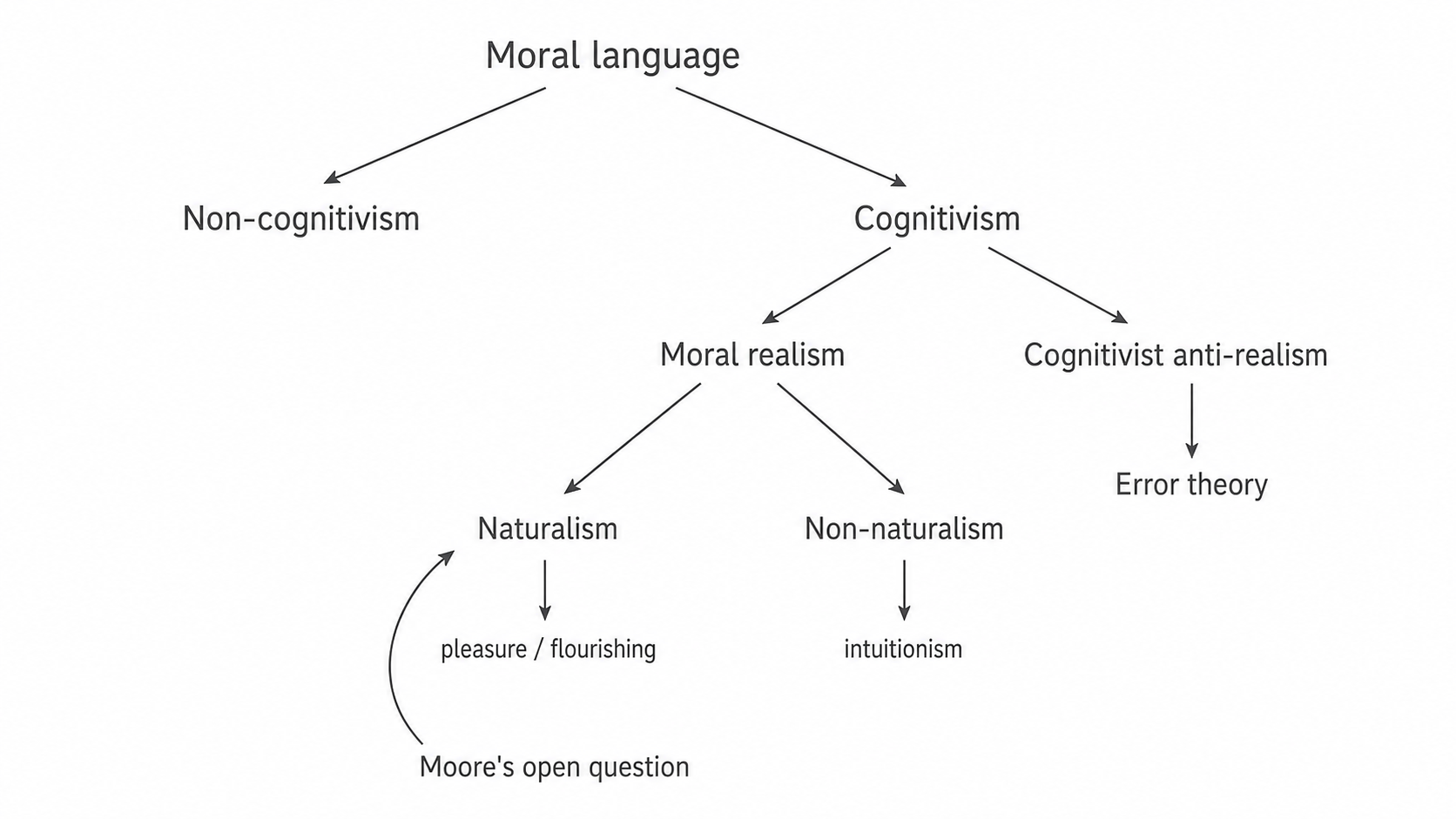
Read the image from the top. Non-cognitivism is included only as the contrasting route about moral language; the lesson then follows cognitivism into moral realism. Within realism, naturalism locates moral facts in natural facts such as pleasure or flourishing, while non-naturalism treats moral facts as non-natural and uses intuitionism as an account of how some basic moral truths are known. Moore's open question arrow points back at naturalism because his argument asks whether any proposed natural property really captures goodness. That arrow highlights the naturalist branch; the same test also challenges other reductive metaethical accounts, which are not drawn in this map.
Keep this separate from normative ethics. Utilitarianism, Kantian ethics and virtue ethics ask what makes actions right or character good. Metaethics asks what kind of claim that is, whether it can be true, and what would make it true.
Cognitivism And Non-Cognitivism
The first key distinction is about ethical language.
A proposition is the content of a claim that can be true or false. "The book is on the table" expresses a proposition. It might be true or false depending on the world. "Close the door!" is meaningful, but it does not describe the world in the same way. It is a command rather than a truth-apt proposition.
Cognitivism
The view that moral sentences express beliefs or propositions, so they can be true or false.
Non-cognitivism
The view that moral sentences do not express truth-apt beliefs or propositions; they may express emotions, attitudes, prescriptions or commitments.
Detailed non-cognitivist theories such as emotivism and prescriptivism are taught in the moral anti-realism lesson, but the distinction is needed now because AQA classifies moral naturalism and moral non-naturalism as cognitivist.
| Claim | Cognitivist reading | Non-cognitivist reading |
|---|---|---|
| "Stealing is wrong." | This expresses a belief that stealing has the property of wrongness, or that a moral fact obtains. | This expresses disapproval of stealing, a negative attitude toward stealing, or a prescription not to steal. |
| "Pleasure is good." | This expresses a proposition that can be assessed as true or false. | This expresses approval of pleasure, or recommends pleasure, rather than stating a fact. |
| "Courage is a virtue." | This attributes a moral property to courage. | This expresses endorsement of courage or commends courageous character. |
The distinction matters because realism needs cognitivism, but cognitivism does not by itself give realism.
1. P1: If moral realism is true, moral claims must be capable of stating moral facts.
2. P2: Only truth-apt propositions can state facts.
3. P3: Cognitivism says moral claims express truth-apt propositions.
4. Therefore, C1: Moral realism requires cognitivism.
5. P4: A claim can be truth-apt even if it is false, or even if there are no facts of the relevant kind.
6. Therefore, C2: Cognitivism alone does not prove moral realism.

Hidden assumption: Stating a fact requires a proposition that can be true or false.
Inference type: Conceptual reasoning about language and truth.
Main pressure point: Whether moral language really works like factual description.
This is why error theory, which is taught in the moral anti-realism lesson, can be cognitivist but anti-realist. It treats moral claims as truth-apt but says they systematically fail because there are no moral facts of the required kind. That is only a signpost here. In this lesson, the focus is the realist family: moral claims are truth-apt and at least some are made true by moral facts.
Moral Realism
Moral realism
The view that there are mind-independent moral properties or facts.
A moral property is a property such as rightness, wrongness, goodness or virtue. A moral fact is something that obtains if a moral claim is true, such as the fact that a particular action is wrong.
Mind-independent does not mean that moral facts never involve minds. Cruelty, suffering, intention and flourishing all involve minded beings. The point is about what makes the moral claim true. For the realist, a moral claim is not made true merely by an individual's approval, a society's acceptance, or a speaker's emotional attitude.
For example:
"Causing needless suffering is wrong."
A realist says this is not just a report that I dislike needless suffering, or that my society condemns it. If it is true, it is true because of how things morally are.
Moral realism has three layers:
| Layer | Question | Realist answer |
|---|---|---|
| Semantic | What does moral language do? | Moral claims express truth-apt propositions. |
| Metaphysical | What exists to make true moral claims true? | Moral properties or facts exist mind-independently. |
| Epistemological | How could we know moral truths? | This depends on the realist theory: naturalists may appeal to empirical facts and reasoning; non-naturalists may appeal to intuition or rational insight. |
A basic reconstruction of moral realism is:
Claim at issue: Some moral claims are objectively true.

1. P1: Some moral claims express propositions, such as "cruelty is wrong".
2. P2: Some of these propositions are true.
3. P3: Their truth does not depend on any individual's attitude, preference or social approval.
4. Therefore, C: There are mind-independent moral facts or properties.

Hidden assumption: If a true moral proposition is not made true by attitudes or conventions, it needs a mind-independent moral truth-maker.
Inference type: Metaphysical and semantic reasoning.
Main pressure point: Whether moral truth really requires moral facts, or whether moral language can be explained without them.
The attraction of realism is that it seems to preserve ordinary moral thought. We argue as if some moral claims are correct and others mistaken. We criticise past societies as unjust, not merely different from ours. We treat moral disagreement as more than a clash of taste. Realism explains that by saying moral claims aim at truth.
But this lesson does not yet teach the major challenges to realism. Hume's Fork, Ayer's verification principle, Hume's motivation argument, Hume's is-ought gap, and Mackie's relativity and queerness arguments are taught in the next lesson, Challenges to moral realism. Here, the issue is internal to realism: if moral facts exist, are they natural or non-natural?
Moral Naturalism
Moral naturalism
A cognitivist realist theory that moral facts or properties are natural facts or properties.
A natural fact is the sort of fact that belongs within the natural world: facts about pleasure, pain, desire, human flourishing, biological needs, psychology, social life, consequences, character, and so on. Different naturalists disagree about exactly which natural facts matter. What unites them is the claim that moral truth does not require a special non-natural realm of moral properties.
The naturalist thought is:
If a moral claim is true, it is true because some natural fact obtains.
For example, a naturalist might analyse goodness in terms of pleasure, happiness, preference-satisfaction, flourishing, or the fulfilment of human nature. A naturalist might analyse wrongness in terms of causing suffering, frustrating interests, preventing flourishing, or failing to meet natural standards for human life.
There are two useful forms of naturalism for AQA:
| Form | Basic claim | Example |
|---|---|---|
| Reductive naturalism | Moral properties can be identified with, or defined in terms of, natural properties. | Goodness is pleasure, happiness, flourishing, or what satisfies desire. |
| Non-reductive naturalism | Moral properties are natural and depend on natural facts, but may not be neatly definable by a simple synonym. | Wrongness might be a higher-level natural property realised by patterns of harm, agency and welfare. |
Moore's open question argument is aimed especially at reductive accounts, because they try to define moral terms in non-moral, natural terms. AQA describes Moore's argument as against all reductive metaethical theories, so the target is any theory that tries to reduce moral goodness to some non-moral property.
The naturalist's basic argument can be reconstructed like this:
Claim at issue: Moral facts are natural facts.

1. P1: Moral facts, if they exist, should fit into our best understanding of the world.
2. P2: The world contains natural facts about pleasure, pain, welfare, flourishing, needs, desires, agency and social life.
3. P3: Moral judgements systematically track these natural facts.
4. P4: We do not need to posit non-natural moral properties if natural facts can explain moral truth.
5. Therefore, C: Moral facts are natural facts, or at least are grounded in natural facts.

Hidden assumption: Explanatory economy favours identifying moral facts with natural facts if this preserves moral practice.
Inference type: Abductive reasoning, an inference to the best explanation.
Main pressure point: Whether natural facts can capture normativity, the "ought" or authority of moral claims.
Naturalism is initially attractive because it promises a less mysterious realism. If moral facts are facts about suffering, pleasure, flourishing or human nature, then moral knowledge may use ordinary observation, psychology, practical reasoning and experience. The realist can say moral truths are objective without making them detached from the natural world.
The central issue is whether natural facts are enough. Suppose we know that an action produces more pleasure than pain. Does that settle that it is good? Suppose we know a trait helps humans flourish. Does that settle that it is a virtue? Moore's open question argument says no reductive answer can close that gap. Naturalists need to show either that Moore's argument fails or that their form of naturalism does not depend on the kind of simple definition Moore attacks.
Naturalist Utilitarianism And Virtue Ethics
AQA specifically requires naturalist forms of utilitarianism, including Bentham, and naturalist forms of virtue ethics. The point is not to re-teach the whole normative theory. The point is to see how each theory can be read as a metaethical naturalism.
Keep the set-text use narrow:
| Text boundary | Use in this lesson |
|---|---|
| Bentham, An Introduction to the Principles of Morals and Legislation, Chapters 1 and 4 | Utility, pleasure and pain as natural facts that can ground a naturalist account of rightness. |
| Mill, Utilitarianism, Chapters 1, 2, 4 and 5 | Happiness, pleasure, desire and justice as naturalist utilitarian context, without re-teaching the full Mill lesson. |
| Aristotle, Nicomachean Ethics, selected Books 1, 2, 3, 5, 6, 7 and 10 | Eudaimonia, human function, virtue, character and practical wisdom as naturalist virtue-ethics context. |
| Annas, "Virtue Ethics", in The Oxford Handbook of Ethical Theory, pp. 515-536 | The classical structure of virtue ethics, used only to support the naturalist virtue-ethics reading. |
Naturalist Utilitarianism
Bentham's utilitarianism is a clear naturalist candidate because it connects moral rightness with natural facts about pleasure and pain. In Chapter 1 of An Introduction to the Principles of Morals and Legislation, Bentham presents the principle of utility as approving or disapproving actions according to their tendency to increase or decrease happiness. In Chapter 4, he treats pleasures and pains as having measurable dimensions such as intensity, duration, certainty, nearness, fecundity, purity and extent.
On a naturalist reading:
Rightness = the action's tendency to maximise utility.
Utility = pleasure, happiness, benefit, or reduction of pain.
Pleasure and pain = natural psychological facts.
That makes moral judgement answerable to facts about consequences.
1. P1: If the right action is the action that maximises utility, then rightness is determined by consequences for pleasure and pain.
2. P2: Consequences for pleasure and pain are natural facts about sentient beings.
3. Therefore, C: Utilitarian rightness can be understood naturalistically.

Hidden assumption: Moral rightness can be identified with utility-maximisation, not merely guided by it.
Inference type: Conceptual reconstruction of a naturalist utilitarian view.
Main pressure point: Whether "maximises utility" means the same as "right", or only gives a proposed criterion of right action.
Continue this lesson.
You’re previewing NovaLearn without an account. Create a free account to read the rest.
Create free account