3.1.3 - Empiricist challenges to Descartes
Can reason move from the contents of thought to claims about what exists? You will examine empiricist challenges to the cogito, God and the external world, using Hume’s account of ideas and his distinction between relations of ideas and matters of fact.
The Problem For Descartes
Descartes wants a foundation for knowledge that cannot be shaken by sceptical doubt. Sense experience can mislead us, dreams can seem like waking life, and even apparently obvious reasoning can be questioned under the evil demon hypothesis. So Descartes looks for certainty in reason: first through a direct a priori intuition, then through deductions from clear and distinct ideas.
The empiricist challenge is not simply "trust your senses instead". That would be too crude, and Descartes has already shown why ordinary sense experience can be doubted. The sharper challenge is this:
Can reason alone move from the contents of thought to claims about what exists?
That question matters because Descartes' project has three linked stages in this lesson:
| Stage | Descartes' rationalist move | Empiricist pressure |
|---|---|---|
| Cogito | I can know my own existence through a priori intuition. | Does this prove only present thinking, or a substantial "I"? |
| God | I can deduce God's existence from clear and distinct ideas and causal principles. | Can an existence claim be proved from ideas alone? |
| External world | Once God is established as no deceiver, I can prove bodies exist. | Does this proof depend on a disputed God argument and a causal leap beyond experience? |
Use these terms carefully:
| Term | Meaning in this lesson | Why it matters |
|---|---|---|
| A priori | Justified independently of sense experience. | Descartes' cogito, God arguments, and proof of the external world are treated by AQA as examples of a priori intuition or deduction. |
| Intuition | Direct intellectual awareness, not a step-by-step inference. | Descartes' cogito is presented as an a priori intuition. |
| Deduction | Reasoning in which the conclusion is meant to follow necessarily from the premises. | Descartes' arguments for God and the external world are presented as a priori deductions. |
| Clear and distinct idea | For Descartes, an idea grasped so clearly and sharply that it can be used as a mark of truth once God is secured. | Empiricists ask whether this mental clarity really proves existence outside the mind. |
| Relation of ideas | In Hume's distinction, a truth discoverable by thought alone, where denial involves contradiction. | This is one side of Hume's Fork. |
| Matter of fact | In Hume's distinction, a claim about existence or the world, whose denial is conceivable without contradiction. | This is the side on which God and external-world claims appear to fall. |
Empiricism
The view that experience is the source or test of the contents of the mind and of factual knowledge.
The lesson's central issue is therefore:
Descartes uses reason to rebuild the world after doubt.
The empiricist asks whether reason can do that much.
The Cogito Under Pressure
The cogito is Descartes' first secure point. If he is doubting, being deceived, imagining, or thinking in any way, then he cannot be nothing at that moment. The very performance of thinking makes his existence undeniable while the thinking occurs.
Descartes' basic move can be reconstructed like this:
Claim at issue: I can know my own existence with certainty through reason.

1. P1: I am now thinking, doubting, or being appeared to.
2. P2: Thinking, doubting, or being appeared to cannot occur unless something exists that is thinking, doubting, or being appeared to.
3. Therefore, C: I exist as a thinking thing whenever I am thinking.

Hidden assumption: The occurrence of thought licenses a thinker, not merely an ownerless event of thinking.
Inference type: A priori intuition, though it can be reconstructed as a short conceptual deduction.
Main pressure point: How much is proved by the words "I" and "thing".
The cogito is initially powerful because it does not depend on ordinary sense experience. If I am dreaming, I still seem to be thinking. If an evil demon deceives me, there must still be something being deceived. So the empiricist should not respond by saying "experience is unreliable"; Descartes already knows that. The empiricist response has to be more targeted.
There are three main empiricist pressures.
| Empiricist response | Target | Why it matters | Descartes' strongest reply | Residual issue |
|---|---|---|---|---|
| The cogito moves too quickly from thinking to a substantial self. | The hidden assumption that thought requires an enduring thinking substance. | The argument may prove only that thinking is occurring now, not that there is a persisting self-substance. | Descartes can say the cogito needs only a minimal present subject of thought, not a full biography or bodily self. | The more Descartes says about the "I" as a thinking thing, the more the empiricist can ask what justifies that extra content. |
| The idea of a thinking substance needs an experiential source or clear test. | The concept of "substance" or "self" if it goes beyond present awareness. | Hume's Section 2 method asks us to trace ideas back to impressions; a bare underlying substance is not obviously given in experience. | Descartes can insist that the cogito is not copied from sensation but directly grasped by intellect. | This reply depends on accepting the rationalist faculty that empiricism is questioning. |
| The cogito has limited scope. | The implication that the cogito can support the rest of the system. | Even if the cogito succeeds, it does not by itself prove God, bodies, or the reliability of clear and distinct ideas. | Descartes can accept this and treat the cogito as only the first foundation, not the whole building. | The later deductions must still be defended separately. |
So the best empiricist answer is not that the cogito is worthless. It is that the cogito is much narrower than Descartes needs. It may secure present thinking, but it does not yet secure a substantial self, God, or a mind-independent external world.
Hume's Fork As A Test
Hume gives the empiricist a precise way to test Descartes' later deductions. In Section 2 of the Enquiry, Hume distinguishes impressions from ideas. Impressions are the more lively perceptions of sensing, feeling, desiring, willing, and inward awareness. Ideas are fainter contents in thought, memory, and imagination. The mind can combine, enlarge, reduce, and rearrange ideas, but Hume's empiricist test asks where the basic materials came from.
This matters for Descartes because Hume explicitly treats the idea of God as something the mind can form by reflecting on human mental qualities and augmenting them without limit. That does not by itself disprove God. It does attack one Cartesian route: if the idea of God can be explained by the mind's operations on experience-derived materials, then Descartes cannot simply assume that only God could be the source of that idea.
Section 4 part 1 then gives the distinction usually called Hume's Fork:
| Humean category | How it is known | What denial involves | Example type | What it can prove |
|---|---|---|---|---|
| Relations of ideas | By thought alone, through intuition or demonstration. | Contradiction. | Mathematics, geometry, conceptual truths. | Necessary relations between ideas. |
| Matters of fact | By experience, memory, testimony, or causal reasoning from experience. | No contradiction; the contrary remains conceivable. | Claims about what exists, happened, or will happen. | Contingent facts about existence or the world. |
The test is simple, but it has serious consequences:
1. Ask whether denying the claim is contradictory.
2. If denial is contradictory, the claim is a relation of ideas.
3. If denial is not contradictory, the claim is a matter of fact.
4. If it is a matter of fact, it cannot be established by a purely a priori deduction.
Hume's Fork can be reconstructed as an objection to Descartes like this:
Claim at issue: Descartes can prove God and the external world by a priori deduction.

1. P1: Any object of human reason is either a relation of ideas or a matter of fact.
2. P2: Relations of ideas can be known a priori, but they do not by themselves establish what exists beyond thought.
3. P3: Matters of fact concern existence, but their denial is conceivable without contradiction and so they are not demonstrable a priori.
4. P4: Claims that God exists and that bodies exist are claims about what exists.
5. Therefore, C: Claims that God exists and that bodies exist cannot be proved by a priori deduction alone.

Hidden assumption: No existence claim can be converted into a mere relation of ideas by building existence into a concept.
Inference type: Conceptual distinction used as a methodological objection.
Main pressure point: Whether Descartes can show that God is a special exception: a being whose existence follows from its essence.
It helps to picture the dispute as a route rather than as three isolated objections. Descartes moves from the cogito to God and then to the external world; the empiricist pressure changes as the route moves from present thinking to existence claims.
[DIAGRAM: asset_name: 3.1.3 - Empiricist challenges to Descartes - diagram 1; asset_slug: epi14_empiricist_challenges_to_descartes__diagram_01; recommended_method: retained_png; description: Descartes' route from the cogito to God and the external world, with Hume's Fork pressing the later deductions]
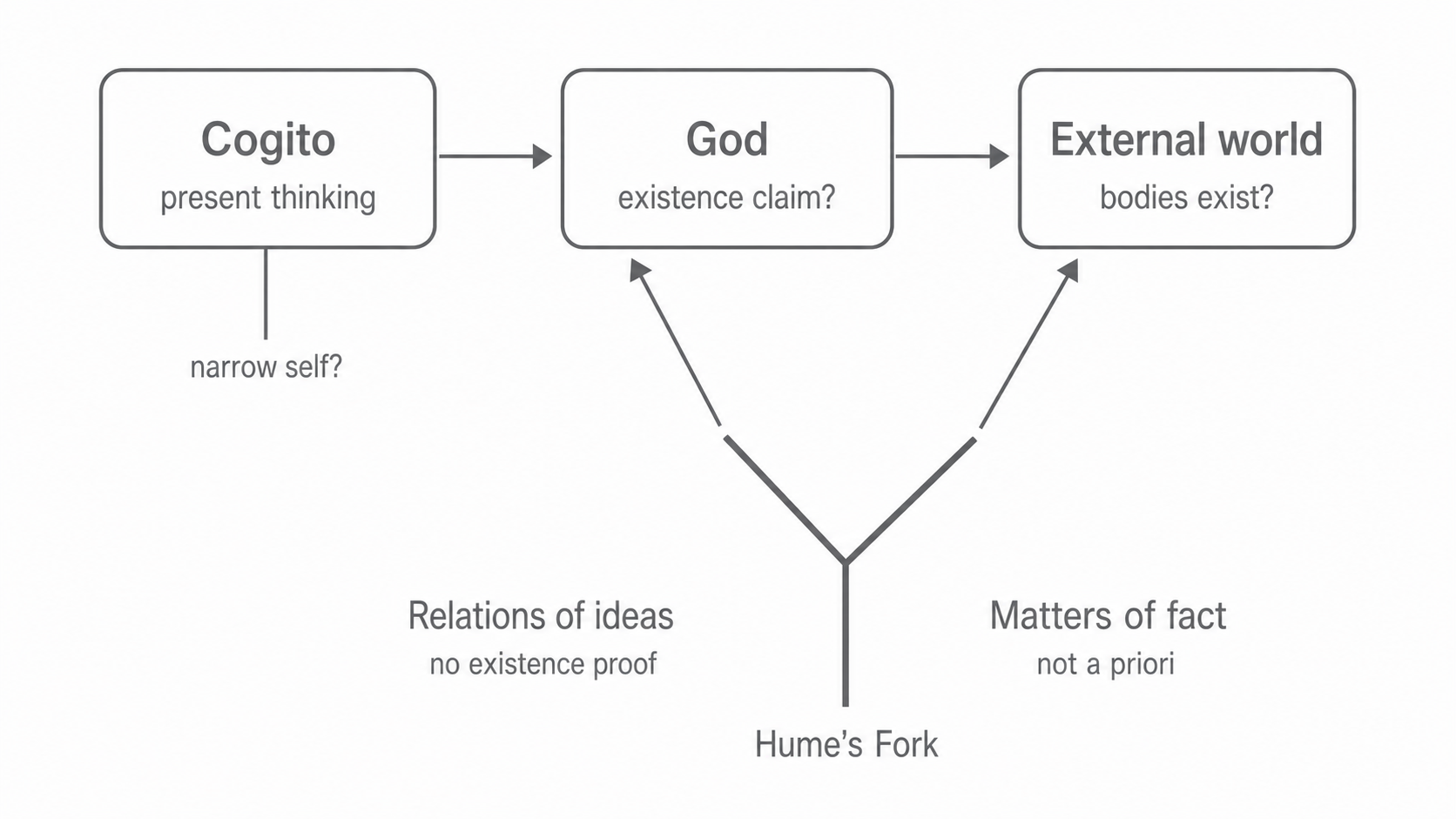
Read the map from top left to top right. The cogito pressure is about how much the present thought proves; Hume's Fork then presses the God and external-world stages because they aim to establish what exists beyond the contents of thought.
Hume's Fork should be applied precisely. It is strongest against Descartes' claims about God and the external world, because those are claims about existence beyond the present contents of consciousness. It is less straightforward against the cogito, because the cogito concerns immediate present thinking rather than an inferred external object. The empiricist pressure on the cogito is about the strength of "I" and "thinking thing", not about using Hume's Fork as a blunt refutation of all self-awareness.
God Arguments Under The Fork
Descartes needs God to do important epistemological work. If God exists and is not a deceiver, then clear and distinct perception can be trusted. But if the proof of God fails, the wider Cartesian system loses its guarantee.
The AQA boundary includes Descartes' arguments for the existence of God as a priori deductions. The two relevant routes are the causal argument in Meditation 3 and the ontological argument in Meditation 5.
The causal argument can be reconstructed like this:
Continue this lesson.
You’re previewing NovaLearn without an account. Create a free account to read the rest.
Create free account