3.1.3 - Intuition, deduction and Descartes
Descartes tries to build certain knowledge from a directly grasped first truth. You will distinguish intuition from deduction and follow the cogito, the arguments for God and the proof of material things, identifying how each stage supports the next.
The Problem For Reason
Descartes begins from a problem about certainty. Sense experience is useful, but it can mislead. Memory can be unreliable. Ordinary beliefs can be inherited from habit rather than tested. If knowledge needs a secure foundation, then simply collecting more experiences will not solve the problem, because those experiences may themselves be among the things that need checking.
The philosophical question is:
Can reason, without depending on sense experience for its justification, give us any certain knowledge?
The intuition and deduction thesis is a rationalist answer. It says that some knowledge can be gained through intellectual insight and reasoning alone. For Descartes, the method starts with something the mind can grasp directly and indubitably, then moves by careful deduction to further conclusions.
This lesson is not mainly about Descartes' sceptical arguments, even though they explain why he wants certainty. The focus is the constructive route:
- Find a first certainty through reason.
- Identify what makes that certainty secure.
- Use that standard to reason toward God.
- Use God as a non-deceiver to recover knowledge of a material world.
The route is easier to keep in view as a dependency map. The diagram is not a substitute for the argument reconstructions later in the lesson; it shows the order in which each claim is meant to support the next one.
[DIAGRAM: asset_name: 3.1.3 - Intuition, deduction and Descartes - diagram 1; asset_slug: epi13_intuition_deduction_and_descartes__diagram_01; recommended_method: retained_png; description: Descartes' route from doubt to the external world]
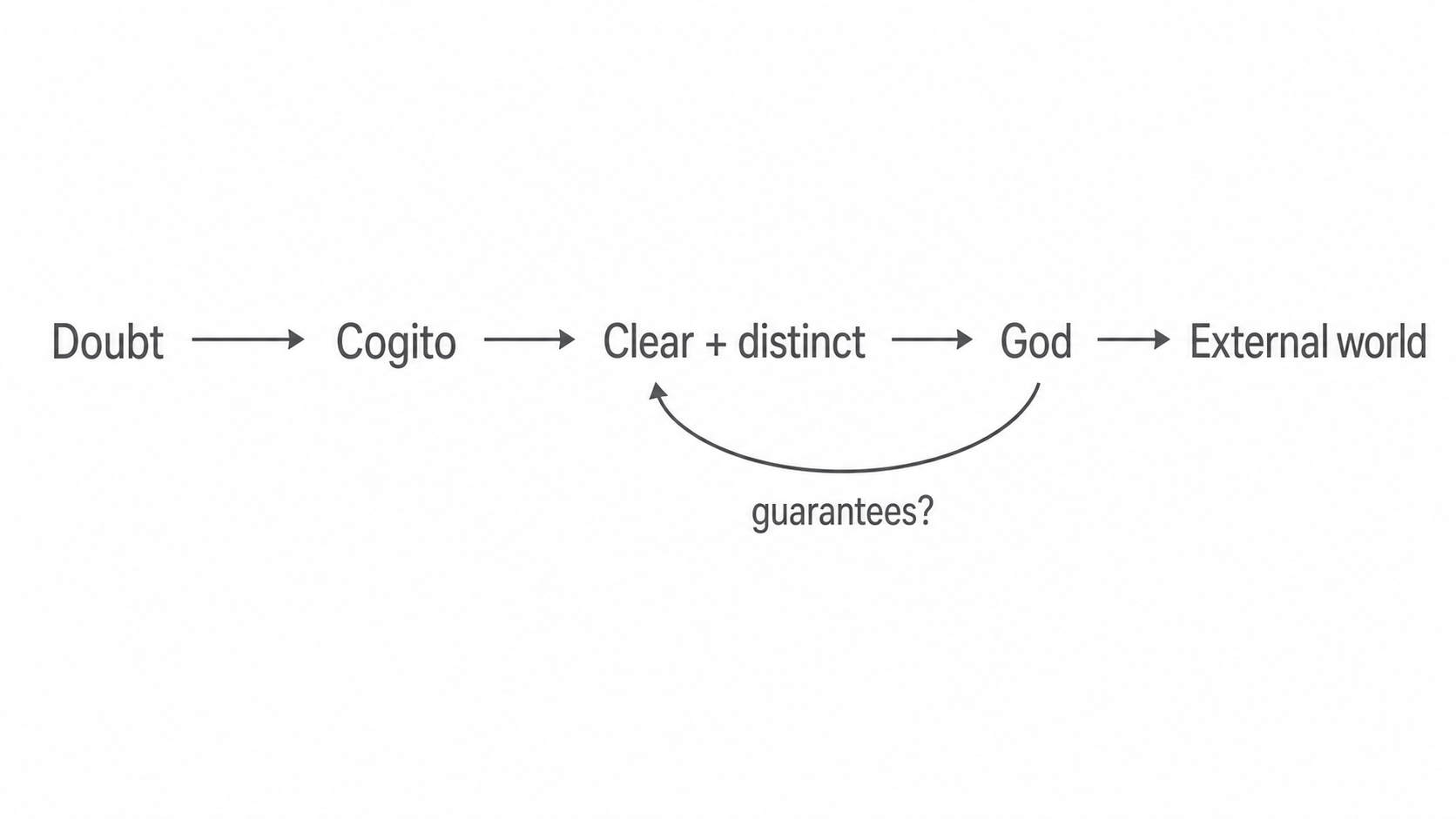
Read the curved arrow as the central pressure point. God is supposed to guarantee clear and distinct perception, but the deduction to God itself uses clear and distinct ideas. That is why the lesson keeps returning to whether Descartes' rational standard can legitimately support the later deductions.
The pressure is immediate. If Descartes' first step is genuinely certain and his deductions preserve certainty, reason can be a source of substantive knowledge. If the clear and distinct standard fails, the route from the cogito to God and the external world loses its foundation.
Intuition And Deduction
Intuition and deduction are two rational operations. They are not guesses, feelings, or sense impressions.
| Term | Meaning | Simple example | Why it matters for Descartes |
|---|---|---|---|
| Intuition | Direct intellectual grasp of something so evident to the attentive mind that it is not reached by a chain of reasoning. | Grasping that a thought is occurring while one is thinking. | The cogito is treated as an a priori intuition. |
| Deduction | Reasoning from what is already known or intuited to a further conclusion, where each step is meant to preserve certainty. | Moving from accepted geometrical truths to a theorem. | Descartes' arguments for God and the external world are treated as a priori deductions. |
| A priori | Justified independently of sense experience. | A mathematical truth grasped by understanding. | Descartes wants knowledge whose justification is not hostage to unreliable senses. |
| A posteriori | Justified through sense experience. | Knowing that the room is warm by feeling it. | Descartes thinks sense-based belief needs rational support before it can count as certain. |
The distinction matters because intuition gives the starting points, while deduction extends them. If a deduction begins from doubtful premises, it will not produce certainty. If it begins from secure intuitions but contains a faulty step, it also fails. Descartes needs both: indubitable starting points and reliable movement from one truth to another.
A common mistake is to treat deduction as the same as any argument. For Descartes, deduction is not mere persuasion. It is supposed to be a rational chain in which the mind can see why the conclusion follows. The model is closer to mathematical demonstration than to a probable explanation.
Clear And Distinct Ideas
Descartes needs a mark of rational certainty. He finds it by reflecting on the first thing he cannot doubt. What makes the cogito secure is not that it comes from the senses, or that many people agree with it. Its force is that the mind grasps it clearly and distinctly.
Clear and distinct idea
A clear idea is present to the attentive mind, not faint, confused or half-noticed. A distinct idea is sharply separated from other ideas, so the mind can identify exactly what is being affirmed.
Clarity concerns how vividly and attentively the idea is grasped. Distinctness concerns how precisely it is separated from what it is not.
For Descartes, clear and distinct ideas are meant to function as a truth standard:
If I clearly and distinctly perceive something, then I have the strongest rational basis for accepting it.
At this stage, the standard is doing two jobs.
| Job | What it does | Risk |
|---|---|---|
| Diagnostic job | It explains why the cogito feels different from ordinary doubtful beliefs. | Someone might wrongly think an idea is clear and distinct. |
| Method job | It guides later deductions by telling the thinker what may be used as a secure premise. | The standard itself may need defence before it can guarantee knowledge. |
This creates the central pressure for the lesson. Descartes does not merely need clear and distinct ideas to seem compelling while he attends to them. He needs them to secure knowledge even after he moves through longer arguments. That is why the God arguments matter in his system: God is supposed to remove the remaining doubt that even our best rational perceptions could be false.
Cogito As Intuition
The cogito is Descartes' first secure point. The basic insight is that the very act of doubting, thinking, or being deceived proves the thinker's existence while that thinking occurs. Even if every belief about the body and the external world is suspended, the occurrence of thought cannot be separated from the existence of something that thinks.
The cogito is best treated as an a priori intuition. It is not discovered by looking inward as if inner experience were a special sense organ. Its justification comes from a rational grasp of the relation between thinking and existing. To doubt the cogito is already to perform the very thinking that confirms it.
The structure can be displayed like an argument, but that display should not mislead us into treating it as an ordinary empirical inference:
1. P1: I am currently doubting or thinking.
2. P2: Doubting or thinking cannot occur unless something exists that doubts or thinks.
3. Therefore, C: I exist as a thinking thing, at least while I am thinking.

Hidden assumption: The occurrence of thought entails the existence of a thinker or thinking subject.
Inference type: A priori intuition, with a conceptual structure that can be reconstructed for clarity.
Main pressure point: whether Descartes is entitled to move from thinking occurs to I exist as a thinking thing.
The cogito is powerful because it turns doubt against itself. The more radically the thinker doubts, the more clearly the act of doubting reveals a thinking existence. A malicious deceiver, a dream, or a mistake about the body cannot make it false that thinking is occurring when it is occurring.
But the cogito is also limited. It does not yet prove that the thinker has a body. It does not prove that there are other minds. It does not prove that the external world exists. It gives Descartes a first certainty and a clue about clear and distinct perception, but the rest of the system still has to be deduced.
God As Deduction
Descartes uses God to secure the reliability of clear and distinct ideas. If a perfect God exists and is not a deceiver, then the mind's clear and distinct perceptions are not the product of a fundamentally deceptive nature. This is why the God arguments are not an optional religious add-on. In the Meditations, they are part of the epistemological route from first certainty to wider knowledge.
Descartes gives more than one argument for God. Two are especially important for this lesson because they show a priori deduction at work.
The causal argument in Meditation 3 begins from the idea of God as infinite and perfect. Descartes uses a causal adequacy principle.
Causal adequacy principle
A cause must have at least as much reality as its effect. Applied to ideas, the cause of an idea must be adequate to the content the idea represents.
Continue this lesson.
You’re previewing NovaLearn without an account. Create a free account to read the rest.
Create free account