3.3.2 - Objections to ontological arguments
Can a definition ever guarantee that something exists? You will test the ontological arguments of Anselm, Descartes and Malcolm against Gaunilo's perfect island, empiricist objections to a priori existence claims and Kant's claim that existence is not a predicate, and ask whether the necessary-existence reply proves more than a conditional.
The Evaluation Problem
Ontological arguments are unusual because they try to prove God's existence without observation. They are a priori arguments: their justification is meant to come from reason, concepts and logical relations, not from sense experience. That makes them ambitious. If they work, God's existence follows from understanding what God is. If they fail, the failure may reveal a limit on what pure reason can prove.
The objections in this lesson ask one central question:
Can an argument move legitimately from the concept of a perfect or necessary being to the real existence of that being?
Keep the target narrow. This lesson is not about whether religious belief is reasonable in general, and it is not about teleological or cosmological evidence. It tests a specific method: deriving existence from a concept.
The three official objections press different weak points. The route map below shows the overall pattern before the detailed reconstructions: the argument tries to move from the concept of God to real existence; the objections attack that a priori move from different directions; the strongest reply shifts toward necessary existence, leaving the residual question of whether the proof has become only conditional.
[DIAGRAM: asset_name: 3.3.2 - Objections to ontological arguments - diagram 1; asset_slug: god04_objections_to_ontological_arguments__diagram_01; recommended_method: retained_png; description: Route map of objections to ontological arguments]
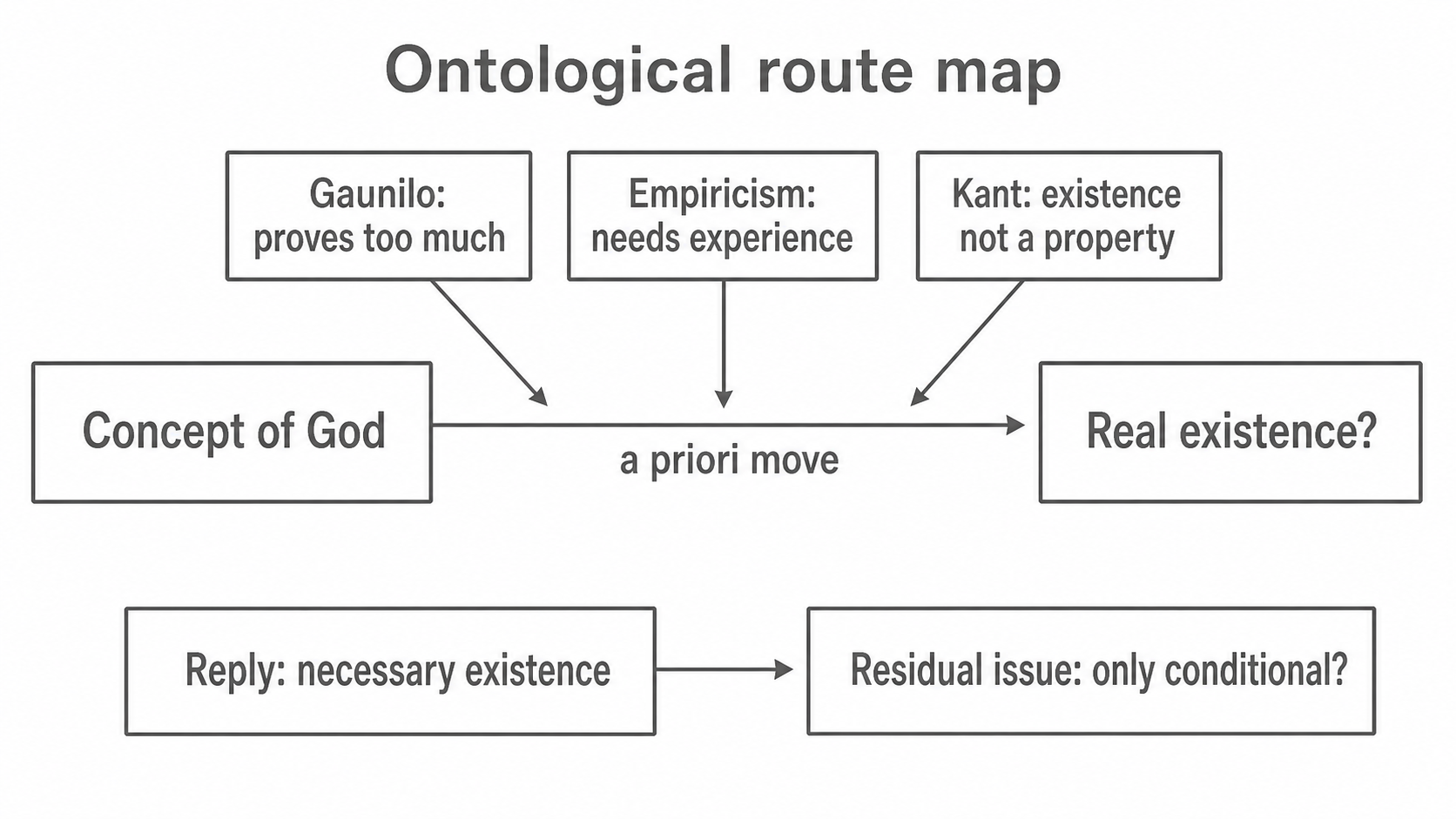
Read the diagram in two passes. First, follow the main arrow from concept to existence and notice where Gaunilo, empiricism and Kant put pressure on it. Then follow the lower arrow: the defender's necessary-existence reply is important, but it still has to answer whether it proves God exists or only says what God would be like if God exists. The table makes those targets precise.
| Objection | Main target | Basic pressure |
|---|---|---|
| Gaunilo's perfect island | The form of Anselm-style reasoning from the greatest conceivable being to existence | If the form works, it seems to prove absurd things too. |
| Empiricist objections | The method of proving existence a priori | Existence claims seem to require experience, not mere conceptual analysis. |
| Kant's predicate objection | The premise that existence is a perfection or real property | Adding existence may not add anything to the concept of a thing. |
In the diagram's terms, the best evaluation does not say simply that the ontological argument is strange. It asks whether each objection hits a premise, an inference, a hidden assumption, or only a simplified version of the argument.
Concept Tools
Four distinctions control the debate.
| Term | Meaning | Why it matters here |
|---|---|---|
| A priori | Justified independently of sense experience. | Ontological arguments claim this kind of support. |
| A posteriori | Justified through sense experience. | Empiricist critics argue that existence claims need this kind of support. |
| Necessary existence | Existence that could not fail to be, rather than merely happening to be. | Malcolm-style and Anselm Proslogion III replies often shift from bare existence to necessary existence. |
Predicate
A property or determination attributed to a subject, such as being wise or being powerful.
The most important distinction is between a logical predicate and a real predicate. A logical predicate is anything that can grammatically be said of a subject. A real predicate adds to the content of the concept. For example, calling something triangular adds a determinate feature to what is being thought. Kant's objection is that exists can function in grammar, but it does not add a new feature to the concept in that way.
There is also a difference between two kinds of a priori result:
| A priori result | Example | What it can show |
|---|---|---|
| Conceptual exclusion | A square circle cannot exist. | The concept is contradictory, so no such thing could exist. |
| Existential proof | God exists. | Something real exists outside the concept. |
The critic's challenge is that the first kind of result is much easier to get than the second. Pure reason may show that some concepts are impossible, but it is much harder to show that a non-contradictory concept must have an instance in reality.
Gaunilo's Perfect Island
Gaunilo responds to Anselm by parody. A parody objection copies the structure of an argument and uses it to generate an obviously unacceptable conclusion. If the copied structure is valid for God, it seems valid for the parody case too. If the parody case is absurd, something must be wrong with the original structure or with a hidden assumption that allows the original but not the parody.
Gaunilo's example is a supremely excellent island. We can understand the idea of an island more excellent than all other lands. If existence in reality makes something greater than existence only in the understanding, then the island would seem greater if it existed. So, by Anselm-style reasoning, the perfect island must exist. But that conclusion looks absurd. You cannot define a perfect island into existence.
Gaunilo's objection reconstructed:
1. P1: Anselm's reasoning says that if we can understand the greatest conceivable F, then F must exist in reality, because existing in reality is greater than existing only in the understanding.
2. P2: We can form the idea of a greatest or most excellent island.
3. P3: If Anselm's reasoning is valid, the greatest island must exist in reality.
4. P4: It is absurd to think that a perfect island exists merely because we can understand the idea of it.
5. Therefore, C: Anselm's reasoning is unreliable, because it proves too much.

Hidden assumption: the same reasoning pattern can be transferred from God to any supposedly greatest conceivable thing.
Inference type: analogical parody and reductio.
Main pressure point: whether God and the island are relevantly similar.
The objection targets the inference from being understood as greatest to existing in reality. It does not merely say that islands are silly. It says that the argument form licenses an unacceptable inference.
The strongest Anselmian reply is that God is not one member of a class of excellent things. God is supposed to be unlimited, unsurpassable and necessarily existent. Islands are finite, contingent and made better or worse by many vague features: size, climate, beauty, resources, inhabitants, location. There may be no coherent maximum island, because adding more palm trees, space, minerals or pleasures could always change the comparison. By contrast, Anselm's defender says the concept of God is the concept of an unsurpassable being, not just a very good example of a type.
This reply has force against a crude island parody. Still, it leaves a residual issue. The defender must explain why the God concept is coherent and uniquely suited to the move from concept to necessary existence. If that special status is merely asserted, Gaunilo's warning remains: do not let a definition do the work of evidence.
Empiricist Objections
Empiricism
The view that substantive knowledge of what exists depends on sense experience.
An empiricist need not deny that there are a priori truths. Mathematics and conceptual truths may be knowable by reason. The objection is narrower: real existence is not normally established by inspecting a concept.
The empiricist pressure on ontological arguments can be reconstructed like this:
1. P1: A priori reasoning can reveal relations between ideas or concepts.
2. P2: Existence claims concern what is actually the case, not just how ideas are related.
3. P3: Claims about what actually exists require experience or evidence connected to experience.
4. P4: Ontological arguments try to prove God's existence from a concept alone.
5. Therefore, C: Ontological arguments use the wrong method for an existence claim.

Hidden assumption: no positive existential claim can be established purely by conceptual analysis.
Inference type: epistemological and methodological objection.
Main pressure point: whether God, as a necessary being, is an exception to the ordinary rule about existence claims.
Hume gives this kind of pressure a distinctive shape. In the Enquiry, he repeatedly restricts reasoning about matters of fact to experience. In Section XI, the theological application is cautious: if someone infers a divine cause from the world, the cause must not be given extra attributes beyond what the observed effect can justify. That is aimed more directly at natural theology than at Anselm's argument, but it supports the same empiricist instinct: do not let reason outrun the evidence when making claims about reality.
Applied to ontological arguments, the objection says:
Continue this lesson.
You’re previewing NovaLearn without an account. Create a free account to read the rest.
Create free account