3.2.1 - Kantian ethics - good will, duty and imperatives
Two people can do the same outwardly right thing for very different reasons, and Kant thinks that difference matters to moral worth. You will connect good will, duty and the two kinds of imperative to the meanings of good, bad, right and wrong in Kantian ethics. The detailed first and second formulations of the categorical imperative are left for the next lesson.
Why Motive Matters
Imagine two people return a lost wallet.
| Person | Outward action | Main motive |
|---|---|---|
| Alex | Returns the wallet | Wants praise and worries about being seen on CCTV. |
| Sam | Returns the wallet | Thinks it would be wrong to keep what belongs to someone else. |
The outward action is the same. The question is whether the two actions have the same moral value.
Kantian ethics begins from this pressure. A theory that looks only at consequences can say the same wallet was returned, so the result is equally good. Kant thinks that misses something central. Morality is not just about producing a desirable state of affairs. It is about the principle on which a rational agent chooses to act.
Deontological ethics
A theory that judges morality in terms of duty and moral law rather than by the consequences an action produces.
In Kantian ethics, the basic question is not "Which action produces the most happiness?" but "What does duty require of a rational will?" A will is the rational capacity to choose an action on a principle. A motive is the reason from which the agent acts.
This creates an important distinction:
| Question | Kantian focus |
|---|---|
| Did the action outwardly match duty? | Rightness or conformity to duty. |
| Was the action chosen because duty required it? | Moral worth or goodness of will. |
The lesson is about that second layer. Kant is not merely asking which actions happen to be useful or socially approved. He is asking what makes an action morally worthy.
The opening problem can be reconstructed like this:
1. P1: The same outward action can be performed from different motives.
2. P2: If moral worth depended only on outward action or result, self-interest and duty could look morally identical.
3. P3: Kant thinks morality must express a rational commitment to moral law, not merely lucky alignment with it.
4. Therefore, C: We must examine the agent's will and motive, not only the action's consequences.

Hidden assumption: Moral worth belongs to the principle from which an agent acts.
Inference type: Conceptual and practical reasoning.
Main pressure point: Whether motive should matter as much as Kant thinks it does.
Good Will
Kant's central claim is that a good will is the only thing that is good without qualification.
Good will
A will that chooses as morality requires because morality requires it: for Kant, the only thing good without qualification.
Something is good without qualification if it remains good in every context and does not become bad when combined with other features.
Many things that people normally call good are only conditionally good.
| Apparently good thing | Why it is only conditionally good |
|---|---|
| Intelligence | A clever person can use intelligence to deceive. |
| Courage | A courageous person can use courage for cruelty. |
| Wealth or power | These can be used justly or unjustly. |
| Happiness | A vicious person being happy does not seem morally admirable. |
Kant's point is not that intelligence, courage, wealth or happiness are worthless. It is that their value depends on how they are used. A good will is different: it is the will that chooses as morality requires, because morality requires it.
A good will is not a vague warm feeling, a kind temperament, or a mere wish to be nice. It is a rational disposition to act on the moral law. If a person tries to do what duty requires but fails because of circumstances outside their control, the result may be unfortunate, but the good will has not lost its moral value.
Kant's argument can be reconstructed like this:
Claim at issue: A good will is the only thing good without qualification.

1. P1: Talents, temperaments, fortune and happiness can be used well or badly.
2. P2: Anything whose value depends on how it is used is not good without qualification.
3. P3: A good will is the rational commitment to choose as morality requires.
4. P4: The value of such a will does not depend on whether the action successfully produces a desired outcome.
5. Therefore, C: A good will is good without qualification in a way that talents, outcomes and happiness are not.

Hidden assumption: The moral value of a rational agent lies primarily in the principle of willing, not in external success.
Inference type: Conceptual argument about moral value.
Main pressure point: Whether Kant is right to separate moral value so sharply from outcomes and feelings.
This is why Kantian ethics is not a pleasure-maximising theory. Pleasure, happiness and desirable consequences may matter in ordinary life, but they are not the source of unconditional moral goodness. For Kant, moral goodness is grounded in the good will.
Duty And Moral Worth
Duty
What the moral law requires of a rational agent.
Human beings experience morality as duty because we are not perfectly rational. We have inclinations, desires and self-interested motives that can pull against what reason requires.
Kant uses duty to make the good will visible. If a person had no desires that could ever conflict with morality, duty would not feel like a command. But human beings do experience the moral law as an "ought": it tells us what we must do even when we would rather do something else.
AQA requires the distinction between acting in accordance with duty and acting out of duty. Many translations and textbooks also say "acting from duty"; in this lesson, "out of duty" and "from duty" mean the same thing.
| Type of action | Meaning | Example | Kantian judgement |
|---|---|---|---|
| Contrary to duty | The action violates what duty requires. | Keeping the lost wallet. | Wrong. |
| In accordance with duty from self-interest | The action matches duty, but the motive is advantage. | Returning the wallet only to gain praise. | Right outward action, but no moral worth. |
| In accordance with duty from inclination | The action matches duty, but the motive is natural feeling. | Helping someone only because you enjoy helping them. | Amiable or praiseworthy in an ordinary sense, but not the pure case of moral worth. |
| Out of duty | The action is done because duty requires it. | Returning the wallet because keeping it would be wrong. | Has moral worth. |
This distinction is easy to blur. Acting in accordance with duty concerns what the action looks like from the outside. Acting out of duty concerns the principle from which the person acts.
The honest shopkeeper example makes the point. A shopkeeper who gives fair prices only to protect their reputation acts in accordance with duty. Customers are treated fairly, so the outward action is right. But the shopkeeper's motive is profit, not duty. By contrast, a shopkeeper who gives fair prices because cheating is wrong acts out of duty.
Because the same outward action can fall into different Kantian categories, it helps to read the distinction as a two-stage route. First ask whether the action conforms to duty. Only if it does should you ask what motive governs it.
[DIAGRAM: asset_name: 3.2.1 - Kantian ethics - good will, duty and imperatives - diagram 1; asset_slug: mor03_kantian_ethics_good_will_duty_and_imperatives__diagram_01; recommended_method: retained_png; description: Kantian route from duty conformity to moral worth]
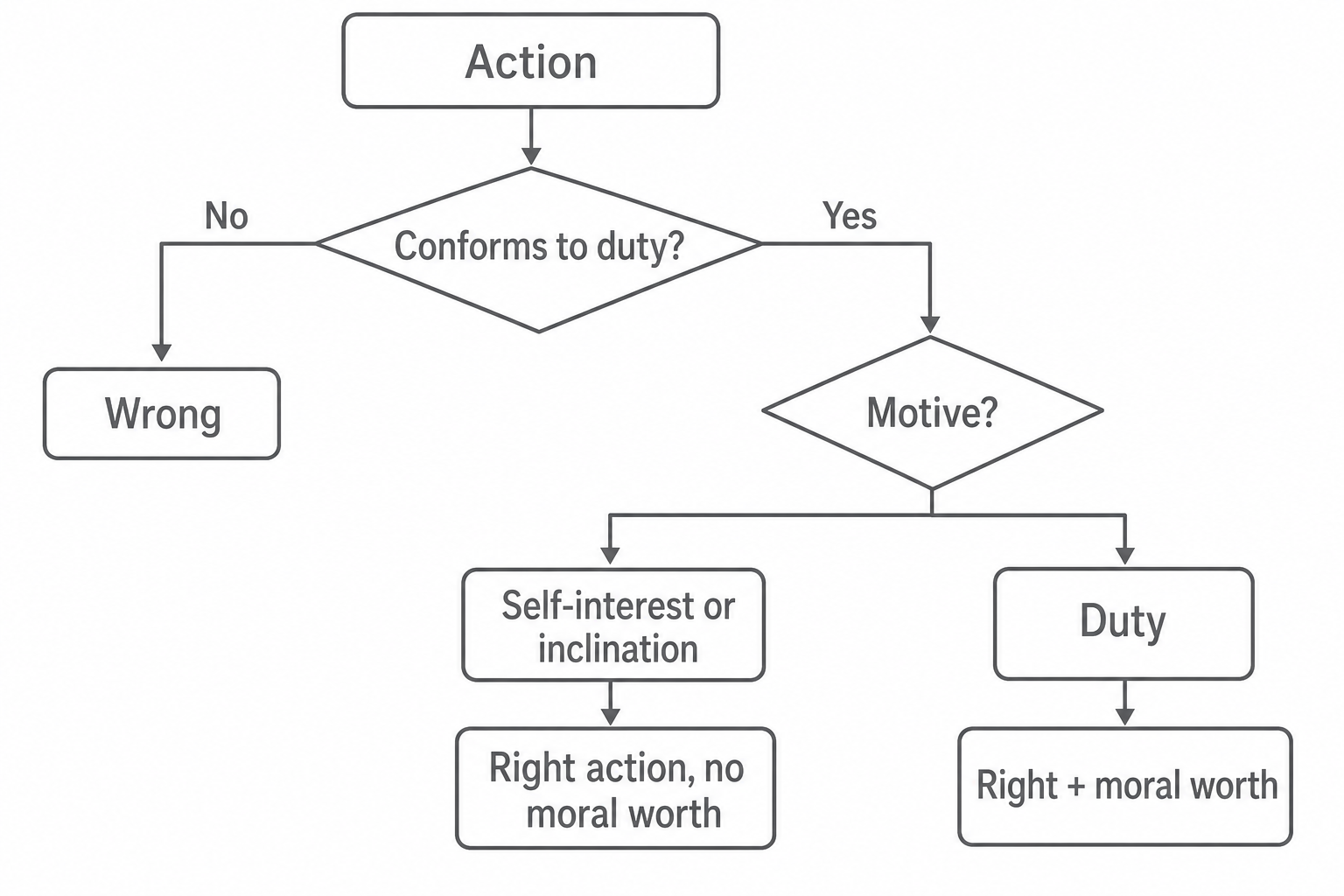
Read the route from top to bottom. If the action fails to conform to duty, it is wrong. If it conforms to duty, the outward action is right; but its moral worth depends on whether the motive is duty rather than self-interest or inclination.
Kant is not saying that kindness, sympathy or love are bad. The sharper claim is that these feelings do not by themselves give an action moral worth. Feelings may support duty, but for Kant they are not the final moral ground because they can vary from person to person and situation to situation.
The practical result is a two-level assessment:
Right action: Does the action conform to duty?
Morally worthy action: Is the action done because duty requires it?
An action can be right without having moral worth. It can match duty while being motivated by self-interest, fear, reputation or inclination.
Continue this lesson.
You’re previewing NovaLearn without an account. Create a free account to read the rest.
Create free account