4.2.2 - The divisions of the nervous system
The nervous system carries information from the body to the brain and spinal cord, then carries commands back to muscles and organs. Learn how its central, peripheral, somatic and autonomic divisions work together, and why an automatic movement is not necessarily an autonomic response.
The nervous system as a map
A nervous-system diagram is a hierarchy: a smaller division belongs inside a larger one. The central nervous system (CNS) and peripheral nervous system (PNS) are the two main divisions. The somatic and autonomic systems are subdivisions of the PNS, rather than extra divisions alongside it.
Nervous system
The body's rapid communication network, using specialised nerve cells to transmit information and coordinate responses.
The CNS consists of the brain and spinal cord. The PNS consists of nerves outside them, linking the CNS with the body. Within the PNS, somatic pathways carry body-sensory information and control skeletal muscles, while autonomic pathways regulate internal organs and glands.
[DIAGRAM: asset_name: Divisions of the nervous system hierarchy; asset_slug: 4_2_2_01_the_divisions_of_the_nervous_system__diagram_01; recommended_method: image_gen; description: Hierarchy showing CNS and PNS, brain and spinal cord, and somatic and autonomic subdivisions.]
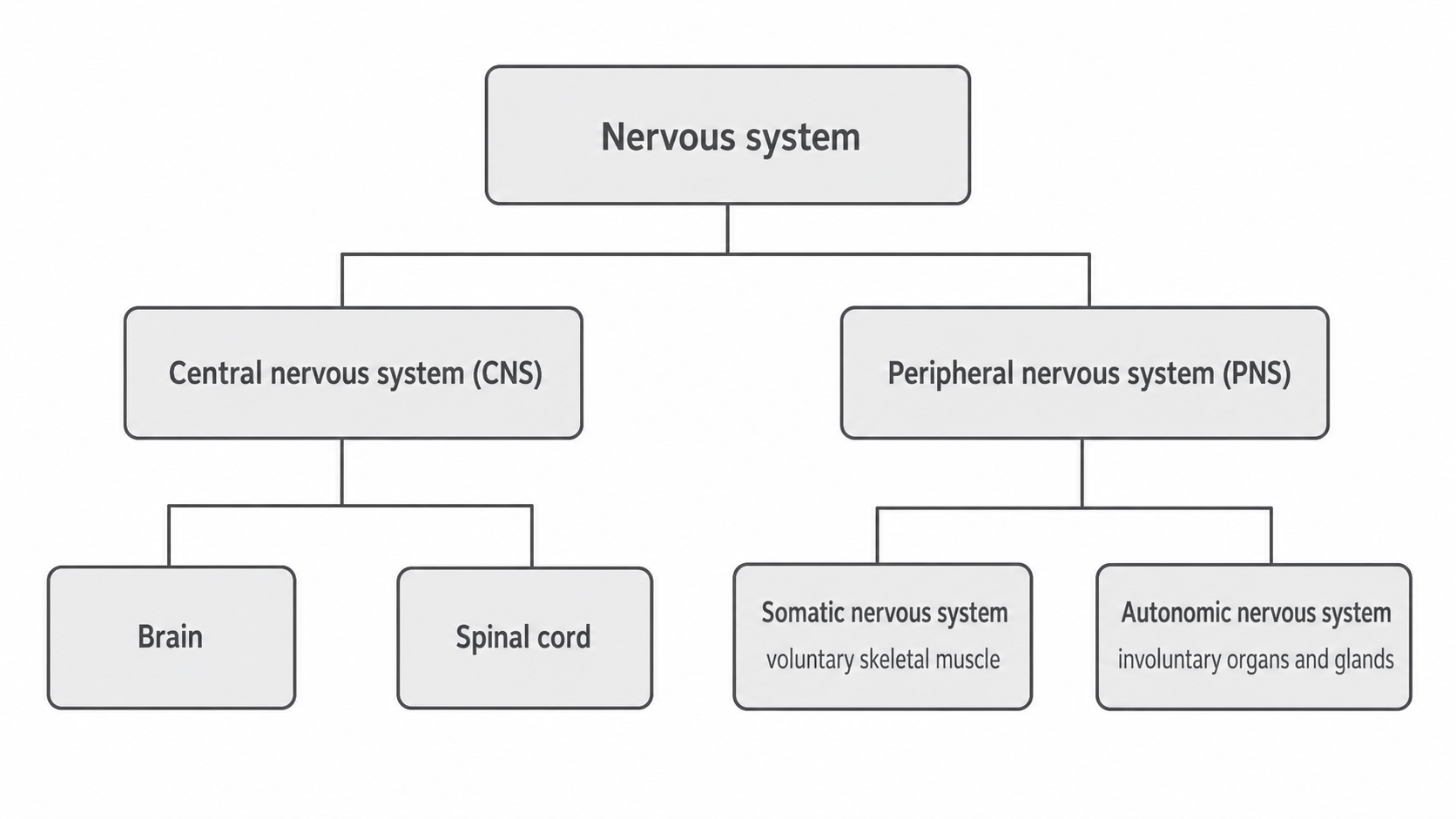
Read each connecting line as “is part of”, not as the direction a message must travel. The diagram highlights somatic movement; somatic pathways also carry sensory information and participate in reflexes. The autonomic system divides further into sympathetic and parasympathetic branches, explained below.
For example, the spinal cord belongs to the CNS. A nerve carrying a command from the spinal cord to a hand muscle belongs to the PNS and its somatic division. These labels answer different questions: where the structure sits in the hierarchy and what it does.
Central nervous system
The brain and spinal cord process information and coordinate responses, including rapid protective reflexes.
The brain interprets incoming information and supports memory, decisions, emotion and the coordination of behaviour. When you hear your name and choose to turn towards the speaker, brain processing connects the sound with a meaningful response.
The spinal cord carries information between the brain and body and coordinates some reflexes. A reflex is a rapid, automatic response to a stimulus. The spinal cord is therefore more than a passive cable: neurons within it can connect incoming sensory information to an outgoing movement command.
Consider touching a dangerously hot surface. Sensory information reaches the spinal cord, which can coordinate withdrawal before a conscious decision to move. Information also travels towards the brain, allowing conscious awareness of pain. The brain and spinal cord have different roles in this event, but both belong to the CNS.
This explains why “central” does not mean “consciously chosen”. Some CNS processing supports deliberate decisions and some supports automatic protection. The messages entering and leaving the spinal cord still require peripheral nerves.
Peripheral and somatic systems
Peripheral nerves carry messages between the CNS and receptors, muscles, organs and glands elsewhere in the body.
Peripheral nervous system
The nerves outside the brain and spinal cord that link the CNS with the rest of the body.
Sensory input travels towards the CNS. Motor output travels away from it towards an effector, a muscle or gland that produces a response. Remember the direction relative to the CNS: “incoming” does not mean towards whichever muscle is about to move.
Somatic nervous system
The PNS subdivision carrying body-sensory information and controlling skeletal muscles, including voluntary movement and somatic reflexes.
A skeletal muscle moves part of the skeleton, such as a hand or leg. Choosing to type uses somatic motor pathways; feeling pressure on a fingertip uses somatic sensory pathways. The somatic system therefore does more than send movement commands.
Worked pathway: catching a dropped book
Pressure receptors signal contact with the book through peripheral sensory nerves to the CNS. Processing in the CNS coordinates the response. Commands then travel through somatic motor nerves to the hand muscles, which contract to grip it. The receptor, processing and muscle action are different stages, rather than three names for the same event.
Somatic motor pathways can also carry a reflex command. What identifies them is their connection to skeletal muscles, rather than whether the person chose the movement consciously.
Autonomic nervous system
Autonomic pathways adjust internal organs and glands as the body's needs change, usually without direct conscious control.
Autonomic nervous system
The PNS subdivision regulating internal organs and glands, including cardiac muscle, smooth muscle and gland activity.
Examples include heart rate, pupil size, sweating and digestion. The heart contains cardiac muscle, so a faster heartbeat is not classified as somatic simply because it involves muscle. The type of target matters: somatic motor control acts on skeletal muscles.
The sympathetic branch helps mobilise the body for action, increasing cardiac activity and reducing digestive activity during arousal. The parasympathetic branch supports rest and recovery, for example slowing the heart and promoting digestion. They often have opposing effects, but this is ongoing regulation rather than a switch between a completely active and completely inactive body.
Before an interview, a person may notice a pounding heart and dry mouth. These are autonomic changes affecting an internal organ and glands. Choosing to pick up a glass of water instead uses somatic skeletal-muscle control. Both systems can be active during the same situation.
Psychological appraisal can influence this regulation. A situation interpreted as threatening can trigger autonomic arousal even when there is no immediate physical danger. “Involuntary” describes the regulation, not an absence of psychological influences.
Coordination across nervous-system divisions
Classifying a whole event under one label can hide the communication that makes the response possible.
| Division | Structures or targets | Contribution |
|---|---|---|
| CNS | Brain and spinal cord | Processing, coordination and relay |
| PNS | Nerves outside the CNS | Messages between CNS and body |
| Somatic PNS | Body-sensory pathways and skeletal muscles | Sensory input and voluntary or reflex movement |
| Autonomic PNS | Internal organs and glands | Internal regulation through sympathetic and parasympathetic activity |
Worked distinction: automatic or autonomic?
A cyclist brakes suddenly when a pedestrian steps out. Sensory input and CNS processing support recognition of the hazard. Somatic motor commands contract the hand muscles to operate the brakes. The cyclist's increased heart rate uses autonomic regulation. These are connected contributions, rather than competing explanations.
Now replace braking with pulling a hand away from a hot surface. Withdrawal is automatic, but it still uses skeletal muscles and somatic pathways. The spinal cord can coordinate that reflex before conscious choice. A simultaneous heart-rate rise is autonomic. Automatic describes how a response is initiated; autonomic identifies a division and its targets.
To analyse a new example, trace the input towards the CNS, identify any processing described, then follow the output to its target. “The nervous system responds” is a starting point; explaining the route shows how its divisions cooperate.
Quick recap
The CNS is the brain and spinal cord; peripheral nerves connect it to the body. Somatic pathways carry body-sensory input and control skeletal muscles, including reflex movements. Autonomic pathways regulate internal organs and glands through sympathetic and parasympathetic activity. A single event commonly involves several divisions working together.