4.3.1 - Product life cycle and portfolio
Sales patterns and a business's range of products can help managers decide where to invest. Learn the phases of the product life cycle, ways to extend a product's sales, and how the Boston matrix supports product portfolio decisions. All business examples and diagrams are illustrative.
Product life cycle phases
The product life cycle describes how a product's sales may change from development through to decline.
Product life cycle
The product life cycle is a model of a product's development and sales over time, commonly shown as development, introduction, growth, maturity and decline.
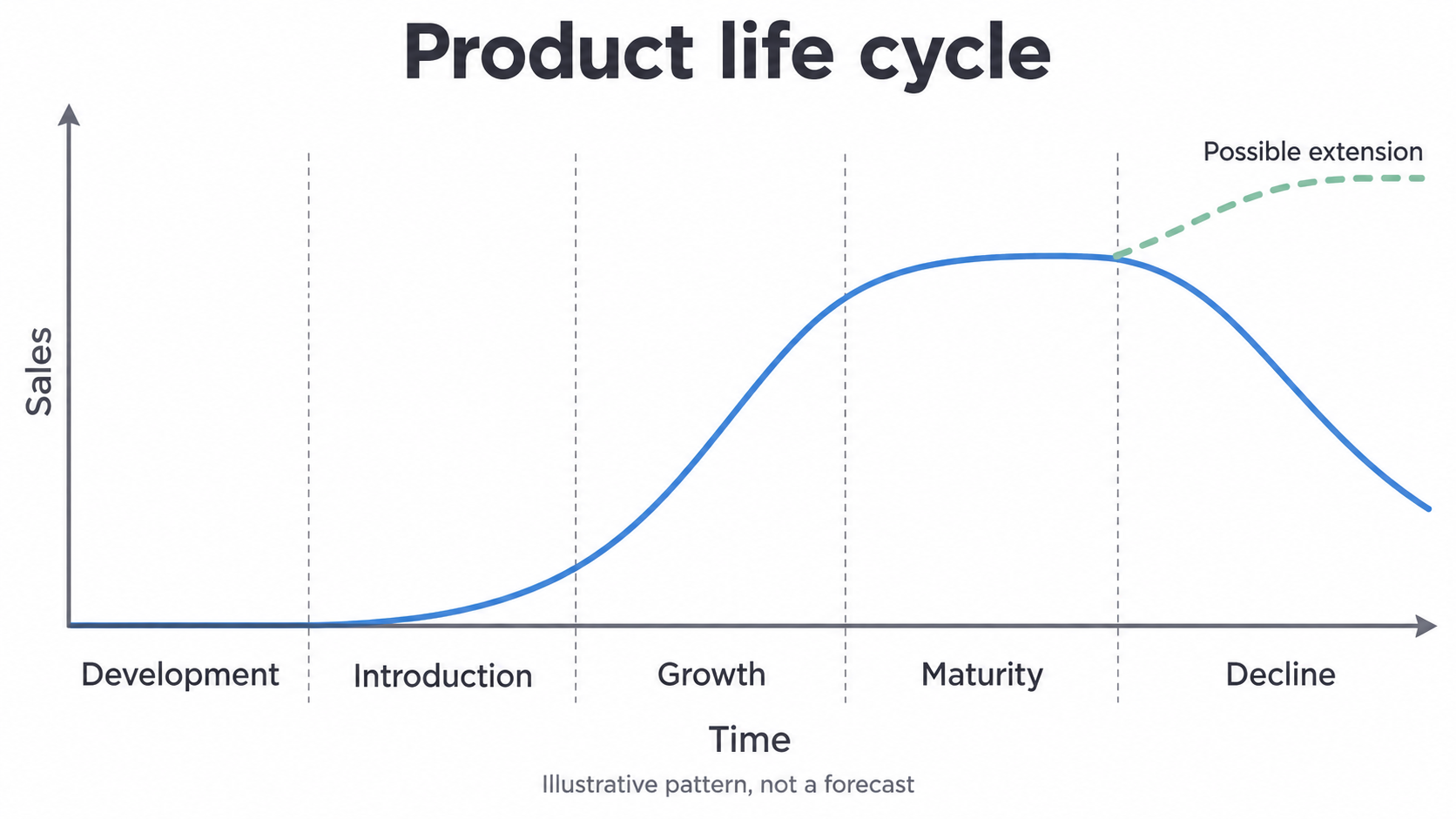
The vertical axis shows sales and the horizontal axis shows time. The dashed extension is a possible outcome of action, not an inevitable second rise.
Read the axes before interpreting the line. Its height shows the level of sales; its slope shows whether sales are rising or falling. A steep upward line means rapid sales growth, not necessarily the highest sales. The broad plateau is high sales with little growth. This diagram has no numerical scale, so it cannot show an exact revenue, profit or number of years.
| Phase | Sales and business activity | A possible business consequence |
|---|---|---|
| Development | The business designs and tests the product before sales begin. | Development spending creates a cash outflow without sales receipts from the product. |
| Introduction | The product is launched; initial sales are usually low as customers become aware of it. | Promotion and distribution are needed, while low sales may make it hard to recover launch costs. |
| Growth | Sales rise rapidly as more customers buy the product. | The business may need more capacity and inventory, and rivals may enter the attractive market. |
| Maturity | Sales are high but growth slows or levels out as much of the market is served. | Competition for existing customers can increase, encouraging differentiation and cost control. |
| Decline | Sales fall as demand moves to alternatives or customer tastes change. | Excess inventory and capacity may develop; the business considers extension or withdrawal. |
An illustrative large electronics business might experience rapid growth after a successful new device launch, but a small bakery's traditional bread could remain popular for many years. Products do not all spend the same length of time in each phase. Some fail shortly after introduction; others remain mature for a long time. The curve is a planning aid, not a timetable that makes decline unavoidable at a fixed age.
Sales are not profit. High sales can coexist with high production and promotion costs. Managers need cost, revenue and cash information before deciding whether a mature product is financially successful.
Extending a product's life
An extension strategy aims to maintain or increase demand for an existing product and delay its decline.
Extension strategy
An extension strategy is action taken to prolong a product's sales life, for example by modifying it or finding new customers or uses.
A business can improve features, introduce a variation, change packaging or reposition its product. An illustrative Tunisian fruit drink producer could introduce a lower-sugar version to meet changing customer preferences. The change may attract customers who rejected the original, but research, testing and production changes cost money. A new package can refresh presentation yet have little effect if customers dislike the drink itself.
The business can also find a new market or use. A large outdoor-clothing business could promote an established waterproof jacket to commuters rather than only hikers, or enter another country where demand is growing. This may increase sales using an existing product, although different customers, climates, competitors and distribution requirements can create extra costs. A new market is not automatically profitable simply because the home market has slowed.
Changing promotion or reducing price can encourage additional purchases. A small café might offer its mature lunch range in a meal deal. This could attract price-sensitive customers, but lower revenue per meal may outweigh any extra sales. A price cut is therefore a possible extension action, not proof of a successful extension.
Managers should act on evidence of changing demand and compare the likely extra contribution with the cost and risk of the strategy. If customers have moved permanently to a superior alternative, investing in a replacement may be better than trying to rescue the old product. The life-cycle diagram's dashed curve shows what a successful extension might achieve; the original downward curve remains a possible outcome.
Continue this lesson.
You’re previewing NovaLearn without an account. Create a free account to read the rest.
Create free account