1.8.1 - Measuring business success
Success depends on what a business is trying to achieve. This lesson uses financial results, market share, growth and stakeholder satisfaction to measure performance, calculate meaningful changes and recognise why one favourable measure cannot settle the whole judgement.
Revenue, profit and objectives
Revenue and profit measure different aspects of performance, and each must be compared with the business's objectives.
Revenue and profit
Revenue is income from sales over a period. Profit is the amount remaining after the relevant business costs are deducted from revenue over that period.
Higher revenue can show stronger sales, but it can result from a price rise rather than more goods sold. It also says nothing by itself about the cost of achieving those sales. Profit helps show whether revenue exceeds costs and whether the business produces a return for owners. Neither measure alone proves that bills can be paid on time: cash receipts and payments may occur at different dates.
Illustrative annual business data: Riva Bikes
| Measure | Year 1 | Year 2 |
|---|---|---|
| Revenue | USD 80,000 | USD 100,000 |
| Total relevant costs | USD 68,000 | USD 93,000 |
| Profit | USD 12,000 | USD 7,000 |
Year 2 revenue is greater, but profit is lower because costs increased by more than revenue. If the owner's objective was higher annual profit, the results do not demonstrate success on that measure. If the business was deliberately investing in a larger operation, a temporary profit fall might be acceptable, but future benefits would need evidence.
Compare the same time period, currency and definition of profit. A large firm's absolute profit is not automatically evidence of better performance than a small firm's; size and resources differ. Targets, earlier performance and suitable competitors provide useful benchmarks. A social enterprise may also judge success by meeting its social objective rather than maximising profit.
Market share and market growth
Market share measures a business's sales relative to total sales in the same defined market.
Use sales measured on the same basis, over the same period and in the same market: units with units, or sales value with sales value.
Illustrative annual market data: bicycle unit sales in one town
| Measure | Year 1 | Year 2 |
|---|---|---|
| Riva Bikes unit sales | 300 bicycles | 420 bicycles |
| Total town market unit sales, including Riva | 2,000 bicycles | 3,000 bicycles |
Year 1 market share is . Year 2 market share is . Riva sold more bicycles but captured a smaller proportion of the market, because total market sales grew faster than its sales. Market share can therefore reveal relative competitive performance that a sales figure alone hides.
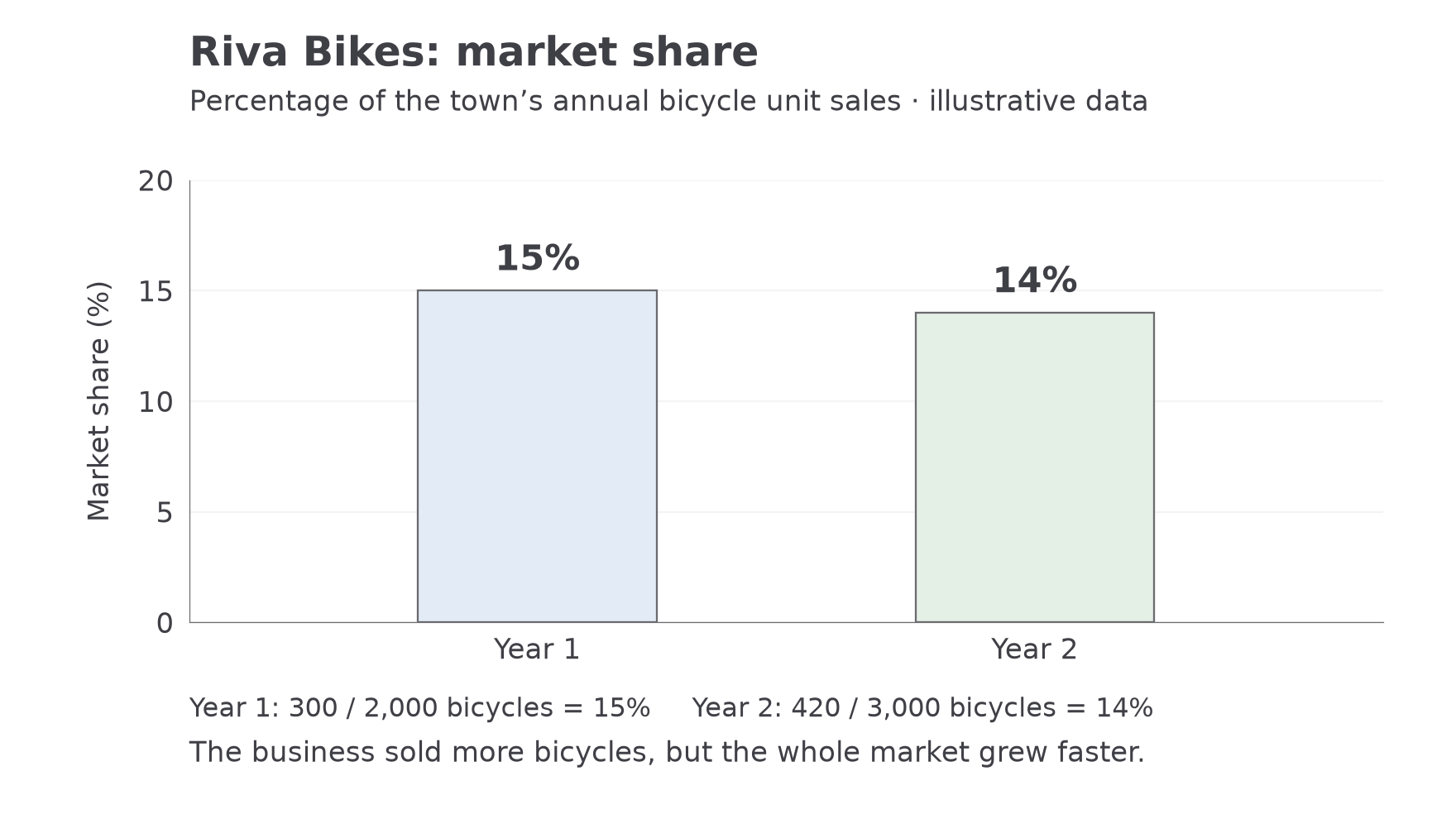
The vertical axis measures percentage of the town's bicycle unit sales, not the number of bicycles or revenue. All values are illustrative.
The fall from 15% to 14% is 1 percentage point. It is not a 1% relative fall: relative to the original share, the percentage change is . Percentage points subtract two percentages; percentage change compares the difference with the starting value.
A high or rising share may indicate customer appeal or competitive strength, but it does not establish profitability. A firm might gain share by selling at a loss. A fall may also reflect an expanding market rather than falling business sales, as the data show. Define the market carefully: national bicycle sales and one town's bicycle sales are different denominators.
Growth and percentage changes
Growth means an increase in the scale of the business, but the measure of scale must be stated.
Sales, output, employee numbers or the number of branches can show growth. Each answers a different question. More employees might support future expansion, but it can also reflect less efficient working. Opening branches adds capacity, yet branches that attract too few customers may weaken profit. Growth is therefore a measure to compare with objectives and other evidence, not a guarantee of success.
Continue this lesson.
You’re previewing NovaLearn without an account. Create a free account to read the rest.
Create free account