2.5.1 - Organisational structures
Learn how organisational charts show reporting relationships and how different structures affect communication, supervision and decisions. Distinguish the number of management levels from the location of decision-making authority.
Reading reporting relationships
An organisational chart shows positions and the formal reporting relationships between them.
Organisational structure
The arrangement of roles, responsibilities and reporting relationships within a business.
Positions higher on a chart normally have authority over those reporting to them. A line from a worker's position to a manager's position shows that the worker reports to that manager. Positions side by side may be at the same level without having authority over one another. The chart shows formal relationships, not every informal conversation or friendship.
A hierarchy is the arrangement of positions into levels of authority. A chain of command is the route through these levels by which instructions and reporting pass. A manager's span of control is the number of people who report directly to that manager. It is not the total number of workers below them at every level.
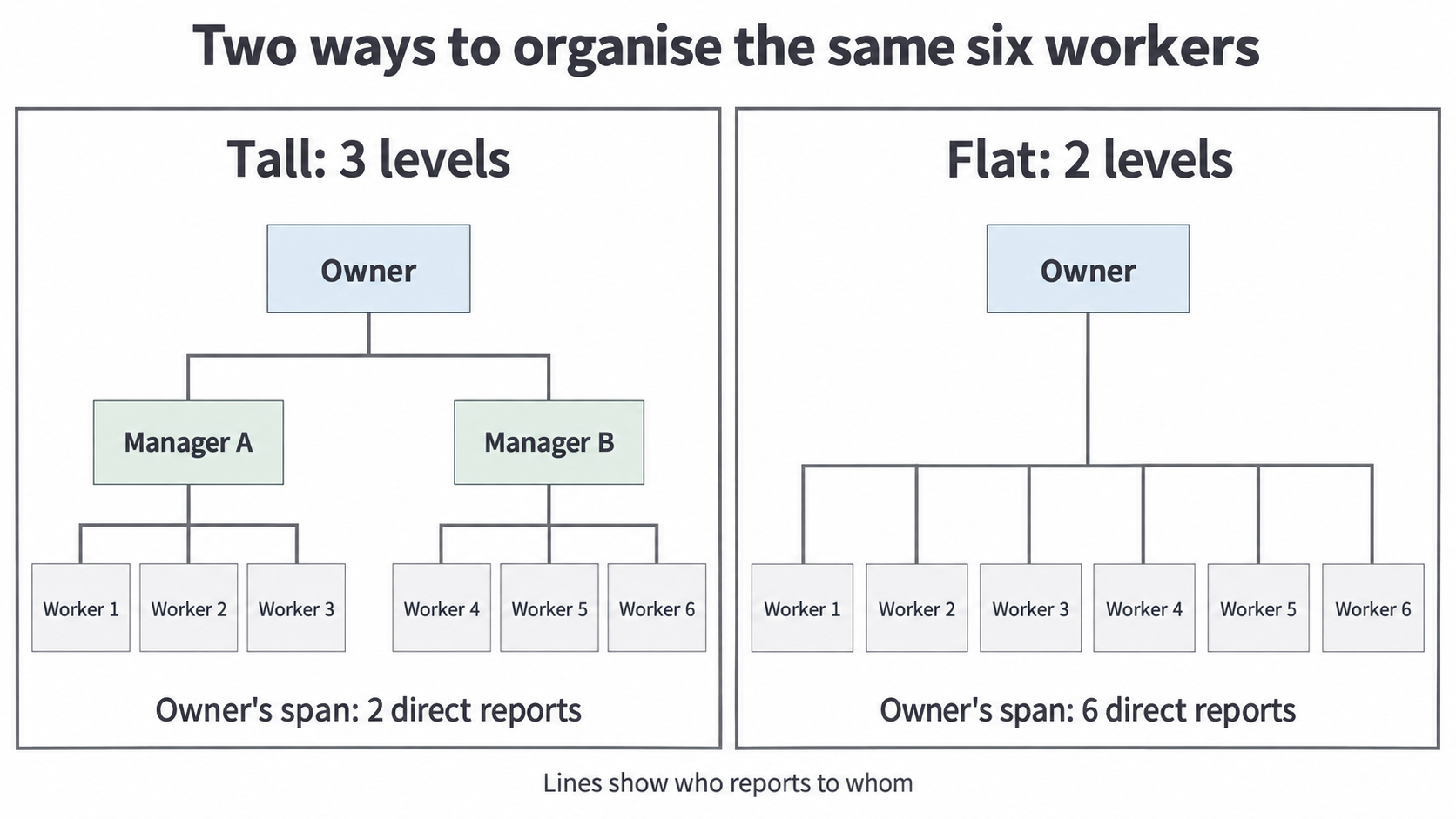
Illustrative comparison: both businesses employ six workers. On the left the owner has two direct reports and each manager has three. On the right all six workers report directly to the owner. The additional managers on the left create a third level.
For Worker 1 on the left, the formal chain runs from owner to Manager A to Worker 1. The owner oversees the business as a whole, but their span is two, because the six workers report directly to the managers. The right-hand owner's span is six. A chart does not tell us which decisions have been delegated: the same reporting lines could support different degrees of freedom.
Hierarchical and flat structures
A tall hierarchical structure has more levels of authority, while a flat structure has relatively few levels.
The comparison is relative to the size and work of the business. Flat businesses still have a hierarchy; they have fewer layers. For a similar workforce size, a flatter structure generally requires wider spans of control, while a tall structure can divide workers among more managers with narrower spans.
| Structure | Possible benefit | Possible limitation |
|---|---|---|
| Tall/hierarchical | Narrower spans can allow closer supervision; levels clarify reporting and create promotion opportunities. | Instructions pass through more layers, potentially slowing decisions or distorting messages; extra managers cost money. |
| Flat | Fewer layers can shorten communication and reduce management costs; employees may have more direct access to senior staff. | Wider spans can overload managers or reduce individual support; fewer higher positions limit promotion opportunities. |
Continue this lesson.
You’re previewing NovaLearn without an account. Create a free account to read the rest.
Create free account