2.1.4-2.1.5 - Binary arithmetic, shifts and overflow
A row of bits can perform arithmetic, but its fixed width sets a hard limit. In 2.1.4, you will add positive binary patterns and apply logical and arithmetic shifts with the correct fill rule. In 2.1.5, you will recognise and explain when the exact result cannot fit in the available bits.
Adding positive binary patterns
Binary addition works from right to left, just like column addition in denary. First make the two patterns the same width and align their least significant bits on the right. Each column produces a sum bit to write in that column and may produce a carry bit for the next column to the left.
| Bits being added in one column | Bit to write | Carry to the left |
|---|---|---|
0 + 0 | 0 | 0 |
0 + 1 or 1 + 0 | 1 | 0 |
1 + 1 | 0 | 1 |
1 + 1 + carried 1 | 1 | 1 |
The result 10 for 1 + 1 means "write 0 here and carry 1". It does not mean writing a digit 2, because binary has only the digits 0 and 1.
Worked example: add two positive 8-bit patterns
Add 0010 1101 and 0001 0111.
Starting at bit 0, the rightmost bit:
| Bit position | Calculation, including incoming carry | Write | Carry left |
|---|---|---|---|
| 0 | 1 + 1 = 10 | 0 | 1 |
| 1 | 0 + 1 + 1 = 10 | 0 | 1 |
| 2 | 1 + 1 + 1 = 11 | 1 | 1 |
| 3 | 1 + 0 + 1 = 10 | 0 | 1 |
| 4 | 0 + 1 + 1 = 10 | 0 | 1 |
| 5 | 1 + 0 + 1 = 10 | 0 | 1 |
| 6 | 0 + 0 + 1 = 1 | 1 | 0 |
| 7 | 0 + 0 = 0 | 0 | 0 |
Read the written bits from bit 7 to bit 0:
  0010 1101
+ 0001 0111
-----------
  0100 0100
As a check, the supplied values are 45 + 23 = 68, and 0100 0100 represents 68.
A carry moves one column to the left. Keep carrying until every column has been processed, including the leftmost column.
Use the same column method on this nearby pair.
Overflow and available bits
Overflow
Overflow occurs when the exact result cannot be represented using the available number of bits with the stated signedness.
Bit width is part of the question, not a formatting choice. An 8-bit register has room for exactly eight stored bits. A carry between columns is normal; it becomes evidence of unsigned overflow only when it leaves an extra bit beyond the register's left edge.
Worked example: a ninth bit appears
Treat both patterns as positive unsigned 8-bit values:
  1110 0100
+ 0011 1001
-----------
1 0001 1101
The exact sum is the 9-bit pattern 1 0001 1101. Only eight bits are available, so the register can retain only 0001 1101; that stored pattern does not represent the exact sum. Overflow has occurred because the result needs nine bits.
Signedness matters too. Suppose two positive 8-bit two's-complement patterns are added:
  0100 0000   (+64)
+ 0100 0000   (+64)
-----------
  1000 0000
There is no ninth carry bit, but the exact positive result is +128. It would need the 9-bit signed pattern 0 1000 0000; the 8-bit pattern 1000 0000 has an MSB of 1 and is not positive in two's complement. This is still overflow. Therefore, "a carry happened" is not a complete definition: always use the stated width and signedness.
Overflow does not automatically mean a program crashes. A particular system might retain a wrapped bit pattern, raise a flag or handle the condition in another way. The defining fact is that the exact value cannot be represented in the available bits.
Internal carries are part of binary addition. Overflow is about whether the complete exact result fits the stated representation.
Now separate the full result from the bits that the register can retain.
Logical binary shifts
A binary shift moves every bit in a fixed-width pattern left or right by a stated number of positions. Bits that move beyond an end are discarded; they do not wrap around to the other end.
Logical shift
A logical shift fills every vacated position with 0, whether the shift is to the left or to the right.
For an 8-bit unsigned pattern:
- a logical shift left by
nmoves the bitsnplaces left, discards bits leaving the left edge and insertsnzeroes on the right; - a logical shift right by
nmoves the bitsnplaces right, discards bits leaving the right edge and insertsnzeroes on the left.
Worked example: shift 0010 1101
| Operation | Movement | 8-bit result | Unsigned numerical check |
|---|---|---|---|
| Logical left by 2 | 00 101101 becomes 101101 00 | 1011 0100 | 45 x 4 = 180; the exact result fits |
| Logical right by 2 | insert 00; discard rightmost 01 | 0000 1011 | 45 whole-divided by 4 = 11 |
Each shift by one position corresponds to a factor of 2. Therefore, a left shift by n corresponds to multiplication by 2^n only when the exact result fits the available bits. A logical right shift of an unsigned value gives the whole-number result of division by 2^n because any bits leaving the right edge are discarded.
Logical means zero fill. Direction tells you which end receives the zeroes and which end loses bits.
Keep both results at exactly eight bits in the following check.
Arithmetic binary shifts
Arithmetic shifts are used with signed two's-complement patterns. The bit width stays fixed, but the fill rule for a right shift changes so that the sign is preserved.
Arithmetic right shift
An arithmetic right shift moves every bit to the right and fills each vacated position on the left with a copy of the original MSB, the sign bit. This is called sign extension.
If the original MSB is 0, an arithmetic right shift inserts 0s. If the original MSB is 1, it inserts 1s. It does not "always add ones".
Worked examples: arithmetic right
The signed values are supplied so that the operation, rather than conversion, stays in focus.
0011 0100  (+52)
  right 1 -> 0001 1010
  right 2 -> 0000 1101  (+13)
The original sign bit is 0, so zeroes enter on the left.
1101 0000  (-48)
  right 1 -> 1110 1000
  right 2 -> 1111 0100  (-12)
The original sign bit is 1, so ones enter on the left. Every existing bit still moves; the sign bit is not held apart in a fixed box.
Arithmetic left
An arithmetic left shift uses the same bit movement as a logical left shift: bits move left, bits leaving the left edge are discarded, and 0s enter on the right. The difference is interpretation. The pattern represents a signed value, so the exact doubled value must still fit the signed bit width.
For example, signed 8-bit 1110 0110 represents -26:
1110 0110  (-26)
  left 1 -> 1100 1100  (-52)
The exact result fits, so this arithmetic left shift is valid without overflow.
[DIAGRAM: asset_name: Logical and arithmetic right shifts; asset_slug: 2_1_4_2_1_5_binary_arithmetic_shifts_and_overflow__diagram_01; recommended_method: image_gen; description: Monochrome three-row comparison of the 8-bit pattern 10110010, showing logical right shift by 2 as 00101100 with zero fill and arithmetic right shift by 2 as 11101100 with copies of the original MSB; in both cases the rightmost bits 10 are discarded.]
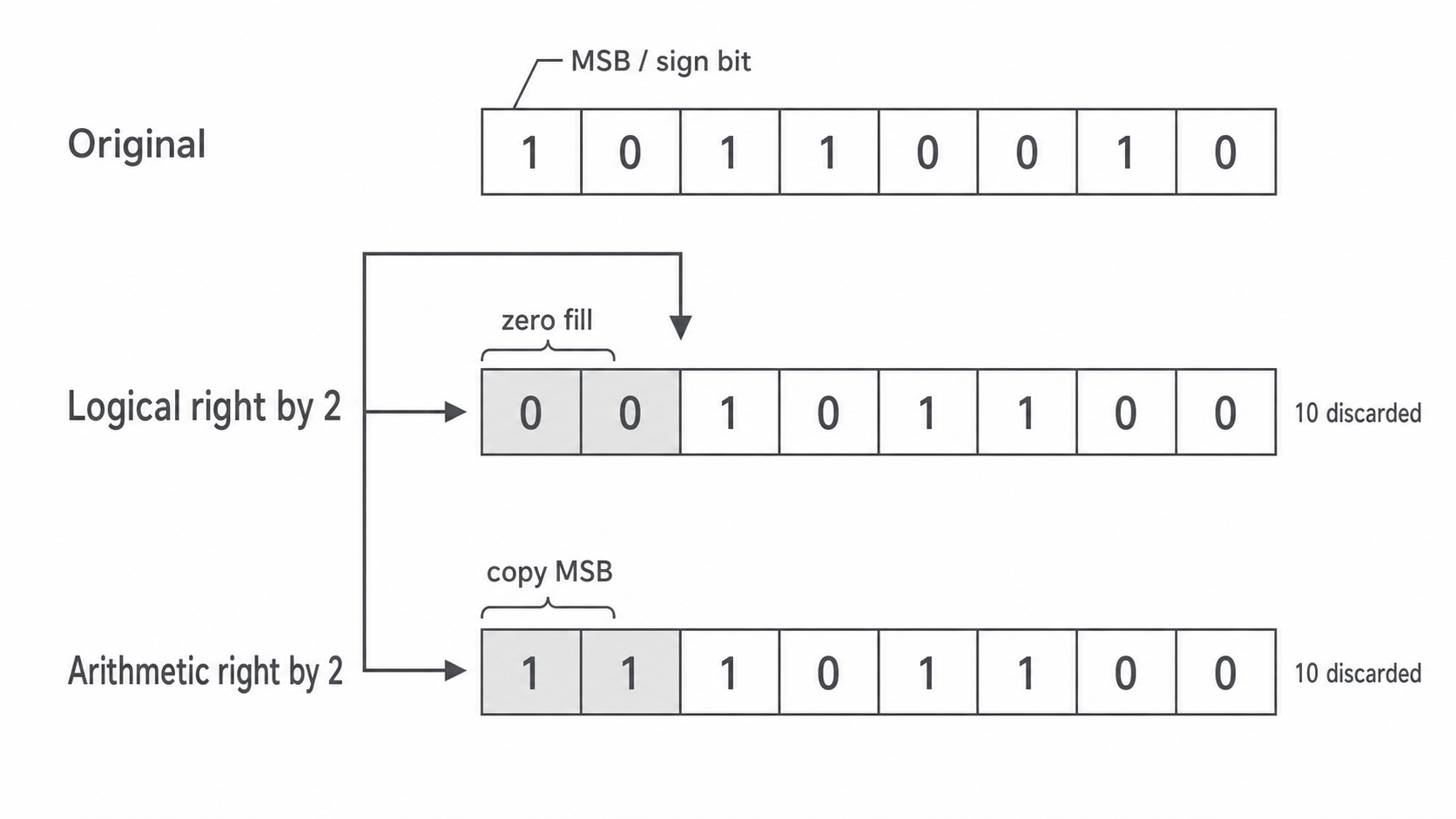
Logical right inserts 0. Arithmetic right copies the original sign bit. Both left shifts insert 0 on the right, but arithmetic left is interpreted as signed.
Apply one left shift and one right shift, keeping the signed interpretation in view.
Shifts, overflow and final decisions
Use this order whenever you apply or explain a shift:
- Record the fixed bit width and whether the pattern is unsigned or signed.
- Identify the direction and whether the shift is logical or arithmetic.
- Move every bit the stated number of positions, use the correct fill rule and discard bits leaving the pattern.
- Keep the required width, then decide whether the exact mathematical result is representable. If it is not, overflow has occurred.
Worked example: unsigned logical-left overflow
An unsigned 8-bit register holds 0111 1000, representing 120, and applies a logical shift left by two.
Exact mathematical result: 120 x 4 = 480
Full binary result:         1 1110 0000
Stored 8-bit result:          1110 0000
The exact result needs nine bits, so the stored 8-bit pattern cannot represent 480. This is overflow.
Worked example: signed arithmetic-left overflow
An 8-bit signed register holds 0101 0000, representing +80, and applies an arithmetic shift left by one.
Bit operation:              0101 0000 -> 1010 0000
Exact mathematical result:  +80 x 2 = +160
The exact positive value +160 cannot be represented in signed 8-bit two's complement; it would need an additional leading sign bit. The stored result begins with 1, so it would be interpreted as negative rather than +160. Overflow has occurred even though the bit discarded from the left was 0.
For the integer right shifts in this lesson, the result does not need a larger magnitude than the starting value, so overflow is a left-shift risk. Do not use "a 1 was discarded" as the universal test: the reliable test is whether the exact result fits the stated width and signedness.
A binary result is meaningful only when its width, signedness and shift type are known. Apply the bit movement first, then test whether the exact value fits.
Use all four decision steps on a new signed value.