1.2.1 - Control flow, input and output
Algorithms are where a solution stops being a vague idea and becomes a route that someone else can follow. In this lesson, you will read and write sequence, selection, count-controlled repetition, condition-controlled repetition and iteration, while keeping input, processing and output clear. You will express the same logic as flowcharts, pseudocode and short program-code examples.
Algorithms and data flow
Algorithm
An algorithm is a finite, ordered set of unambiguous steps that solves a problem or completes a task.
An algorithm describes the method, not just the final answer. It must be precise enough for the same valid input to be handled in the intended way. Algorithms can be represented in three forms:
| Representation | What it is | What must be clear |
|---|---|---|
| Flowchart | A diagrammatic representation using standard shapes and directed arrows | The order, decisions, branches and loops |
| Pseudocode | An informal written description of an algorithm | The logic and indentation; no single strict syntax is required |
| Program code | Instructions written using a programming language's syntax | The exact statements and structure used by that language |
Most useful algorithms can also be understood as input, processing and output:
| Stage | Meaning | Ticket-kiosk example |
|---|---|---|
| Input | Data supplied to the algorithm | The customer enters 3 tickets |
| Processing | Work carried out using the input | Calculate the cost at GBP 6 per ticket |
| Output | Information produced by the algorithm | Display 18 |
The input is not necessarily the first value visible in an algorithm, and the output is not simply the last variable used. Ask instead: What data enters the solution? What is done with it? What information leaves the solution?
Sequence and selection
Sequence
Sequence is the execution of instructions in their stated order, one after another.
Sequence still exists inside a branch or loop. It does not mean that the whole algorithm must be one straight path.
Selection
Selection uses a condition to choose which path through an algorithm is followed.
In a two-way selection, one branch is followed when the condition is true and the other when it is false. The algorithm then continues with the next instruction after the selection.
Consider this Python 3 program code as a written Paper 1 algorithm:
tickets = int(input())          # 01
total = tickets * 6             # 02
if tickets >= 5:                # 03
    print("Group booking")      # 04
else:                           # 05
    print("Standard booking")   # 06
print(total)                    # 07
With the supplied input 6, line 1 accepts the input and line 2 processes it to produce 36. The condition on line 3 is true, so line 4 is followed and lines 5-6 are skipped. Line 7 then follows in sequence.
Predicted screen output for input 6:
Group booking
36
The common near-miss is to treat if and else as two instructions that both run. They are alternative paths: only the matching branch is followed.
Two kinds of repetition
Repetition
Repetition executes the same block of steps more than once.
The correct loop depends on what controls the repetition.
Count-controlled repetition
Count-controlled repetition runs a block a known or determined number of times.
This written Python algorithm produces three copies of Scan:
for count in range(1, 4):   # 01
    print("Scan")           # 02
The values supplied by range(1, 4) are 1, 2 and 3; the stop value 4 is not included. The chosen range therefore controls three passes.
Condition-controlled repetition
Condition-controlled repetition runs a block while a condition remains true.
doors_open = 2                       # 01
while doors_open > 0:                # 02
    print("Check door")              # 03
    doors_open = doors_open - 1      # 04
print("Complete")                    # 05
For the supplied starting value 2, the condition is true twice. The predicted output is therefore:
Check door
Check door
Complete
A while condition is checked before each pass. If doors_open began at 0, the loop body would execute zero times and only Complete would be output. This is different from assuming that every loop must run at least once.
When writing the two forms in pseudocode, make the controller visible:
REPEAT <known number> TIMES
    <steps>
END REPEAT

WHILE <condition is true>
    <steps that can lead to a new condition result>
END WHILE
Iteration over items
Iteration
In this specification, iteration means repeating a block over every item in a data structure.
The loop is controlled by the actual items to be visited, not by a separately chosen number. Here the supplied data structure is a list of three parcel codes:
parcel_codes = ["A2", "B1", "C4"]   # 01
for code in parcel_codes:             # 02
    print(code)                        # 03
The first pass uses A2, the second uses B1 and the third uses C4. The predicted output is:
A2
B1
C4
Compare the controlling ideas:
| Form | What controls the next pass? | Typical written form |
|---|---|---|
| Count-controlled repetition | A known or determined number of passes | for number in range(...) |
| Condition-controlled repetition | Whether a condition is still true | while condition: |
| Iteration | Whether another item remains in the data structure | for item in structure: |
Count-controlled repetition and iteration can happen to make the same number of passes, but that does not make them identical. for position in range(3) is controlled by three generated numbers; for code in parcel_codes is controlled by the three actual parcel-code items.
Flowchart control
Flowchart
A flowchart is a diagrammatic representation of an algorithm using symbols connected by directed flow lines.
A flowchart makes the route through an algorithm visible. It is useful for seeing the order of processing, where a decision splits the route, and where a loop returns to an earlier condition without depending on one programming language's syntax.
Pearson uses six symbols in Paper 1 questions:
| Symbol appearance | Meaning |
|---|---|
| Rounded start/end shape | Start or end of the algorithm |
| Rectangle | A process or action |
| Parallelogram | Input or output |
| Diamond | A decision or condition |
| Directed arrow | The logical flow and direction |
| Rectangle with double vertical sides | A pre-defined subprogram |
[DIAGRAM: asset_name: Flowchart symbols and a condition-controlled loop; asset_slug: 1_2_1_control_flow_input_and_output__diagram_01; recommended_method: image_gen; description: Original 16:9 monochrome teaching diagram. The left panel shows the six Pearson Paper 1 flowchart symbols with exact short labels Start/End, Process, Input/Output, Decision, Flow line and Pre-defined subprogram. The right panel shows Start leading to INPUT jobs, then decision jobs > 0?; Yes leads to PROCESS Complete one job, then PROCESS jobs = jobs - 1, with an arrow returning to the decision; No leads to OUTPUT Done and then End. Both decision outcomes are labelled, all arrows are directed, and there are no hanging paths.]
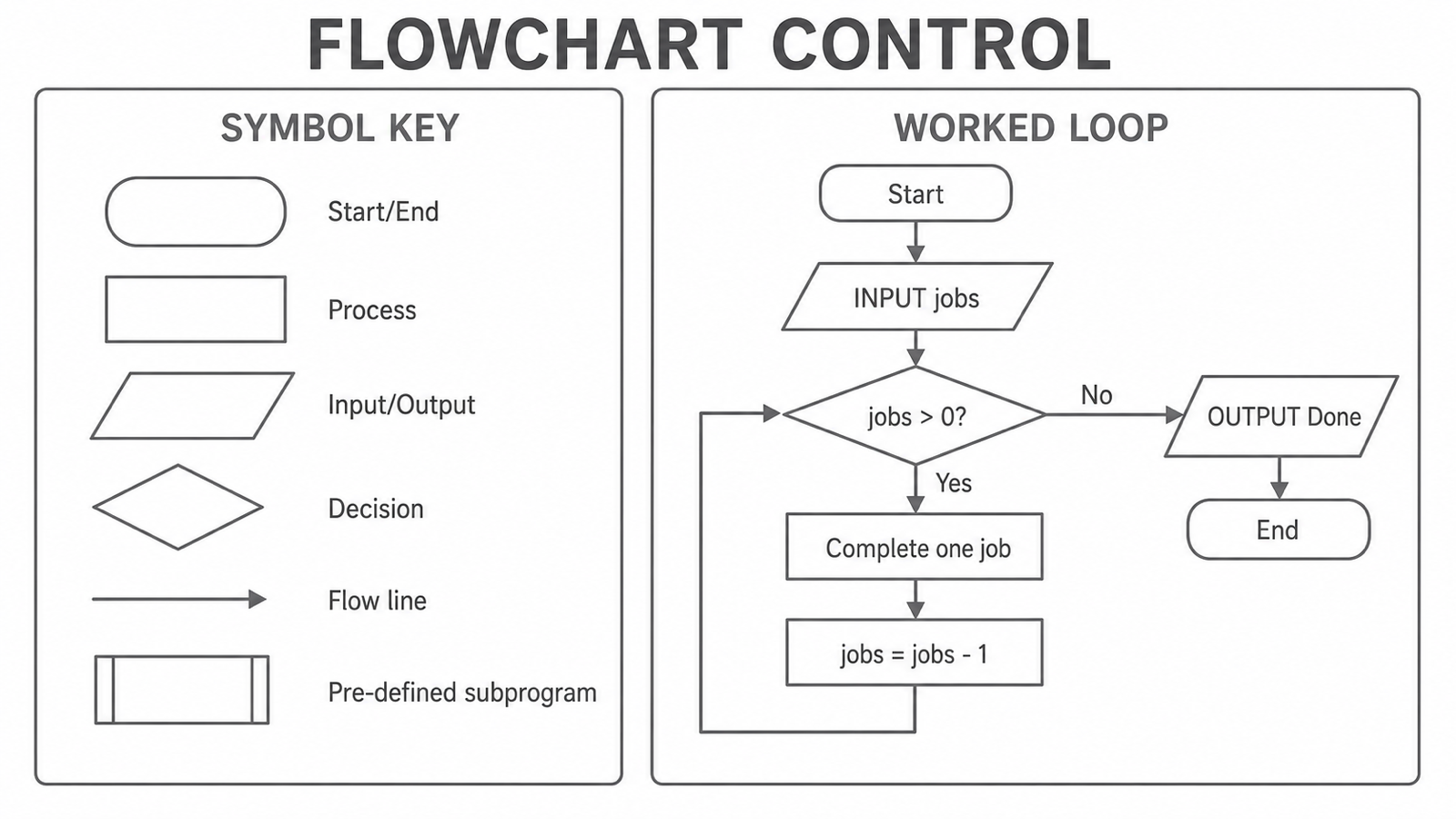
In the worked loop, the decision is tested before the process. The Yes route completes one job, changes the amount remaining and returns to the same decision. The No route leaves the loop, outputs Done and reaches the end. A decision diamond contains the question; an action such as Complete one job belongs in a process rectangle.
When writing a flowchart, check that every symbol is connected, every arrow has an unambiguous direction, and every two-way decision has two clearly labelled outcomes that reach the correct next step.
Complete algorithms
Real algorithms combine constructs. The key is to decide what controls each section rather than choosing a construct because its keyword looks familiar.
Requirement: A reviewer inputs a minimum rating. The supplied data structure is ratings = [4, 2, 5]. For every rating, output Recommend when it meets the minimum and Review otherwise. After every item has been handled, output Finished.
One clear pseudocode solution is:
INPUT minimum_rating
FOR EACH rating IN ratings
    IF rating >= minimum_rating THEN
        OUTPUT "Recommend"
    ELSE
        OUTPUT "Review"
    END IF
END FOR
OUTPUT "Finished"
With supplied input 4, the algorithm visits ratings 4, 2 and 5 in turn. The selection produces Recommend, Review and Recommend. Only after the iteration has finished does the final instruction run in sequence.
Predicted output:
Recommend
Review
Recommend
Finished
This one algorithm contains all of the following relationships:
- Input: the minimum rating.
- Processing: compare each supplied rating with the minimum and choose a message.
- Iteration: visit every item in
ratings. - Selection: choose one of two messages for the current item.
- Sequence: output
Finishedonly after the loop ends. - Output: the three item messages followed by the final message.
Control flow answers one question: which instruction happens next? Sequence fixes the order, selection chooses a path, and repetition or iteration sends control through a block again.
To write a new algorithm, first state the required input and output. Put unavoidable steps into sequence, use selection only where a condition chooses a path, then choose a fixed count, a continuing condition or every-item iteration for any repeated block. Finally, follow each possible route on paper to check that it reaches the intended output.