2.1.3 - Socialisation Process and Agencies of Socialisation
Socialisation is central to sociology because it explains how people become members of a society rather than just biological individuals. In this lesson you will see how primary and secondary agencies transmit culture, shape identity and help reproduce inequalities, and why different perspectives disagree over whether socialisation creates social order or mainly serves the powerful.
Learning culture and identity
Human beings are not born with a ready-made understanding of language, acceptable behaviour or social identity. They have to learn what counts as normal, desirable and shameful in the group around them. That learning process is socialisation. It gives people a culture, but it also gives them a sense of self: ideas about who they are, what sort of future is open to them, and how they are expected to behave as a son or daughter, friend, student, worker, man, woman, or member of an ethnic or religious community.
Socialisation
The process through which individuals learn the norms, values, meanings and expected behaviours of the culture around them.
Primary socialisation
The earliest stage of socialisation, mainly within the family, where children first learn language, behaviour, identity and basic ideas of right and wrong.
Parsons — saw the family as the main agency of primary socialisation. In his view, children internalise shared values there, helping to create value consensus, or agreement about what is proper and important. Families do not only teach table manners or speech; they also teach emotional control, attitudes to authority and assumptions about gender. They may also pass on class-based expectations about education and work, as well as ethnic, religious and cultural traditions.
A useful distinction is between the early, intimate setting of primary socialisation and the wider institutions that continue shaping behaviour later on.
| Type of socialisation | Main setting | What is usually learned | Why it matters |
|---|---|---|---|
| Primary | Family | Language, basic norms, emotional behaviour, early identity | Builds the first sense of self and belonging |
| Secondary | School, peers, media, religion, workplace | Wider rules, social roles, public identities and expectations | Connects the individual to the wider social order |
Functionalists tend to treat this early learning as necessary for social order, but sociology also asks a sharper question: whose values are being passed on, and who benefits when some identities are treated as more normal than others?
Secondary agencies and social control
Secondary socialisation continues after early childhood and involves institutions outside the family. These agencies do not all teach exactly the same lessons, but they usually reward conformity and discourage deviance through sanctions such as praise, approval, mockery, exclusion or punishment. That is why socialisation is closely linked to social control.
Durkheim — argued that education helps create social solidarity by teaching shared moral rules and making individuals feel part of something larger than themselves. For Durkheim, weak socialisation risks anomie, a condition of normlessness in which shared moral guidance breaks down. Parsons also saw school as a bridge between the family and wider society: in the family a child is treated as special, but in school they are judged by more universal standards that prepare them for adult roles.
Peer groups matter because they train people in belonging. Friends can reward the right clothes, accent or style of masculinity and femininity, and punish those who seem strange or disloyal. This means peer groups can reinforce class identities, police gender expectations and sometimes stigmatise ethnic difference.
The media is a particularly powerful agency because it works every day and often appears natural. Through agenda-setting it helps decide which issues are important. Through norm referencing it signals what counts as normal, respectable, attractive or dangerous. Through the social construction of reality it can make particular versions of family life, success, crime, gender or ethnicity seem like simple common sense rather than socially created viewpoints. Religion can do something similar by attaching moral authority to certain family forms, sexual behaviour or gender roles. The workplace socialises adults into punctuality, hierarchy, teamwork and professional identity.
A simple agency map helps here because socialisation works through overlapping influences rather than through one institution at a time.
[DIAGRAM: asset_name: 2_1_03_socialisation_agencies__diagram_01; asset_slug: 2_1_03_socialisation_agencies__diagram_01; recommended_method: retained_png; description: Hub-and-spoke diagram with "Individual / self" in a central circle. A thicker arrow from "Family (primary socialisation)" to the centre. Around it place five outer circles labelled "School", "Peer group", "Media", "Religion", and "Workplace" with arrows pointing inward. Add short labels on the arrows such as "norms", "values", "identity", "sanctions", and "roles". Keep the layout simple and uncluttered.]
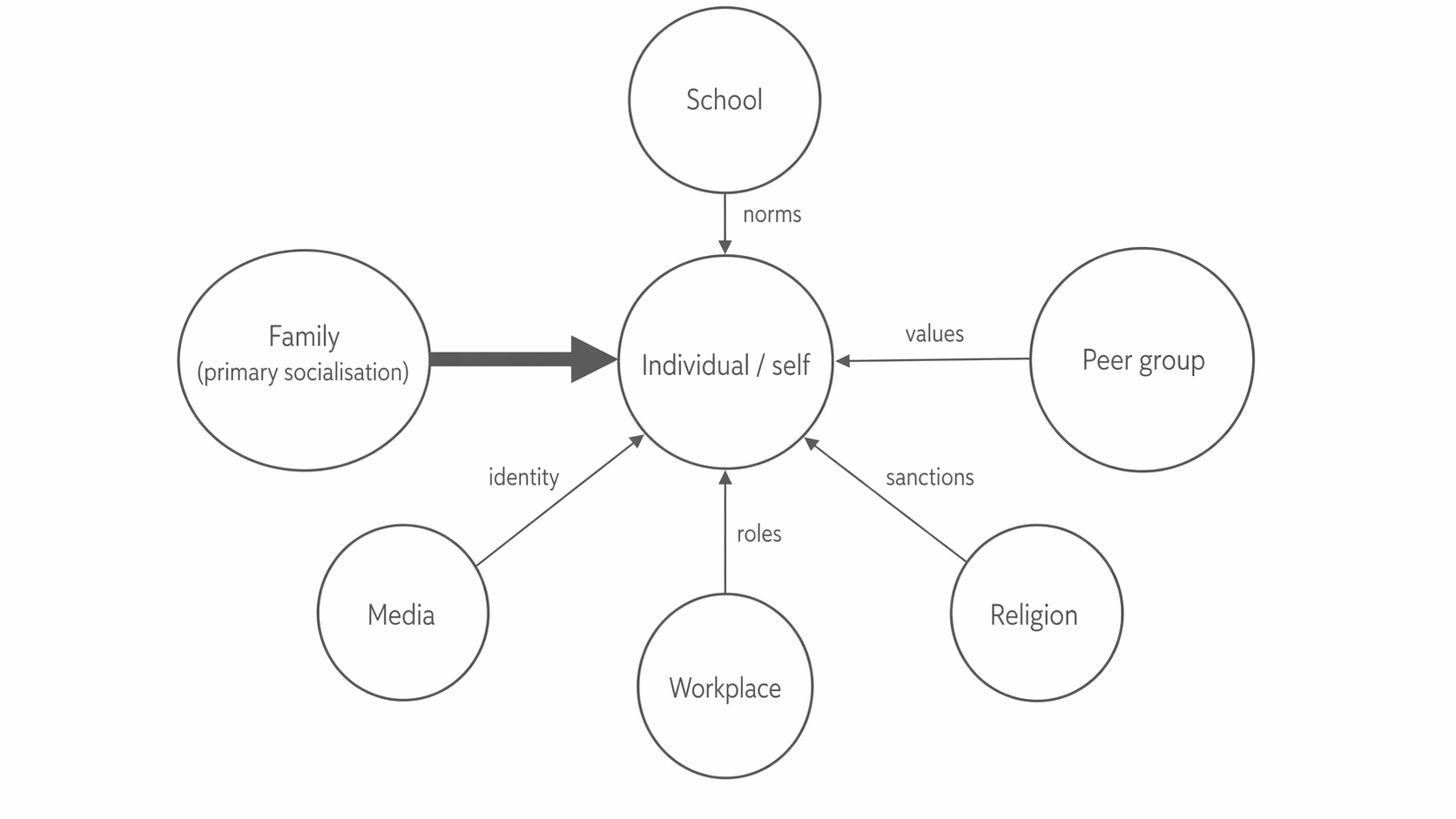
The key thing to notice is that the family starts the process, but later agencies keep reshaping identity and ideas of what counts as normal.
A student may be taught discipline by school routines, learn what earns approval in a friendship group, and then see social media feeds presenting certain body types, lifestyles or accents as desirable. These agencies work together, so identity is shaped not by one message alone but by a repeated pattern of rewards, pressures and normalising images.
Competing perspectives on socialisation
Different perspectives agree that socialisation matters, but they strongly disagree about its purpose. The table below captures the main contrast before we look more closely at each view.
| Perspective | Main view of socialisation | Key thinkers | Main concern |
|---|---|---|---|
| Functionalist | It integrates individuals into society through shared norms and values | Parsons, Durkheim | Order, value consensus, social solidarity |
| Marxist | It reproduces ruling-class ideology and acceptance of inequality | Althusser, Bowles and Gintis | Class power and ideological control |
| Feminist | It teaches gender roles and helps reproduce patriarchy | Oakley | Male power and gender inequality |
| Interactionist | It develops the self through interaction, interpretation and role-taking | Mead, Cooley | Identity formation and meaning-making |
Althusser — argued that agencies such as the family, education, media and religion work as Ideological State Apparatuses. Instead of simply teaching shared values, they transmit the dominant ideology of capitalism so that inequality seems natural.
Ideological State Apparatuses (ISAs)
Institutions such as the family, education, media and religion that help reproduce the dominant ideas of a society and secure consent to existing power relations.
Bowles and Gintis (1976) — developed this Marxist argument by claiming that schools teach a hidden curriculum of obedience, punctuality and acceptance of hierarchy, preparing working-class pupils for subordinate jobs. From this view, socialisation reproduces class inequality across generations rather than benefiting everyone equally.
Oakley (1974) — showed how gender-role socialisation begins early in family life. Through manipulation, canalisation, verbal appellations and different activities, girls and boys are steered towards different identities. Feminists extend this beyond the family: schools, religion and media representations can all reinforce patriarchy by presenting care, beauty and dependence as feminine, while authority and toughness are coded as masculine.
Mead (1934) — took a very different approach. He argued that the self develops through interaction. The "I" is the more spontaneous part of the self, while the "Me" is the socialised part shaped by the expectations of others. Children first copy significant others, then take roles in play, and eventually understand the generalised other, meaning the wider expectations of society. Cooley similarly argued that people build a looking-glass self by imagining how others see them. This reminds us that socialisation is not just imposed from above; it is lived through everyday interaction.
These perspectives also help explain inequality. Functionalists focus on integration, whereas Marxists and feminists ask whose culture becomes dominant. Schools and media may present middle-class or patriarchal expectations as universal, and minority ethnic identities may be stereotyped or marginalised rather than treated as equal alternatives.
Limits, evidence and resistance
Cases of extreme isolation help show why sociologists take socialisation seriously. The case of Genie, discovered after severe isolation in childhood, is often used to show that language, social skills and a stable sense of self do not simply unfold automatically. Without sustained human interaction, key human capacities may remain underdeveloped. Such cases support the view that culture is learned, not instinctive.
At the same time, sociologists are cautious about turning these rare cases into a complete theory of behaviour. They are unusual case studies, shaped by trauma as well as isolation, so they cannot tell us everything about ordinary social life. More broadly, critics argue that some theories of socialisation are too deterministic. Marxists can overstate how successfully dominant ideology is absorbed. Feminists may underplay change and diversity in gender identities. Interactionists may pay too little attention to the structural pressures of class, gender and ethnicity.
Willis — is useful here because he showed that working-class boys could resist school values rather than simply absorb them. However, their resistance still ended up feeding class inequality because it pushed them towards low-paid manual work. This is a good sociological reminder: people have agency, but they do not exercise it in conditions of their own choosing.
A teenager may reject some family expectations, adopt a new identity through peers or online communities, and still find that school, employers or media stereotypes place limits on how they are seen. Socialisation shapes the range of likely identities, but it does not produce identical outcomes in every case.
The strongest conclusion is therefore balanced. Socialisation matters enormously because it transmits culture and stabilises expectations, but it is never a perfect mould. Individuals interpret, negotiate and sometimes resist the messages they receive, even though power relations mean some groups start with much more cultural authority than others.
Essay Bank
Functionalists make a useful point because no society could survive if people never learned rules, language or shared expectations. Parsons and Durkheim help explain why families and schools matter: they integrate individuals into the wider social order and create enough value consensus for cooperation and social solidarity.
A major criticism is that this picture is too harmonious. Marxists and feminists show that agencies of socialisation do not simply transmit neutral values; they can reproduce class inequality and patriarchy by presenting dominant interests as normal, natural and deserved.
Overall, socialisation is best seen as both enabling and constraining. It is essential for identity formation and social order, but its content reflects power relations, and individuals do not just absorb it mechanically because they can negotiate, reinterpret and sometimes resist what they are taught.