1.1.11 - Pupil Subcultures
Pupil subcultures matter because they show that educational inequality is not produced by external class, gender, and ethnic differences alone. What happens inside schools also shapes how pupils see themselves, how they relate to teachers, and whether success is treated as respectable or embarrassing. This lesson explains how interactionists and Marxists account for pupil subcultures, why some pupils become pro-school or anti-school, and why later sociologists argue that pupil responses are more varied than a simple two-way split.
How schools help create subcultures
Interactionist sociology starts from the idea that pupil identities are formed through everyday interaction. Subcultures are not just friendship groups. They are collective responses to how pupils are classified, taught, and rewarded inside school. This is why streaming, banding, and teacher judgements matter: they organise status.
In this topic, differentiation means the process by which teachers categorise pupils by ability, behaviour, attitude, or potential, often through streaming, setting, and informal labelling.
Polarisation
The process by which pupils respond to differentiation by moving towards opposing subcultures, especially pro-school and anti-school groups.
Colin Lacey — In his study of Hightown Grammar, Lacey argued that streaming encouraged teachers to separate pupils into the more able and less able. Those in higher streams were more likely to gain approval and form a pro-school identity. Those in lower streams were more likely to feel rejected and to seek status elsewhere, producing anti-school attitudes.
David Hargreaves — Studying a secondary modern school, Hargreaves found a similar pattern. Top-stream pupils tended to become conformists, while lower-stream boys developed the anti-school subculture he called the delinquescents. The key sociological point is that failure was not just an individual weakness. It was socially organised through labelling and ranking.
Stephen Ball — Ball's study of Beachside Comprehensive showed that school organisation can intensify or soften subcultures. Under banding, clear pro-school and anti-school divisions appeared. When mixed-ability teaching replaced banding, polarisation reduced, but informal teacher labelling still survived. This suggests that changing formal structures helps, but it does not end subcultures if unequal expectations remain in everyday interaction.
The interactionist explanation therefore treats pupil subcultures as a response to social control inside school. Pupils are not simply discovering their "true" ability. They are reacting to a status system in which some are defined as promising and others as problems.
The flow below is useful because it turns Lacey's argument into one clear sequence.
[DIAGRAM: asset_name: 1_1_11_pupil_subcultures__diagram_01; asset_slug: 1_1_11_pupil_subcultures__diagram_01; recommended_method: retained_png; description: Flowchart showing teacher differentiation and streaming at the left, leading to two contrasting paths. Upper path: positive label -> higher status in school -> pro-school subculture -> effort, conformity, teacher approval. Lower path: negative label -> lower status in school -> anti-school or counter-school subculture -> defiance, peer approval, rejection of school values. Keep the two paths symmetrical and easy to compare.]
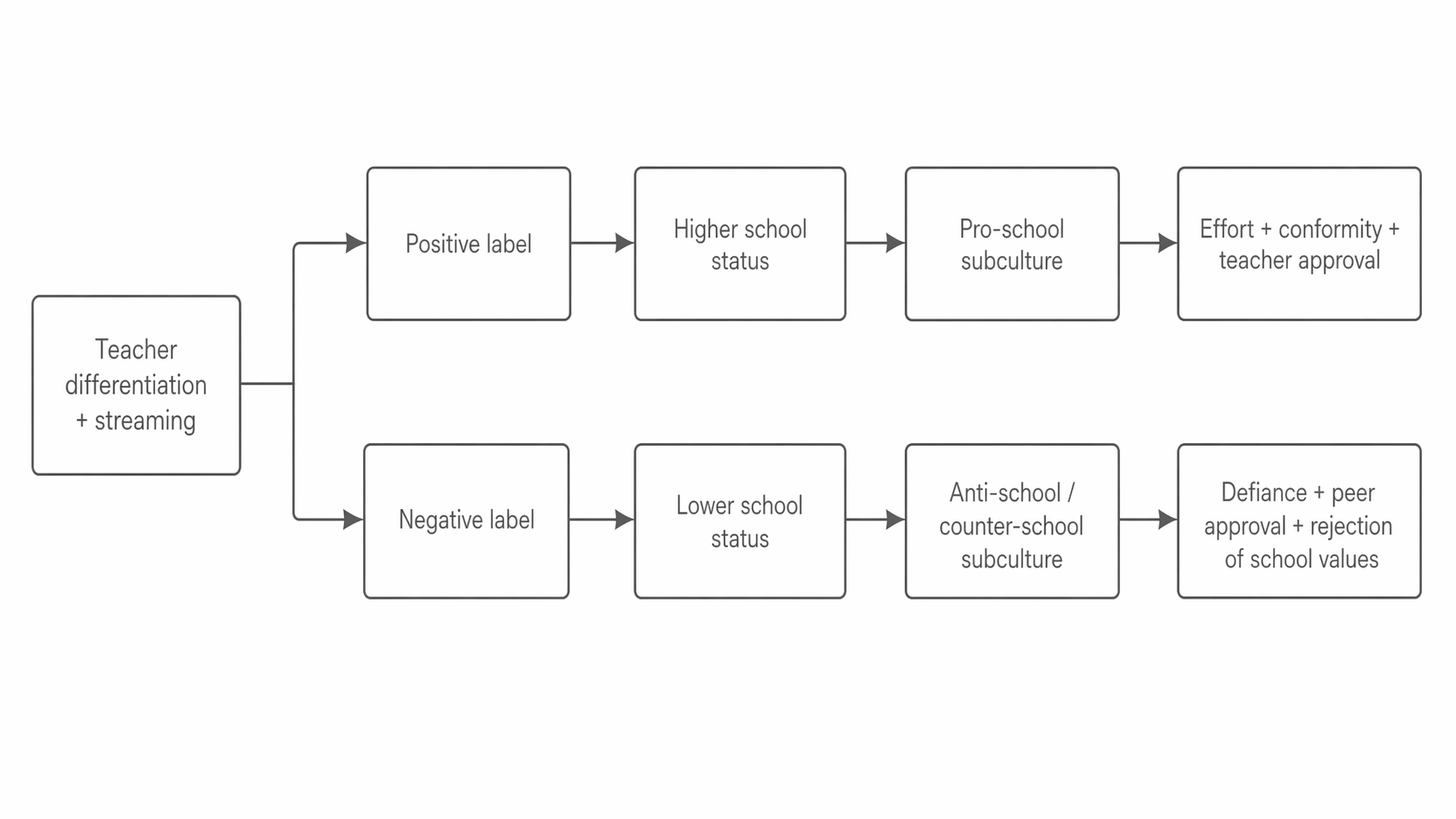
What matters is that the subculture grows out of school status allocation, not just out of individual attitude.
Imagine a Year 9 cohort where pupils in the top set are regularly praised as mature and capable, while pupils in the bottom set are watched more closely and spoken to as if they will misbehave. Even before exam results arrive, the school has created two different identities. Some pupils gain status by pleasing teachers, while others gain status by rejecting the labels placed on them.
Pro-school and anti-school identities
Lacey's model becomes clearer when we compare the two main subcultures it produces. The difference is not just whether pupils behave well. It is about where they look for status, recognition, and identity.
| Subculture | Typical values and behaviour | Link to power and inequality |
|---|---|---|
| Pro-school | Works hard, follows rules, values qualifications, seeks teacher approval | Usually fits the school's definition of success and is rewarded by staff |
| Anti-school | Rejects lessons, mocks effort, resists teachers, gains peer status through defiance | Often grows among pupils denied status by the official school system |
Pro-school subcultures often appear natural because they match what schools reward. Yet they are still social products. They are easier to sustain when pupils receive positive labels, stronger resources, and confidence that achievement will be recognised. This helps explain why pro-school identities are often associated with middle-class values or with pupils who are treated as future successes.
Counter-school culture
An anti-school subculture that rejects school values and gains status by opposing teachers, rules, and academic effort.
Paul Willis — In Learning to Labour, Willis studied working-class boys he called the lads. Their counter-school culture centred on "having a laff", rejecting authority, and treating academic work as pointless or unmanly. This was not just misbehaviour for its own sake. It was bound up with class identity and masculinity. The lads valued manual labour, toughness, and loyalty to mates.
Willis gives the lesson a Marxist edge. He shows that resistance to school does not necessarily challenge inequality. Instead, it can reproduce it. By rejecting qualifications, the lads were pushed towards the same class position as their fathers. In other words, an anti-school subculture can feel rebellious while still helping capitalism reproduce a supply of working-class labour.
This is an important contrast with simple deterministic Marxism. Willis does not present pupils as passive victims of the hidden curriculum. They have agency. But their agency operates inside unequal structures, so their resistance still leads them back towards class inequality.
In one school, a high-status group gains prestige by winning praise, top sets, and leadership roles. In the same school, another group gains prestige by mocking homework, refusing to "act keen", and showing toughness in front of peers. Sociologically, both groups are chasing status, but they are doing so through rival value systems.
Why the simple split is not enough
Later sociologists argue that the pro-school versus anti-school contrast is useful, but too blunt on its own. Many pupils drift, compromise, or switch behaviour depending on the subject, teacher, or peer audience.
Peter Woods — Woods argued that pupil adaptations form a spectrum rather than a neat binary. His typology included ingratiation, compliance, opportunism, ritualism, retreatism, colonisation, intransigence, and rebellion. Some pupils genuinely seek approval. Others go through the motions, enjoy the social life of school without caring much about learning, or openly resist authority. This matters because it stops us treating all non-conformity as one single anti-school culture.
Intersectionality
The idea that class, gender, and ethnicity interact to shape identities and experiences, rather than acting as separate influences.
Gender and ethnicity also change how subcultures form. Mac an Ghaill showed that working-class boys did not all respond in the same way. His macho lads built an anti-school masculinity around toughness and resistance. By contrast, academic achievers accepted school success as a route to mobility, while new enterprisers embraced vocational routes linked to a changing labour market. This shows that class position still matters, but it is lived through different versions of masculinity.
Tony Sewell also rejected the idea that Black boys form one single anti-school group. He identified conformists, innovators, retreatists, and rebels. The category of innovators is especially useful because it shows a mixed response: some pupils are pro-education but anti-school. They want success, but distrust institutions that stereotype or discipline them unfairly.
The same point can be extended beyond boys. More recent work suggests that girls also develop subcultures shaped by status, fear of failure, racism, and peer expectations. Studies such as Shain's work on Asian girls and Jackson's work on laddish behaviour suggest that subcultures can be shaped by the intersection of ethnicity, gender, school pressure, and popularity, not only by class alone.
Evaluation and exam judgement
Subculture studies are valuable because they show that schools help produce inequality rather than merely reflecting it. Interactionists are especially strong on the micro-processes of labelling, streaming, and status allocation. Marxist work, especially Willis, adds a wider explanation of how class inequality is reproduced through apparently rebellious behaviour.
However, there are important limits. Many classic studies are small-scale, older, and heavily focused on boys. Contemporary schools are shaped by marketisation, de-industrialisation, mass participation in further education, and more complex identity politics. This makes it less likely that all pupils fall into stable, clearly bounded subcultures.
There is also a risk of overstatement. Not every lower-set pupil becomes anti-school, and not every successful pupil becomes deeply pro-school. Woods, Sewell, and later intersectional work are useful because they show mixed positions, shifting identities, and contradictory responses. A pupil may want qualifications, dislike teachers, enjoy peer approval, and fear failure all at once.
For exam answers, the strongest line is usually a qualified one: pupil subcultures are real and sociologically important, but they are created by an interaction between internal school processes and wider inequalities of class, gender, and ethnicity.
Essay Bank
Interactionist explanations are useful because they show exactly how schools generate subcultures through differentiation and polarisation. Lacey, Hargreaves, and Ball all suggest that streaming, banding, and teacher labelling allocate status unevenly, so some pupils attach themselves to school values while others build an alternative status system in opposition.
A criticism is that classic subculture studies can be too binary and too dated. Woods shows that many pupils occupy middle positions such as ritualism or colonisation, while later work on gender and ethnicity suggests that subcultures are shaped by intersecting pressures, not just by a simple pro-school versus anti-school split.
Overall, pupil subcultures are best understood as patterned but diverse responses to power inside schools. Internal processes such as labelling matter, but they work through wider inequalities of class, masculinity, ethnicity, racism, and labour market change, so the most convincing explanation combines interactionist insight with wider structural analysis.