1.1.5 - Class Differences in Achievement — Internal Factors
This lesson looks at the in-school processes that can widen class differences in educational achievement. You will learn how teacher labelling, self-fulfilling prophecies, ability grouping, pupil subcultures, and market pressures can all shape working-class and middle-class outcomes from inside the school itself.
Teacher labelling and the ideal pupil
Internal explanations focus on what happens inside schools rather than outside them. The key interactionist idea is that achievement is socially constructed: teachers do not simply discover ability, they also interpret it.
Labelling
The process by which teachers or other people attach meanings or judgements to a pupil, such as "bright", "hard-working", or "trouble-maker".
Howard Becker (1971) argued that teachers judge pupils against an image of the ideal pupil. This ideal is not based on ability alone. It often includes middle-class qualities such as polite speech, neat appearance, compliance, and an attitude that fits the school's expectations.
Ray Rist (1970) found a similar process in an American kindergarten. Children were grouped early in ways that reflected teachers' assumptions about class background rather than objective ability. The key sociological point is that class can influence how teachers read behaviour from the very start of schooling.
Kai arrives late a few times, speaks in a local accent, and does not always bring the right equipment. Another pupil, Emma, speaks more confidently in formal classroom language and seems more "school-like". An interactionist would ask whether teachers begin to see Emma as more able and Kai as more problematic even before strong evidence about ability has appeared.
Self-fulfilling prophecy and teacher expectations
Once a label has been applied, it may begin to shape what happens next.
Self-fulfilling prophecy
A prediction that comes true because it has been made and acted upon.
Rosenthal and Jacobson (1968) showed this in Pygmalion in the Classroom. Teachers were told that certain pupils were likely to show rapid intellectual growth, even though those pupils had actually been chosen at random. Later, many of these so-called spurters had made greater progress. The argument is that teacher expectations changed teacher behaviour, and teacher behaviour then helped change pupil performance.
A simple flow diagram is useful here because the process works as a chain rather than as one isolated moment.
[DIAGRAM: asset_name: 1_1_05_class_achievement_internal__diagram_01; asset_slug: 1_1_05_class_achievement_internal__diagram_01; recommended_method: retained_png; description: Flow showing class-based teacher labelling -> higher or lower expectations -> different treatment in class -> pupil self-concept changes -> achievement rises or falls -> the original label appears confirmed.]
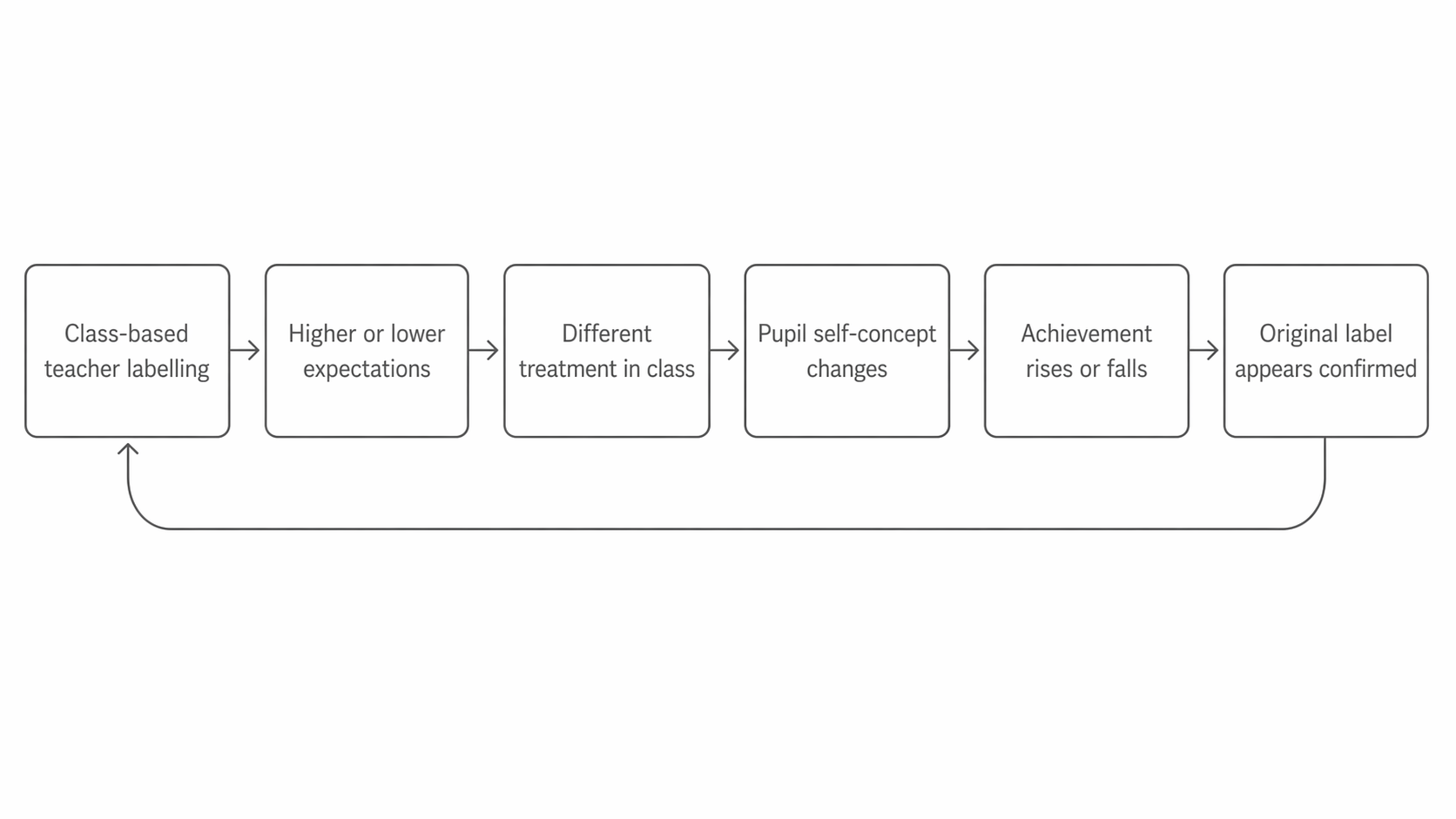
If you can follow each arrow in that chain, you can usually explain the self-fulfilling prophecy clearly in an exam answer.
This matters for class inequality because if middle-class pupils are more likely to be seen as capable, they may receive more encouragement, harder work, and greater confidence from teachers. Working-class pupils may receive the opposite. The result is not just a label but a chain of interactions that can push achievement in different directions.
Streaming, subcultures, and polarisation
Labelling often becomes more powerful when it is built into school organisation through streaming, setting, or banding.
| Grouping method | What it does |
|---|---|
| Streaming | Places pupils in one overall ability group across most subjects |
| Setting | Groups pupils by ability in particular subjects |
| Banding | Places pupils in broader ability bands within the school |
Douglas (1964) argued that streaming can shape performance because pupils in lower streams may internalise lower expectations. Stephen Ball (1981) found that abolishing banding reduced some polarisation, although informal labelling still continued. This shows that school organisation can amplify class inequalities even when it does not create them alone.
Lacey (1970) described a process of differentiation and polarisation. Teachers categorise pupils, and pupils then respond in different ways. Some become pro-school; others develop anti-school identities. Working-class pupils are more likely to be pushed into lower groups, where they may gain status by rejecting the school's values rather than accepting them.
This is why internal factors are so important sociologically. They show that class inequality is not just brought into school from outside. It is also actively reproduced through daily school practices and pupil responses.
Marketisation, educational triage, and evaluation
Internal processes are also shaped by wider policy. Under marketisation, schools are judged heavily by results, league tables, and inspection outcomes. This changes how teachers and managers distribute attention.
Educational triage
The process by which schools sort pupils into groups based on how likely they are to improve headline results, giving most support to borderline cases and least to those seen as secure passes or hopeless cases.
Gillborn and Youdell (2001) argued that schools operating in an A-to-C economy often focus extra resources on pupils who are close to a grade boundary. This can mean that pupils seen as unlikely to achieve key benchmark grades, many of whom are working class, are written off. Gewirtz (1995) added that marketisation advantages middle-class parents because privileged-skilled choosers are better able to use school choice, admissions processes, and information about performance.
Nadia's parents compare league tables, visit open evenings, and appeal an admissions decision. Jay's family choose the nearest school because travel and time are both difficult. A marketisation explanation would say that school choice exists in theory for both families, but middle-class resources make it far easier for Nadia's family to use it effectively.
These arguments are powerful, but they have limits. Labelling theory can be too deterministic because some pupils reject labels rather than accepting them. Small interactionist studies may not always generalise. Marxists also argue that internal factors alone cannot explain where class biases come from in the first place. The best conclusion is that internal and external factors work together: poverty, culture, school organisation, and teacher expectations reinforce one another.
Essay Bank
Internal-factor explanations are useful because they show how inequality is reproduced through ordinary school processes. Labelling, self-fulfilling prophecies, and ability grouping all help explain why class differences can widen inside schools rather than simply reflecting home background.
A major limitation is that interactionist explanations can be too deterministic and too narrow. Not all pupils accept labels, and small-scale studies do not always explain why class-biased assumptions exist in the first place. That is why many sociologists combine internal explanations with wider structural ones.
Overall, internal factors are most convincing when they are used alongside external factors. Teacher expectations, streaming, educational triage, and marketisation do not replace class inequality outside school, but they can turn that inequality into everyday school experiences that deepen the class attainment gap.