1.3.8 - Research Design
Research design is the overall plan sociologists use to turn a question about society into evidence. It matters because every design choice shapes what kind of data are produced, how far findings can be generalised, and whose experiences are made visible or ignored. In exams, this topic gives you the language to explain why positivists and interpretivists design research differently, and why practical, ethical, and theoretical issues matter from the first research idea to the final conclusions.
Planning sociological research
Research design begins before any data are collected. Sociologists have to decide what they want to find out, why the topic matters, and what kind of evidence would best answer the question. A design usually moves through several stages: choosing a topic, reviewing existing literature, setting aims and sometimes hypotheses, selecting methods, deciding on a sample, collecting and analysing data, and presenting findings. Good design links each stage together so the research question, the method, and the final conclusions all fit.
The sequence below is worth picturing because later design choices only make sense if the earlier stages are clear.
[DIAGRAM: asset_name: 1_3_08_research_design__diagram_01; asset_slug: 1_3_08_research_design__diagram_01; recommended_method: retained_png; description: Flowchart showing the main stages of sociological research design from left to right: Topic or problem -> Literature review -> Aims or hypothesis -> Method choice -> Sample -> Data collection -> Analysis -> Evaluation and findings. Add a small branch under Method choice with two short options: quantitative and qualitative. Keep the layout clean and linear.]
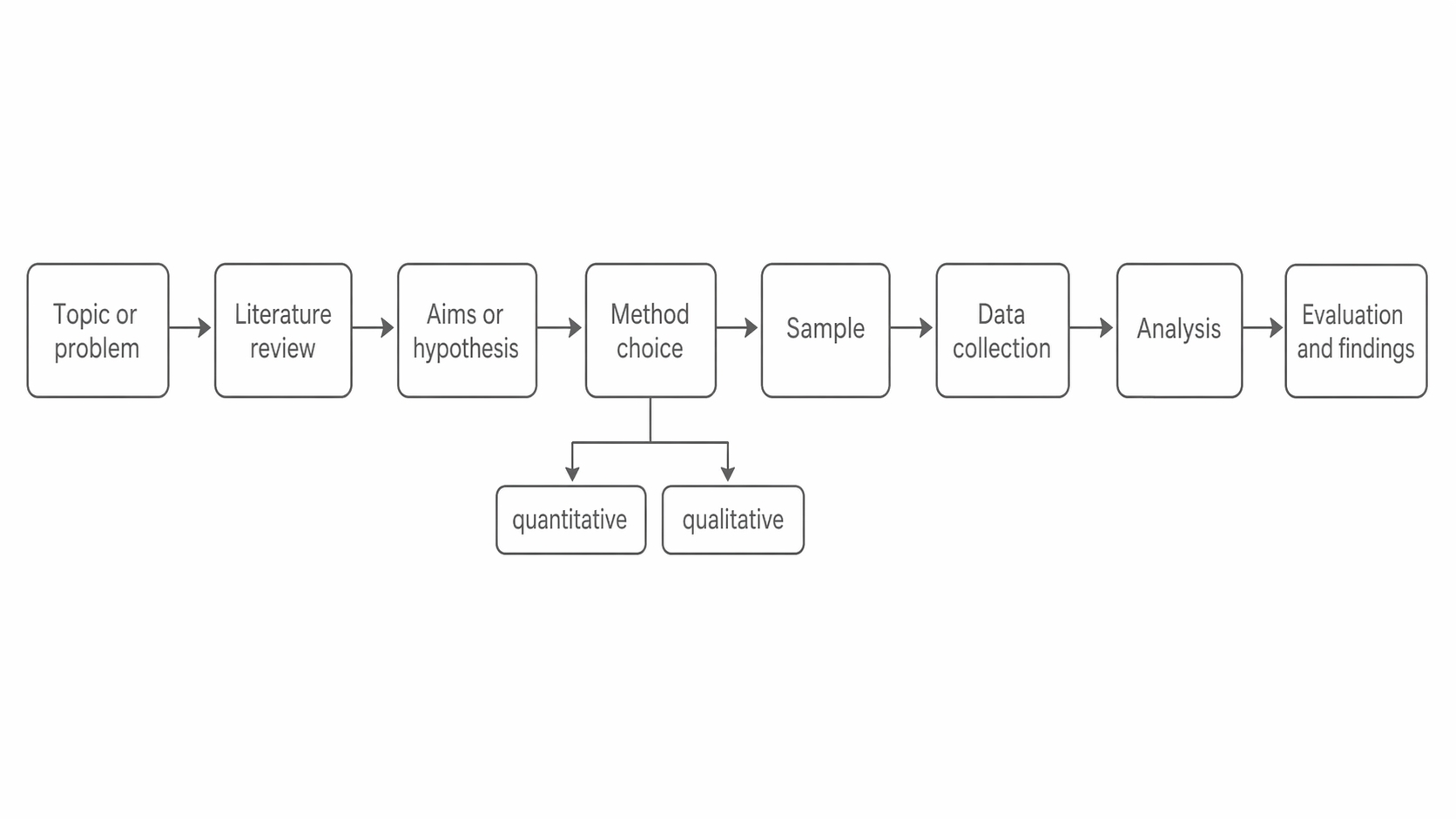
If you can walk through that order, you can usually explain why research design is about planning a whole study rather than just picking one method.
Research design
The overall plan for a sociological study, including the choice of topic, method, sample, data collection, analysis, and evaluation.
One early choice is the kind of data needed. Primary data are produced first-hand by the researcher through methods such as interviews, questionnaires, or observation. Secondary data already exist before the study begins, for example official statistics, documents, media texts, or previous research. Sociologists also choose between quantitative data, which are numerical and easier to compare, and qualitative data, which are descriptive and often better at revealing meanings, identities, and experiences.
Durkheim exemplifies a positivist design because he used official statistics on suicide to test explanations about social integration. Positivists generally prefer structured research, measurable concepts, and data that can be compared across large populations. Interpretivists, by contrast, are more likely to design research around meanings, interaction, and lived experience, so they often favour flexible qualitative methods such as unstructured interviews or participant observation.
The choice of topic is never purely technical. Researchers may be influenced by funding, access, public concerns, and their own values. A feminist researcher may prioritise hidden forms of gender inequality, while a Marxist may focus on class power and exploitation. This means design choices are tied to wider questions of social differentiation, power, and stratification, not just to neutral technique.
A sociologist studying educational inequality could begin with secondary data on exam results by social class, then decide whether those patterns need primary qualitative data from students and teachers to explain how class differences are produced inside schools. The design already reflects a theoretical question: is inequality mainly measurable from patterns, or does it need interpretation of everyday meanings and interactions?
Sampling and representativeness
Most sociologists cannot study everyone in the wider group they are interested in, so they select a sample. The target population is the full group the research is about, while the sampling frame is the list from which the sample is actually drawn. Research design matters here because the method of sampling affects representativeness and therefore whether findings can be generalised.
Representativeness
The extent to which a sample reflects the main characteristics of the wider population being studied.
A representative sample is especially valuable when sociologists want to make claims about broader social patterns such as class differences in achievement, gendered subject choices, or ethnic inequalities in stop and search. However, some research focuses less on representativeness and more on depth, especially when interpretivists study small groups in detail.
| Sampling technique | How it works | Main strength | Main limitation |
|---|---|---|---|
| Random sampling | Every person in the sampling frame has an equal chance of selection | Reduces conscious researcher bias | Needs a complete sampling frame |
| Stratified random sampling | The population is divided into groups such as class, gender, or ethnicity, then sampled proportionally | Improves representation of key social groups | More time-consuming to organise |
| Systematic sampling | Every nth person on the list is chosen | Simple and efficient | Can be distorted by patterns in the list |
| Quota sampling | The researcher fills set categories, such as a certain number of men and women | Fast and cheap | Selection within quotas is not random |
| Snowball sampling | Existing participants recruit others | Useful for hidden or hard-to-reach groups | Often biased toward connected networks |
| Opportunity sampling | Whoever is available is selected | Very quick and inexpensive | Usually highly unrepresentative |
Snowball and opportunity samples are often criticised for weak representativeness, but they may be the only realistic way to study groups with low visibility or high distrust of outsiders. That shows how practical realities and power relations shape design. Researchers investigating undocumented migrants, criminal networks, or stigmatised groups may accept weaker generalisability in exchange for any access at all.
Sampling and representativeness Continued
If a researcher wants to study the experiences of young carers, a fully random sample may be impossible because many are not publicly identified. Snowball sampling may produce a less representative sample, but it can still reveal important qualitative insights about caring responsibilities, stress, and family expectations that would otherwise remain hidden.
Operationalisation, reliability and validity
Research design also involves deciding how abstract sociological ideas will be measured. Concepts such as social class, religiosity, or educational achievement do not come ready-made as data. Researchers have to operationalise them by turning them into indicators they can observe or record.
Operationalisation
The process of translating an abstract sociological concept into specific measurable indicators.
For example, social class might be operationalised through occupation, income, or qualifications. Educational achievement might be measured using exam grades, progression rates, or teacher assessments. Positivists tend to welcome operationalisation because it makes comparison and hypothesis testing possible. Interpretivists criticise it because it can flatten rich social meanings into narrow categories designed by the researcher rather than by the participants themselves.
Pilot studies help improve design before the main research begins. A pilot is a small-scale trial run that tests whether questions are clear, whether access is realistic, whether recording methods work, and whether the design is likely to produce useful evidence. This can save time and money, but it also shows that research design is a process of refinement rather than a one-off decision.
Reliability and validity are central ways of judging the quality of a design. Reliable research can be repeated using the same procedures and produce similar findings. Valid research gives a true picture of what is really happening.
| Concept | What it asks | Usually prioritised by | Typical design implication |
|---|---|---|---|
| Reliability | Would the same method produce consistent results again? | Positivists | Standardised procedures, clear categories, structured questions |
| Internal validity | Does the research accurately capture the social reality it claims to study? | Interpretivists more strongly | Depth, flexibility, attention to meaning and context |
| Ecological validity | Does the research reflect real social life rather than an artificial setting? | Interpretivists more strongly | Natural settings, less researcher control |
A highly structured questionnaire may be reliable because everyone is asked the same questions in the same order, but it may lack validity if respondents interpret those questions differently or if the answer categories miss what really matters. By contrast, participant observation may produce richer and more valid insights into culture and identity, but it is harder to replicate exactly. In practice, sociologists often face a trade-off rather than a perfect design.
Mixed methods and time
Many sociologists try to escape the simple choice between quantitative and qualitative design by combining methods. Denzin developed the idea of triangulation, which means using more than one method, researcher, or source of data to cross-check findings. Bryman argued that mixed methods can combine breadth and depth, allowing sociologists to see both patterns and meanings.
Triangulation
Using more than one method, source of data, or researcher to check findings and build a fuller picture of social reality.
If questionnaire data suggest that working-class pupils feel less positive about school, interviews may test whether that pattern reflects teacher labelling, material deprivation, peer pressure, or something else. If the different sources point in a similar direction, confidence in the findings increases. If they clash, the contradiction becomes sociologically useful because it shows that reality may be more complex than a single method suggests.
Paul Hodkinson provides a good example of methodological pluralism. In his study of Goth subculture, he combined participant observation, interviews, questionnaires, and documentary material to build a fuller picture of identity, style, and belonging. That design was useful because subcultures involve both measurable patterns and subjective meanings.
Research design also includes a time dimension. Longitudinal research follows the same people or group over time, making it useful for studying change, continuity, and cause-and-effect processes. It can reveal how identities, opportunities, or inequalities develop. Cross-sectional research takes a snapshot at one moment, making it faster and cheaper but weaker at showing change.
Longitudinal designs are powerful for studying processes such as social mobility, educational careers, or changing family roles, but they can suffer from attrition when participants drop out. Cross-sectional designs are easier to manage, yet they may confuse short-term patterns with long-term trends. Again, the best design depends on the question being asked.
Theory, practice and ethics
The final test of a research design is whether it balances theoretical aims with practical and ethical limits. Positivists usually design studies to maximise reliability, representativeness, and comparability. Interpretivists usually design studies to maximise validity, meaning, and closeness to everyday life. Neither approach is automatically best. The better design is the one that fits the sociological problem.
Practical factors often reshape theoretical preferences. Time, money, access, safety, and the characteristics of the researcher all matter. A study of elite institutions may be blocked by lack of access. Research with children, prisoners, or stigmatised groups may need careful negotiation of trust. A large-scale survey may be ideal in theory but impossible within budget. Equally, a year-long participant observation study may be high in validity but unrealistic for a researcher with limited funding.
Ethical issues also shape design from the start, not as an afterthought. Sociologists must think about informed consent, privacy, confidentiality, and protection from harm. These issues matter especially where unequal power relationships exist, because participants may feel pressured, exposed, or misrepresented. Researching domestic abuse, racism, religious conversion, or youth offending requires methods that do not deepen the very harms sociology is trying to understand.
Howard Becker argued that values inevitably influence the research process, including the choice of topic. That does not mean sociologists should abandon objectivity; it means they should be reflexive about how their interests and assumptions shape design. In this sense, research design is where methods, theory, ethics, and power all meet.
Strong research design is not about following one perfect formula. It is about matching the question, the theory, the sample, the method, and the ethical responsibilities as closely as possible.
Essay Bank
A strong argument in favour of careful research design is that it increases the quality of sociological knowledge before the study even begins. Clear operationalisation, appropriate sampling, and pilot studies help researchers collect data that are more reliable, valid, and relevant to the question. This matters because sociological claims about class, gender, ethnicity, or identity are only convincing if the design can justify how the evidence was produced.
A major criticism is that no design can solve every methodological problem at once. Positivist designs may achieve reliability and generalisability, but they can miss meanings and reduce complex social life to fixed categories. Interpretivist designs may capture rich experience and ecological validity, but they often struggle with representativeness and replication, so critics question how far the findings can be generalised.
Overall, the best research design is usually the one that is most appropriate to the research question rather than the one that is most rigid or most flexible. Sociologists often need to balance theoretical commitments with practical and ethical constraints, and mixed methods can sometimes help by combining strengths. However, even triangulation does not remove all problems, so good evaluation should always ask what a design reveals clearly and what it is still likely to miss.