3.3.4 - Critical Path Analysis
When a business opens a new outlet, launches a product, or manages a building project, managers need to know more than the list of jobs to complete. They need to know the order of those jobs, the shortest possible completion time, and which delay would hold up the whole project. This lesson shows you the nature and purpose of critical path analysis, how to interpret a simple network, and how to calculate EST, LFT, and total float in a way that is useful in exams.
What CPA is for
Critical path analysis is used for projects with linked activities. Some tasks can happen at the same time, but others depend on earlier tasks being completed first. CPA helps managers plan that sequence properly so they can see the minimum completion time for the whole project and identify the tasks that cannot slip without causing a delay.
Critical path analysis (CPA)
Planning the sequence and dependencies of all project activities to find the shortest feasible completion time and identify time-critical tasks, given estimated durations and available resources.
Critical path
The sequence of activities in a project which, if delayed, will delay the whole project.
This matters because deadlines in business often affect costs, revenue, and reputation. If managers know which tasks are critical, they can put labour, equipment, or management attention onto those activities first. Because the most time-sensitive tasks are monitored closely, delays are more likely to be spotted early, which improves the chance of the project finishing on time.
If Greggs is opening a new shop, managers may need shop fitting, oven installation, staff training, and stock delivery to happen in the right order. CPA helps them see which activities can run simultaneously and which delayed task would push back the opening date.
Reading a simple network
A simple network shows activities in the order they must be completed. The arrows represent activities and the nodes show the points where activities start or finish. If two activities leave the same node, they can happen at the same time. If a later activity depends on two earlier ones, it cannot start until both are complete.
Network diagram
A chart that shows the order of the tasks in a project and the time each task takes.
Use this simple project data to interpret the network:
| Activity | From -> To | Duration (days) | Must follow |
|---|---|---|---|
| A | 1 -> 2 | 2 | Start |
| B | 1 -> 3 | 3 | Start |
| C | 2 -> 4 | 4 | A |
| D | 3 -> 4 | 2 | B |
| E | 4 -> 5 | 3 | C and D |
[DIAGRAM: asset_name: 3_3_4_critical_path_analysis; asset_slug: 3_3_4_critical_path_analysis; recommended_method: retained_png; description: Critical path network diagram for activities A, B, C, D and E. Show activity A from node 1 to node 2 taking 2 days, activity B from node 1 to node 3 taking 3 days, activity C from node 2 to node 4 taking 4 days, activity D from node 3 to node 4 taking 2 days, and activity E from node 4 to node 5 taking 3 days. Label node timings so node 1 has EST 0 and LFT 0, node 2 has EST 2 and LFT 2, node 3 has EST 3 and LFT 4, node 4 has EST 6 and LFT 6, and node 5 has EST 9 and LFT 9. Make the critical path A-C-E visually distinct and show that the non-critical route through B-D-E is shorter.]
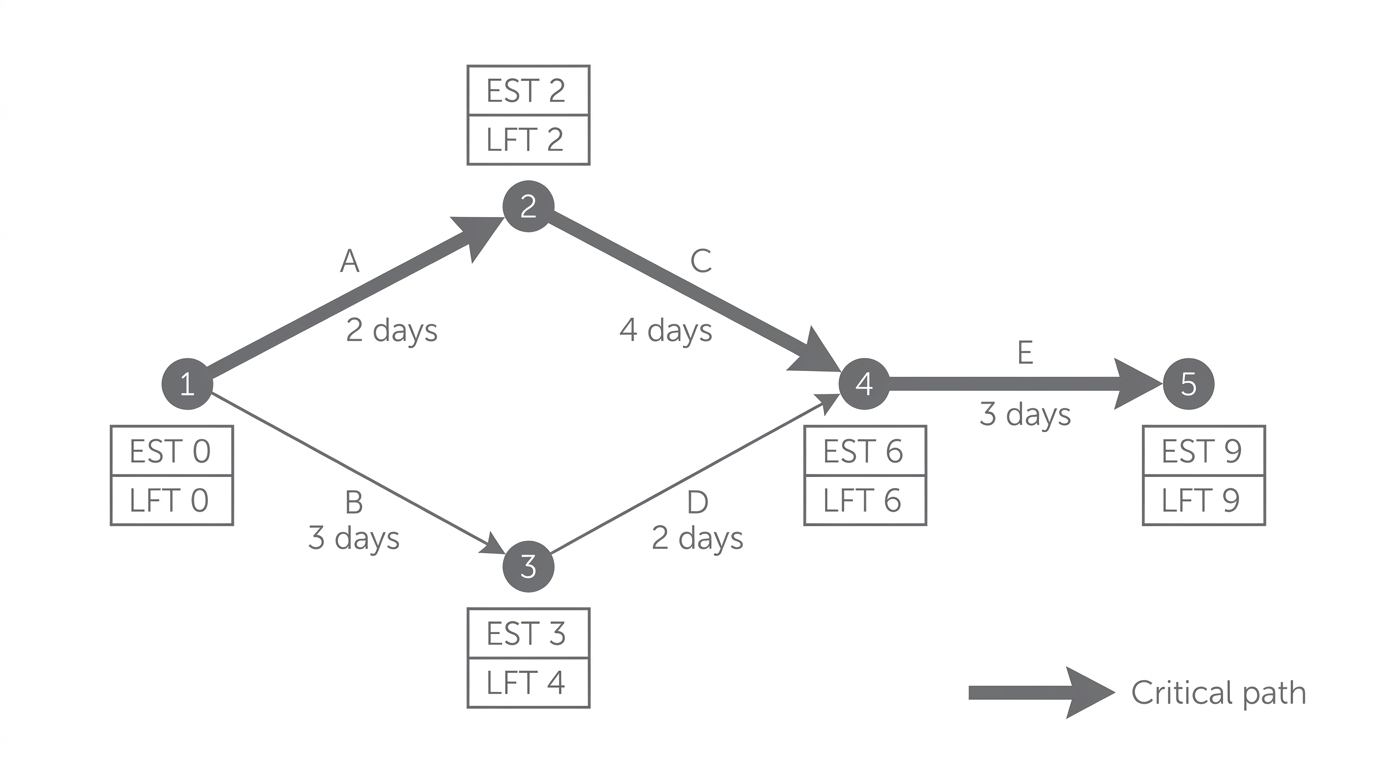
There are two complete routes through this network. Read the diagram by tracing each complete route from node 1 to node 5, then compare the total time for each route. Route A-C-E takes 9 days in total. Route B-D-E takes 8 days. The critical path is therefore A-C-E because it is the longest route through the network, so any delay to A, C, or E delays the final completion date.
Calculating EST, LFT and total float
Once the activities are in the correct order, you complete the timing in three steps. First, do a forward pass to find EST. Second, do a backward pass to find LFT. Third, calculate total float for each activity. This sequence matters because float can only be calculated once the network has been completed in both directions.
Earliest Start Time (EST)
How soon a task in a project can begin.
Start at the first node with an EST of 0 and move forwards, adding activity durations. When two routes arrive at the same node, use the larger total. This is because the next activity cannot begin until all earlier activities feeding into that node have been finished.
Latest Finish Time (LFT)
The latest time a task can finish without delaying the whole project.
Now work backwards from the final node using the total project time. Subtract durations as you move back through the network. When there is a choice of backward routes, use the smaller result, because the project must still finish by the required final time.
For the network above, the node timings are:
| Node | EST | LFT |
|---|---|---|
| 1 | 0 | 0 |
| 2 | 2 | 2 |
| 3 | 3 | 4 |
| 4 | 6 | 6 |
| 5 | 9 | 9 |
Notice the key exam logic here: node 4 gets an EST of 6, not 5, because activity E must wait for both C and D to be complete. On the backward pass, node 1 ends up with an LFT of 0, because the smaller backward value must be used to keep the whole project on time.
Continue this lesson.
You’re previewing NovaLearn without an account. Create a free account to read the rest.
Create free account