2.4.3 - Stock Control
Stock control is about getting the balance right: a business needs enough stock to keep production and sales moving, but not so much that cash, space and materials are wasted. In this lesson, you will learn how to read a stock control diagram, why buffer stock matters, how poor stock control damages performance, and how JIT and lean production can reduce waste and strengthen competitiveness.
Reading stock control diagrams
Stock can include raw materials, work in progress, and finished goods. A business controls stock because running out can stop sales or production, but holding too much increases costs.
Stock control
Managing the quantities and timing of materials, work in progress and finished goods held for production or resale, balancing availability against stockholding costs.
A stock control diagram shows how stock changes over time. Read the line as a repeating cycle: stock slopes downward as items are used or sold, the business places a new order when the line reaches the re-order level, stock continues to fall during lead time, and then it rises sharply when the delivery arrives.
[DIAGRAM: asset_name: 2_4_3_stock_control; asset_slug: 2_4_3_stock_control; recommended_method: retained_png; description: Stock control diagram with Time on the horizontal axis and Stock level on the vertical axis. Show a repeating sawtooth stock line that falls steadily as stock is used and rises sharply when a delivery arrives. Label the maximum stock level, re-order level, buffer stock, lead time, and re-order quantity. Make clear that a new order is placed at the re-order level and stock continues to fall during lead time before delivery restores stock.]
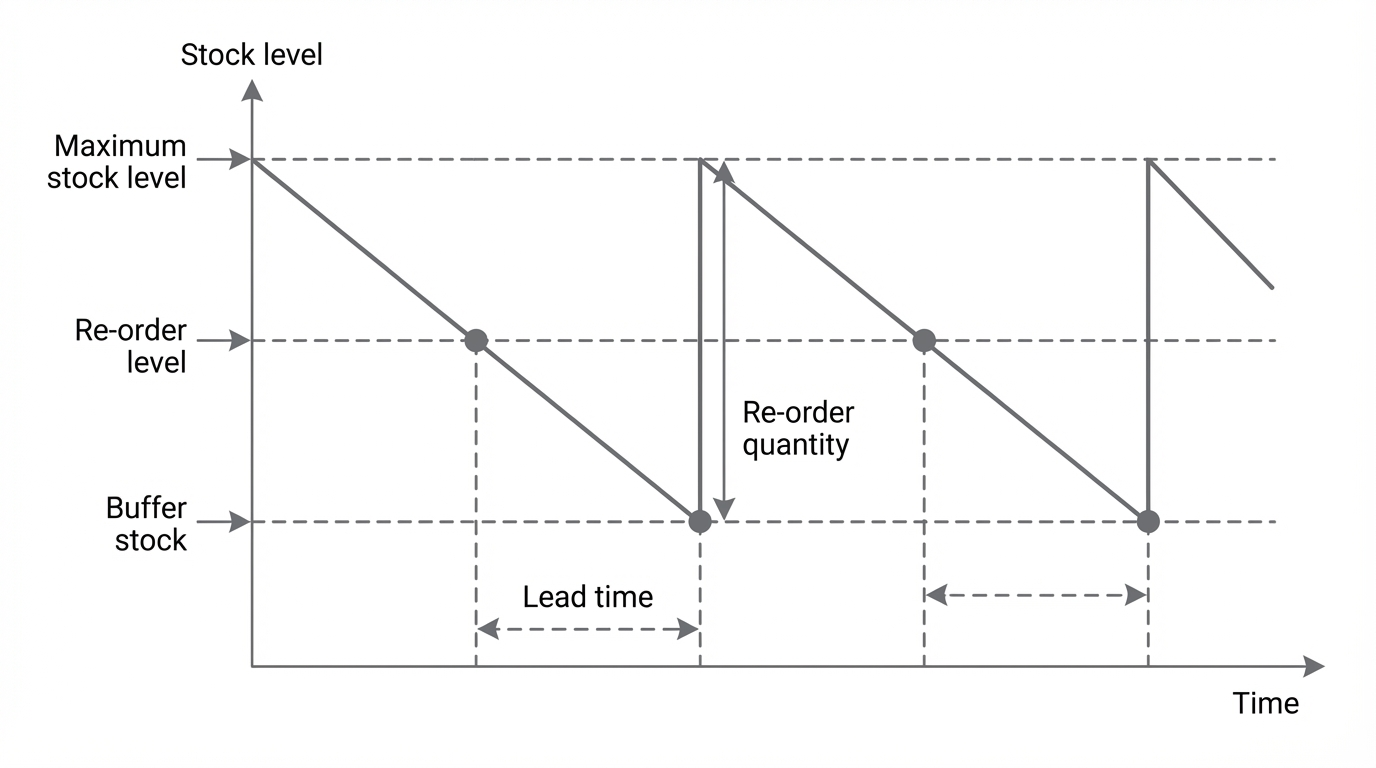
| Feature on the diagram | What it shows | Why it matters |
|---|---|---|
| Stock level line | Stock falling through usage or sales, then jumping up when a delivery arrives | Helps managers see the rate at which stock is being used |
| Maximum stock level | The highest stock level the business plans to hold | Limits storage, insurance and finance costs |
| Re-order level | The stock level at which a new order is placed | Gives enough time for fresh stock to arrive before the business runs out |
| Lead time | The gap between placing an order and receiving the delivery | Longer lead times usually require earlier re-ordering |
| Re-order quantity | The amount of stock ordered each time | Determines how far stock rises after delivery |
| Buffer stock | The minimum reserve held for protection | Reduces the risk of disruption if demand rises or deliveries are late |
The most important interpretation point is the sequence. Once stock falls to the re-order level, the business places an order. During lead time, stock keeps falling, so the buffer stock is what protects the business from running out before the delivery arrives. In reality, usage is not always steady and deliveries are not always punctual, which is exactly why stock control matters.
Buffer stocks and poor stock control
Buffer stock is the safety margin built into the diagram. It is most valuable when demand is uncertain, suppliers are unreliable, or a missing component would stop production completely.
Buffer stocks
The minimum level of stock held in reserve to protect against surges in demand or late delivery by suppliers.
A business may choose a larger buffer stock if lead times are long, if demand can rise suddenly, or if the stock is critical to keeping output going. However, that protection is not free. Money tied up in stock cannot be used for the next best alternative, such as marketing, staff training or new equipment, so there is an opportunity cost to holding excessive stock.
Poor stock control can damage a business from both directions:
| If stock levels are too high | If stock levels are too low |
|---|---|
| Cash is tied up in working capital | Customer orders may be lost |
| Storage, insurance and finance costs rise | Production may stop because key inputs are missing |
| Old, perishable or unfashionable stock may become unsellable | Workers may be left idle while waiting for materials |
| The business may be left with slow-moving or obsolete items | The business may lose reputation and goodwill |
| The firm may miss bulk-buying discounts |
So, the best stock policy is not simply "more" or "less". It is the level that keeps total cost low while still allowing the firm to respond to demand and maintain smooth operations.
JIT and waste minimisation
Just in time takes stock control further by trying to receive stock immediately before it is needed for production or sale. That means the firm aims to hold little or no buffer stock, so less cash is trapped in storage and fewer resources are spent looking after unused stock.
Continue this lesson.
You’re previewing NovaLearn without an account. Create a free account to read the rest.
Create free account