12-14 - Scalars, Vectors and Resultants
This lesson covers rows 12-14: the difference between scalar and vector quantities, resolving vectors, and finding resultants. The main goal is to see direction as part of the quantity, especially when components and resultants are drawn or calculated.
Magnitude Is Not Enough
Imagine a dynamics trolley on a squared lab floor. A student moves it 4 m east, then 3 m north. Another student moves a trolley through a curved route of the same total distance. The number of metres travelled tells you something, but it does not tell you where the trolley ends up.
That is the first split:
- A scalar quantity has magnitude only. It tells you "how much".
- A vector quantity has magnitude and direction. It tells you "how much, and which way".
Useful scalar examples in mechanics include distance, speed, mass, time and energy. Useful vector examples include displacement, velocity, acceleration, force and momentum.
The pairs are worth separating carefully:
- Distance is the length of the route followed. It is scalar.
- Displacement is the straight-line change in position from start to finish, with a direction. It is vector.
- Speed is how fast something moves. It is scalar.
- Velocity is speed in a stated direction. It is vector.
Vector notation is a signal that direction matters. In print you may see a bold symbol such as F, or an arrow over the symbol such as \vec{F}. The magnitude of a vector is the size only, written as F or |\vec{F}|. So a force could be 12 N east; its magnitude is just 12 N.
Misconception contrast: "12 N" is not enough information for a force vector. A 12 N pull east and a 12 N pull north have the same magnitude, but they do not have the same physical effect. Direction is not a decoration added after the answer; it is part of the quantity.
For Edexcel command words, state or identify can ask you to name whether a quantity is scalar or vector. If the command word is explain, the mark is not just for naming the type; it is for linking the type to whether direction is needed.
Resolving One Vector
Resolving a vector means replacing one vector with two perpendicular components that have the same combined effect. The components are not extra pushes or extra journeys. They are a different description of the same vector.
Use the squared lab floor again. A force on a trolley might point diagonally, but the floor gives two natural directions: horizontal and vertical. The diagonal force can be described by how much of it acts horizontally and how much acts vertically.
Worked example: a student pulls a trolley with a force of 45 N at 35 degrees above the horizontal. Find the horizontal and vertical components of the force.
Decision point 1: Is this a scalar or vector problem?
Force is a vector. The 45 N magnitude and the 35 degree direction both matter.
Decision point 2: Which axes should be used?
The question gives the angle above the horizontal, so choose a horizontal axis and a vertical axis.
Decision point 3: Which trig function goes with which component?
The force is the hypotenuse of the right-angled triangle. The horizontal component is adjacent to the 35 degree angle, so:
F_x = F cos theta
F_x = 45 cos 35 = 36.9 N
The vertical component is opposite the 35 degree angle, so:
F_y = F sin theta
F_y = 45 sin 35 = 25.8 N
The answer is not "36.9 N plus 25.8 N gives more than 45 N, so something is wrong." The components are perpendicular vectors, not scalar pieces laid end to end. They recombine by vector geometry, not by ordinary addition.
If the same 45 N force had been given at 35 degrees from the vertical, the sin and cos choices would swap. Always attach the angle to the triangle before choosing the equation.
For Edexcel calculate, show the substitution and include units. A component of a force is still measured in newtons.
Drawing Components to Scale
The calculation route is powerful, but the specification also requires resolving by drawing. A scale drawing turns the vector into a measurable arrow.
The procedure is mechanical, but each step has a reason:
- Choose a scale that uses a sensible amount of space, such as 1 cm representing 10 N.
- Draw the vector at the stated angle with a ruler and protractor.
- Draw perpendicular lines to make a right-angled triangle.
- Measure the horizontal and vertical component lengths.
- Convert the measured lengths back into the physical quantity using the scale.
[DIAGRAM: asset_name: Component and right-angle resultant geometry; asset_slug: 004_scalars_vectors_and_resultants__diagram_01; recommended_method: image_gen; description: Two-panel white-background vector diagram. Left panel shows a 45 N vector at 35 degrees above the horizontal resolved into horizontal Fx = F cos theta and vertical Fy = F sin theta components. Right panel shows 12 m east and 5 m north perpendicular displacement vectors placed head-to-tail, with resultant R = 13 m and theta = 22.6 degrees north of east.]
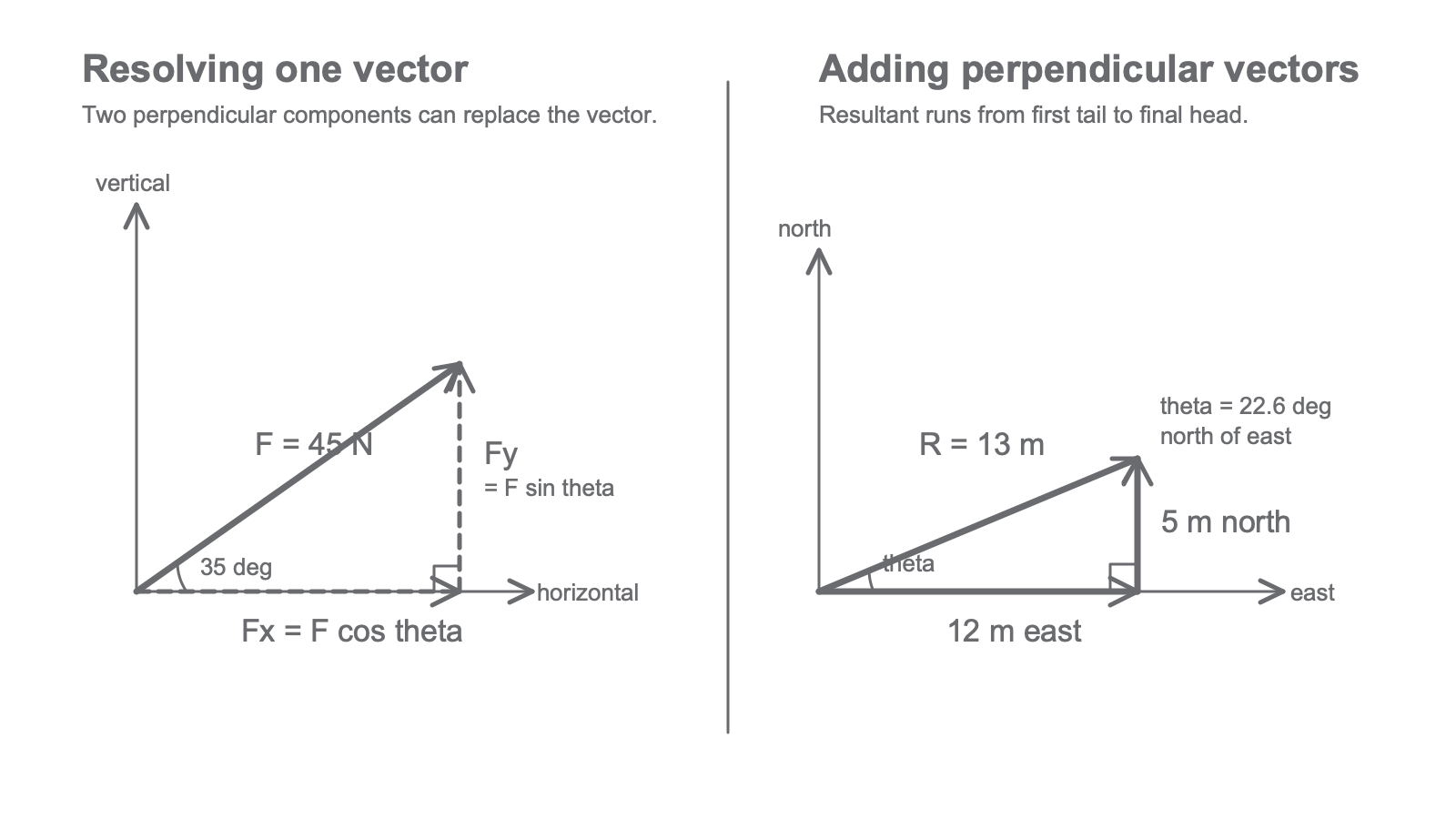
Treat a vector drawing like practical measurement. If your scale is 1 cm = 10 N, then 1 mm represents 1 N. A ruler reading of 3.7 cm supports about 37 N, not 36.873 N. A protractor reading is similar: a scale drawing can justify a direction to the nearest degree or two, not to many decimal places.
For the command word draw, Edexcel expects the diagram conventions to carry marks: clear scale, straight ruled arrows, arrowheads, labelled directions, and a resultant or component that starts and ends in the correct place. A correct numerical answer from a messy unlabelled sketch may not earn the drawing marks.
Misconception contrast: component arrows should be perpendicular and should connect with the original vector to make a right-angled triangle. Two random shorter arrows that visually "look like" the diagonal do not prove they are the components.
Perpendicular Resultants
A resultant vector is the single vector with the same overall effect as two or more vectors combined. For displacements, it is the straight-line movement from the starting point to the final point. For forces, it is the single force that would replace the pair.
Start with the right-angle case, because Edexcel expects calculation here.
Worked example: a marker on the lab floor is moved 12 m east, then 5 m north. Determine the resultant displacement.
Decision point 1: Can the magnitudes be added directly?
No. The displacements are perpendicular. 12 m + 5 m = 17 m would be the total distance travelled, not the resultant displacement.
Decision point 2: What shape does the vector diagram make?
The east and north displacements are at right angles, so the resultant is the hypotenuse of a right-angled triangle.
Magnitude:
R^2 = 12^2 + 5^2
R = sqrt(144 + 25) = 13 m
Decision point 3: How should the direction be stated?
An angle is meaningless unless the reference direction is named. Here, use the angle north of east:
tan theta = opposite / adjacent = 5 / 12
theta = 22.6 degrees
So the resultant displacement is 13 m at 22.6 degrees north of east.
For Edexcel determine, the answer must come from a quantitative route. That can be a calculation from the numbers or a scale drawing if the question asks for drawing. For a right-angle calculation, show Pythagoras and the trigonometric ratio, not just the final line.
Any Angle by Drawing
The specification makes an important boundary: for two coplanar vectors at any angle, you need to find the resultant by drawing. Calculation is required in this row when the two vectors are at right angles to each other.
"Coplanar" means the vectors lie in the same plane, such as the page, tabletop or lab floor. You can draw both arrows on the same flat set of axes.
For a scale drawing of two vectors at any angle:
- Choose and state a scale.
- Draw the first vector with the correct length and direction.
- From the head of the first vector, draw the second vector with its own correct length and direction.
- Draw the resultant from the tail of the first vector to the head of the second vector.
- Measure the resultant length and convert using the scale.
- Measure and state the direction relative to a named reference, such as "north of east" or "above the horizontal".
The second vector keeps its direction when it is moved head-to-tail. You are not rotating it just to make the triangle look neat. The order of addition does not change the resultant: walking east then north ends at the same point as walking north then east, if the two steps have the same sizes and directions.
Misconception contrast: drawing both vector tails from the same point and joining their heads does not normally give the resultant. That head-to-head line is linked to the difference between the vectors. For addition, place vectors head-to-tail and draw from the first tail to the final head.
There is also measurement judgement here. If your diagram scale makes the resultant only 1 cm long, a 1 mm ruler uncertainty is already about 10 percent. A larger, clear diagram reduces percentage uncertainty in the measured resultant and direction.
Choosing the Route
Vector questions feel easier when you choose the route before you calculate.
Use this decision pattern:
- If the task is to classify a quantity, ask whether direction is part of the quantity. That separates scalar from vector.
- If the task is to resolve one vector, draw the right-angled component triangle first. Then choose sin or cos from the angle given.
- If the task is to find a resultant of two perpendicular vectors by calculation, use Pythagoras for magnitude and tan for direction.
- If the task is to find a resultant of two vectors at any angle in this lesson, use a scale drawing unless the question gives a right-angle calculation route.
- If the command word is
explain, link the vector idea to the physical effect. Do not just repeat a calculation.
A useful final contrast is distance against displacement. For a 9.0 m east then 12.0 m north route, the total distance is 21.0 m. The resultant displacement is not 21.0 m, because the two parts of the route are perpendicular. The displacement is the straight-line vector from start to finish:
R = sqrt(9.0^2 + 12.0^2) = 15.0 m
tan theta = 12.0 / 9.0
theta = 53.1 degrees north of east
Both answers are true, but they answer different questions. Distance describes the route length. Displacement describes the change in position.