3.1 - Parliamentary law making and parliamentary supremacy
This lesson teaches how proposed law becomes an Act of Parliament in England and Wales, how Parliament is influenced before and during that process, and why parliamentary supremacy makes statute the strongest domestic legal source. For AQA Law, the aim is to move beyond a loose process story: you need accurate stage labels, precise legal consequences, and reasoned evaluation of whether parliamentary law making is democratic, expert and controlled enough.
Scope And Core Idea
Parliamentary law making is the process by which Parliament creates primary legislation. Primary legislation is law made by Parliament itself, usually called an Act of Parliament or statute once it has received Royal Assent. Before that point it is a Bill: a proposal for a new law or a change to an existing law.
The specification requires five connected ideas:
| Requirement | What you must be able to do |
|---|---|
| Green and White Papers | Explain how government policy may be consulted on before a Bill is introduced. |
| Formal legislative process | Put the main parliamentary stages in order and state what each stage does. |
| Influences on Parliament | Explain who may shape law making and whether that influence improves or weakens the process. |
| Parliamentary supremacy | State the constitutional doctrine that Parliament can make or unmake law. |
| Limitations | Distinguish true legal invalidity from political, constitutional and interpretive pressure. |
The legal category is constitutional and law-making process. The main authority is institutional: Parliament, its legislative stages, and the constitutional doctrine of parliamentary supremacy. Some case law helps define how courts treat Acts of Parliament, but the focus is not a case list. Cases matter only where they prove a legal consequence, such as courts applying a valid Act rather than refusing it.
Keep three boundaries clear:
- Parliamentary law making is about primary legislation, not delegated legislation.
- The legislative process starts with a Bill in Parliament; Green and White Papers may happen before that but are not parliamentary stages.
- Parliamentary supremacy explains the legal status of Acts, not whether every Act is wise, fair or popular.
In AQA answers, short AO1 questions often reward precise knowledge, such as the role of a Second Reading or the meaning of a Private Member's Bill. Longer evaluation needs a judgement about the quality of the process, not a general speech about politics.
Policy Before The Bill
Many Acts begin as political or social problems before they become legal rules. Government departments may consult, collect evidence and test possible reforms before the formal parliamentary process begins. AQA names Green Papers and White Papers because they show how Parliament can be influenced before a Bill is even introduced.
| Document or route | Legal function | Consequence | Common confusion |
|---|---|---|---|
| Green Paper | A government consultation document that explores possible policy or legislative options. | Interested groups, experts and the public can respond before the government fixes its final plan. | A Green Paper is not a Bill and does not itself change the law. |
| White Paper | A government policy document setting out firmer proposals for future legislation. | It may lead to a Bill and can provide a basis for final discussion before formal introduction. | A White Paper is still not an Act; it is a proposal, not enforceable law. |
| Draft Bill | A proposed Bill published before formal introduction, often for scrutiny. | Committees and stakeholders may identify problems before Parliament spends time on the final version. | A draft Bill is not yet going through the ordinary Bill stages. |
The threshold for these documents is not a legal test like liability in tort. The exam point is functional: explain whether the document invites consultation, states firmer policy, or begins formal law making. If a question asks for House of Commons stages, do not include Green or White Papers. They are pre-legislative influences.
You also need to classify Bills accurately:
| Type of Bill | Who promotes it | What it is for | Exam use |
|---|---|---|---|
| Government Bill | A government minister. | Implements government policy and is the most likely route for major national legislation. | Strong for explaining party majority, manifesto promises and government control of timetable. |
| Private Member's Bill | An MP or member of the House of Lords who is not a government minister. | A public Bill seeking to change the general law, often on an issue raised by a backbench member. | Useful for showing influence and publicity, but most have limited parliamentary time. |
| Private Bill | A private individual, company, local authority or body seeking special powers. | Affects particular people, organisations or localities rather than the general public. | Do not confuse it with a Private Member's Bill. |
| Hybrid Bill | Usually government, but with public and private features. | Changes the general law while especially affecting particular individuals or bodies. | Mention only if needed; it is usually not the centre of this spec point. |
The important distinction is between who starts the route and what legal effect is sought. A minority interest group that persuades an MP to introduce a public law reform would usually be linked to a Private Member's Bill, not a Private Bill, because the desired law applies generally.
Bill To Act Process
The formal legislative process turns a Bill into an Act. Most public Bills must pass through both the House of Commons and the House of Lords, with broadly similar stages in each House. A Bill can usually begin in either House, but Money Bills begin in the Commons. The House of Commons is usually more powerful because it is elected, controls finance, and can in some circumstances use the Parliament Acts 1911 and 1949 to overcome the Lords' refusal or delay.
Use the diagram to hold the broad sequence in mind before you learn the function of each stage. It deliberately shows the route at a high level; the table below then gives the exam-useful detail.
[DIAGRAM: asset_name: Bill to Act pathway; asset_slug: 3_1_parliamentary_law_making_and_parliamentary_supremacy__diagram_01; recommended_method: image_gen; description: A sparse left-to-right pathway from Proposal to Bill introduced, Commons stages, Lords stages, Royal Assent and Act of Parliament, with a note that Parliament can create primary legislation.]
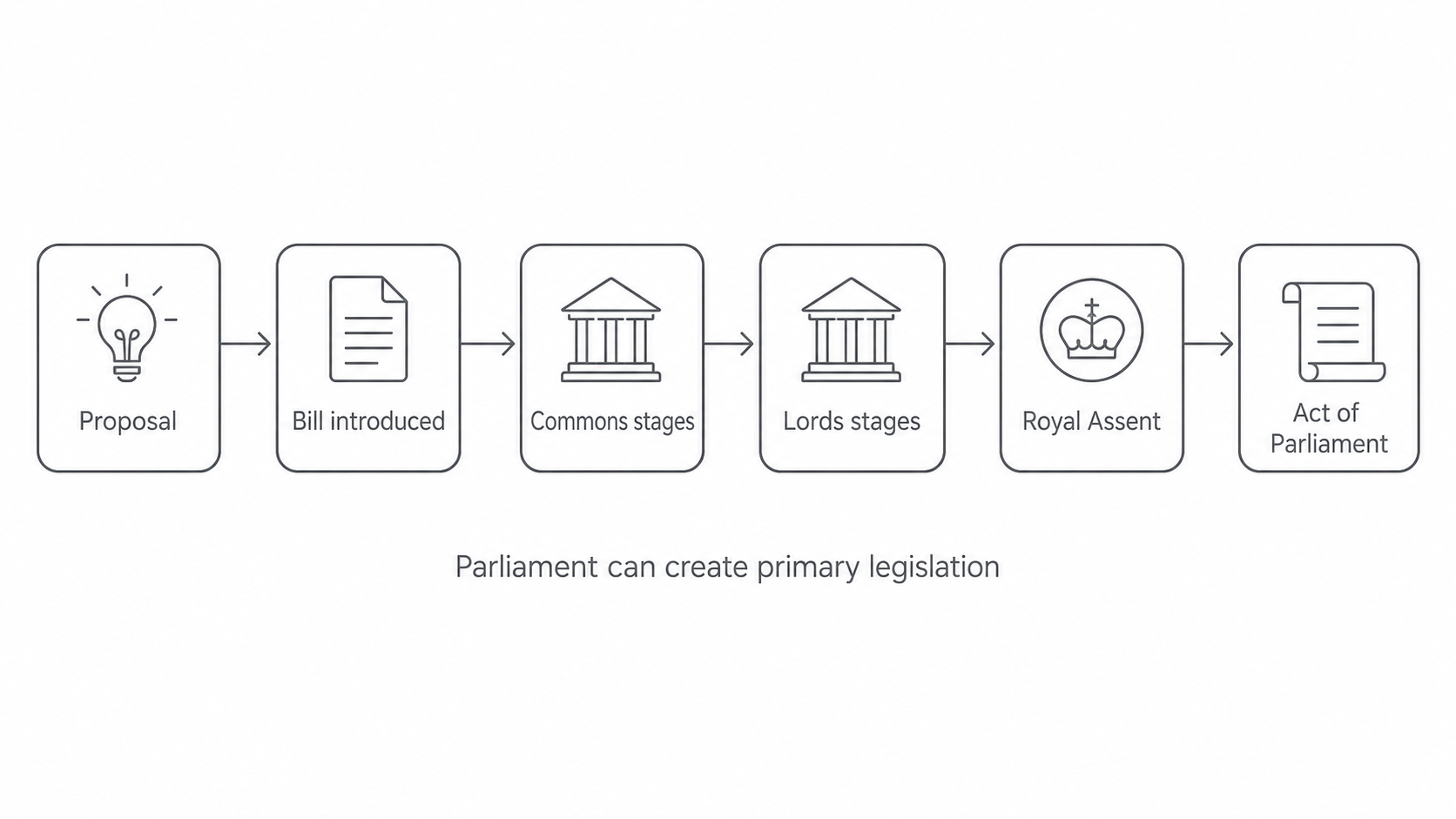
For AQA, you must know what each stage does, not just list the labels.
| Stage | What happens | Legal consequence | Common confusion |
|---|---|---|---|
| First Reading | The Bill is formally introduced and its title is read. There is normally no debate on the merits. | The Bill enters the parliamentary process and is usually ordered to be printed. | Do not describe this as detailed scrutiny. |
| Second Reading | The House debates the Bill's main principles and normally votes. | If the Bill is rejected here, it does not proceed in that House. If it passes, detailed scrutiny follows. | The Second Reading is about broad principle, not line-by-line detail. |
| Committee Stage | A smaller committee, or sometimes the whole House, examines the Bill in detail and considers amendments. | Clauses may be changed, removed or added before the Bill returns to the House. | This is the main detailed scrutiny stage, not merely a report. |
| Report Stage | The House considers the Bill as amended in committee and may make further changes. | MPs or Lords who were not on the committee can debate and vote on amendments. | It is not a report by journalists or civil servants. |
| Third Reading | Final debate and vote on the completed Bill in that House. | If approved, the Bill passes to the other House or moves toward final approval if both Houses agree. | It is not another full committee stage. |
| Consideration of amendments | The two Houses consider each other's amendments. This may move back and forth. | The same final text must normally be agreed. | This is sometimes called "ping-pong", but use the formal description in exams. |
| Royal Assent | The monarch formally approves the Bill. | The Bill becomes an Act of Parliament. | Royal Assent is after the parliamentary stages; it is not the same as Third Reading. |
When a question narrows the focus, obey the narrowing. If it asks for three House of Commons stages, use Commons stages such as First Reading, Second Reading, Committee Stage, Report Stage and Third Reading. Do not spend the answer on Green Papers, the House of Lords or Royal Assent unless the question invites the whole process.
A strong five-mark AO1 explanation usually has this shape:
- Name the stage accurately.
- State the function of the stage.
- Add the consequence of that stage for the Bill.
- Repeat for the number of stages requested.
For example, "Second Reading" is stronger than "the Bill is debated" because the label tells the examiner you know the sequence, and the explanation tells them you know the legal function.
Influences On Parliament
Parliamentary law making is not sealed off from society. The specification asks for influences because law is often shaped by political promises, public pressure, expert evidence and organised campaigning. The legal skill is to explain how an influence affects the route to statute and then evaluate whether that influence improves or weakens democratic law making.
| Influence | How it works | Advantage | Disadvantage |
|---|---|---|---|
| Government and manifesto policy | The governing party may introduce Bills promised in an election campaign. | Gives democratic authority and lets voters connect policy to legislation. | A large majority and party discipline can reduce independent scrutiny. |
| Party whips and MPs | Whips encourage party members to vote with the party; MPs may also raise constituency concerns. | Helps Parliament make decisions and pass coherent programmes. | Can make MPs support a Bill despite doubts about its quality or local effect. |
| Pressure groups | Cause groups campaign for a principle; sectional groups represent a particular group or interest. They may lobby MPs, give evidence, run campaigns or brief the media. | Can supply expertise, represent affected people and expose neglected problems. | Wealthy or well-organised groups may get more access than less powerful groups. |
| Media and public opinion | Reporting, investigations and public campaigns can place pressure on ministers and MPs. | Can bring urgent problems into public view. | Media pressure may oversimplify technical legal issues or encourage rushed law. |
| Expert reports and inquiries | Specialist reviews, public inquiries or law reform work may identify defects in existing law. | Improves technical quality and evidence-based reform. | Expert proposals can be slow, politically unattractive or only partly implemented. |
| Consultation responses | Green Papers, White Papers and draft Bills invite responses before final law making. | Affected groups can identify practical problems before the Bill is fixed. | Consultation may be selective, ignored, or dominated by groups with resources to respond. |
Pressure groups are a common AQA trap. They may influence Parliament, lobby individual MPs and run campaigns. They do not normally put forward candidates for election to Parliament as their defining feature. If a body starts putting up candidates as a party, that is different from the ordinary pressure-group role.
Evaluation should use legal criteria:
- Democratic legitimacy: Is influence connected to voters, elected MPs and open debate?
- Expertise: Does the influence improve Parliament's understanding of the problem?
- Equality of access: Do all affected groups have a realistic chance to be heard?
- Scrutiny: Does the influence lead to better amendment and checking?
- Clarity and certainty: Does pressure produce clear rules, or rushed and symbolic law?
The strongest answer balances the point. For example, pressure groups can improve law by giving specialist evidence to MPs, but they can also distort law making if access depends on money, publicity or political popularity rather than the legal merits of the reform.
Parliamentary Supremacy Doctrine
Parliamentary supremacy, also called parliamentary sovereignty, is the doctrine that Parliament is the highest domestic law-making authority. In orthodox AQA terms, it has three operational elements:
| Element | Meaning | Legal consequence |
|---|---|---|
| Parliament can make or unmake any law | Parliament can legislate on any subject within the UK constitutional order. | A valid Act can create, amend or repeal legal rights and duties. |
| No Parliament can bind a future Parliament | A later Parliament can repeal or change an earlier Act. | Parliament cannot make an ordinary Act unrepealable by future legislation. |
| Courts must apply valid Acts of Parliament | Courts interpret and apply Acts; they do not strike down primary legislation merely because they disagree with it. | Statute prevails over inconsistent common law and earlier ordinary statutes. |
Use cases as tools, not decorations:
| Authority | Material point | How to use it |
|---|---|---|
| Pickin v British Railways Board [1974] | A challenge alleged improper parliamentary procedure behind a private Act. | The House of Lords treated a validly enacted Act as conclusive; courts do not normally investigate parliamentary proceedings to invalidate an Act. |
| Ellen Street Estates v Minister of Health [1934] | Later legislation conflicted with an earlier statutory compensation scheme. | A later Act prevails over an earlier inconsistent Act, showing that one Parliament cannot bind a later Parliament. |
| R v Secretary of State for the Home Department, ex parte Simms [2000] | Prisoners challenged restrictions affecting access to journalists. | Courts presume Parliament does not override fundamental rights by general or ambiguous words, but Parliament can do so with clear wording. This is an interpretive pressure, not a power to invalidate an Act. |
The doctrine explains legal hierarchy. If an Act of Parliament conflicts with a judicial precedent, the Act wins. If a later Act conflicts with an earlier ordinary Act, the later Act wins. If a court thinks an Act is unfair, the court's ordinary role is to apply and interpret the Act, not to replace it with the court's preferred rule.
Common confusion: saying "Parliament can make any law" does not mean Parliament can make a law that no future Parliament can repeal. The ability to repeal is part of supremacy. AQA has tested this distinction directly, so keep it sharp.
Limitations And Constitutional Pressure
The specification asks for limitations on parliamentary supremacy, but the word "limitations" must be handled carefully. Most limits do not mean that courts can simply declare an Act of Parliament invalid. Many are political, procedural, interpretive or constitutional pressures on how Parliament legislates.
| Limitation or pressure | Category | Effect on parliamentary supremacy | Exam precision |
|---|---|---|---|
| House of Lords scrutiny | Procedural and political. | The Lords can revise, delay and require the Commons to reconsider, but the Commons is normally stronger. | This improves scrutiny, but is not the same as a legal veto over all Bills. |
| Parliament Acts 1911 and 1949 | Statutory control of the Lords' delaying power. | Some public Bills can become Acts without Lords agreement if statutory conditions are met. | Shows Commons dominance, not the end of bicameral scrutiny. |
| Human Rights Act 1998, section 3 | Interpretive legal duty. | Courts must read legislation compatibly with Convention rights where possible. | This may affect meaning, but it does not allow courts to rewrite the statute beyond what is possible. |
| Human Rights Act 1998, section 4 | Declaration of incompatibility. | Senior courts may declare that legislation is incompatible with Convention rights. | A declaration does not invalidate the Act or stop it being enforced. It creates political pressure for change. |
| Principle of legality | Common law interpretation. | Courts require clear words before treating Parliament as having overridden fundamental rights. | This is the point in Simms; it controls interpretation, not parliamentary competence. |
| Elections and public opinion | Political accountability. | MPs may lose support if legislation is unpopular or unjust. | A strong political limit is not the same as a court striking down an Act. |
| Devolution and constitutional conventions | Constitutional and political. | Parliament often respects devolved competence and constitutional practice. | Conventions can be important but are not usually enforced like ordinary legal rules against Acts of Parliament. |
| International obligations | Political and diplomatic. | Parliament may avoid breaching treaties or international standards. | International obligations can create pressure, but an inconsistent later Act may still be valid domestically unless a specific domestic rule changes the result. |
The strongest evaluation is calibrated. Parliamentary supremacy gives certainty because courts know that valid Acts are the highest domestic source. It also gives democratic legitimacy because elected representatives can change the law. But it creates risk if a government majority can pass broad or rushed legislation with limited effective scrutiny. The limits reduce that risk, but many of them depend on political accountability rather than strict legal invalidity.
Avoid two overstatements:
- Do not say the Human Rights Act lets courts strike down Acts of Parliament. It does not.
- Do not say Parliament is practically unlimited just because it is legally supreme. Politics, rights scrutiny, parliamentary procedure and public accountability matter.
AQA Application And Evaluation
Although this topic is often assessed through AO1 and AO3, you should still practise application. AQA rewards answers that select the legally relevant part of the process and ignore distractors.
Consider this invented scenario:
The government wants to regulate facial recognition technology. It publishes a consultation document asking whether the law should limit police use, private-company use, or both. Civil liberties groups warn about privacy, police representatives argue that the technology helps detect crime, and technology companies lobby for narrower regulation. After consultation, the government introduces a Bill in the Commons. At Second Reading, MPs debate whether the Bill's broad principles are justified. In committee, amendments are proposed to define when the technology can be used. The Lords later proposes extra safeguards. The Commons accepts some amendments but rejects others. The Bill receives Royal Assent.
An application plan should map facts to legal categories:
| Legal issue | Material fact | Legal reasoning |
|---|---|---|
| Green Paper or consultation stage | Government asks for views before introducing the Bill. | This is pre-legislative consultation, not an Act and not a formal parliamentary stage. |
| Influences | Civil liberties groups, police representatives and companies lobby or respond. | These are social and sectional influences; they may add expertise but may also create unequal access. |
| Formal process | Second Reading debates broad principles; committee proposes amendments; Lords suggests safeguards. | The facts fit the Bill-to-Act process and show scrutiny at different stages. |
| Parliamentary supremacy | Royal Assent turns the Bill into an Act. | Courts would treat the valid Act as primary legislation and apply it, subject to interpretation. |
| Limitation | If rights concerns arise, HRA interpretation or a declaration of incompatibility may be relevant. | Rights review can pressure Parliament but does not automatically invalidate primary legislation. |
Evaluation can be structured as a legal judgement:
| Argument | Counter-view | Reasoned judgement |
|---|---|---|
| Parliamentary law making is democratic because elected MPs debate and vote on Bills. | Party control and manifesto politics may reduce independent scrutiny. | Democracy is strongest where debate is meaningful and MPs can amend weak clauses. |
| Consultation and pressure groups improve expertise. | Unequal lobbying power may privilege louder or wealthier interests. | Influence is valuable when transparent and evidence-based; it is risky when access is uneven. |
| Supremacy gives certainty because Acts are authoritative. | It may leave weak remedies where an Act breaches rights or seems unjust. | The HRA and legality principle soften the doctrine, but they mostly create interpretation and pressure rather than invalidity. |
For AQA, choose the answer mode that matches the command:
- Explain: define, sequence, and give legal consequences.
- Suggest: pick relevant points from the facts and briefly apply them.
- Discuss or evaluate: weigh a benefit against a limitation using legal criteria.
Recap: use this topic in AQA answers by identifying whether the question is about pre-legislative consultation, formal parliamentary stages, influence, supremacy or limitations. State the rule precisely, attach authority where useful, apply only material facts, and make a balanced judgement when evaluation is required.